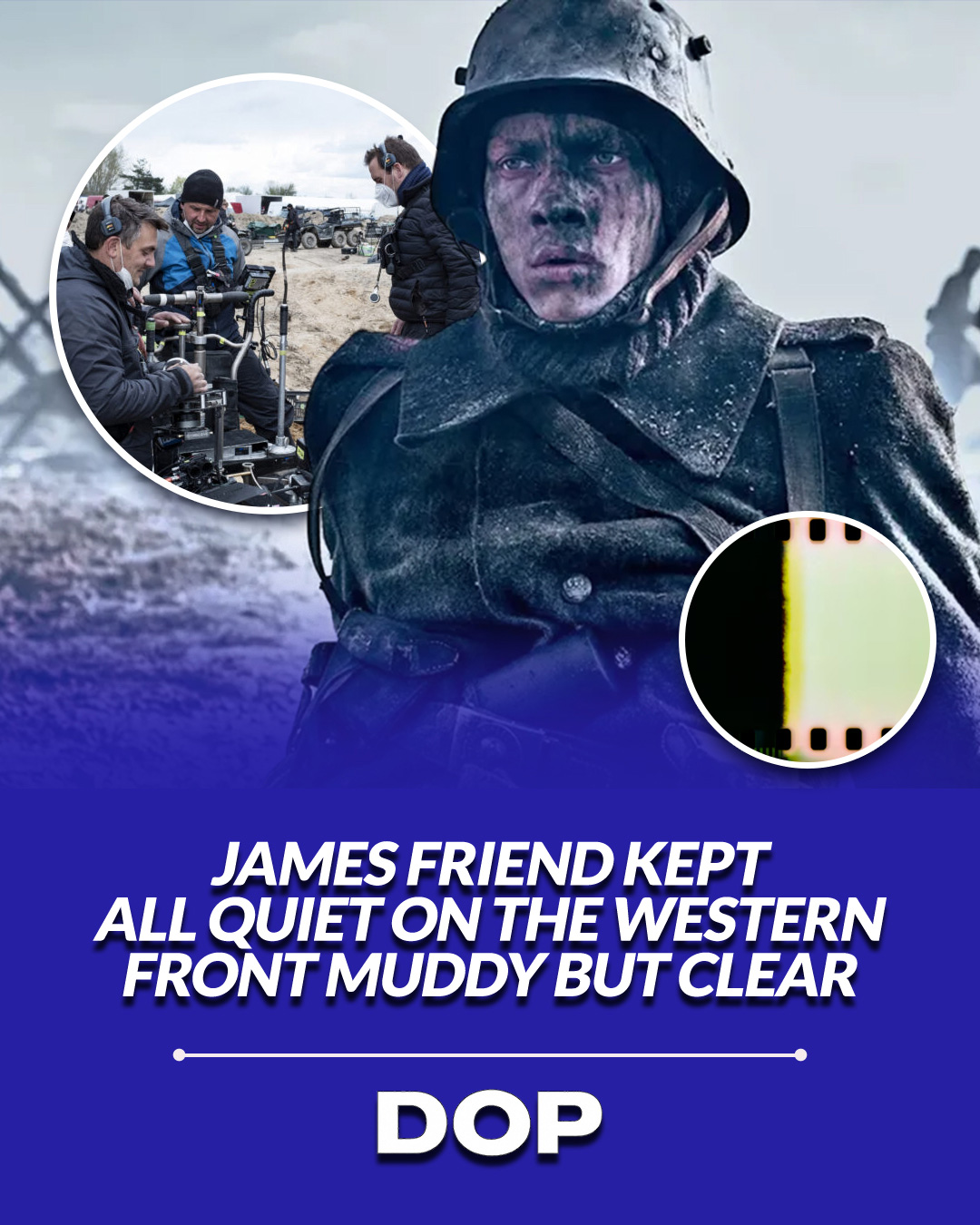
When director Edward Berger set out to adapt Erich Maria Remarque’s landmark anti-war novel All Quiet on the Western Front, he turned to cinematographer James Friend, BSC, ASC, to construct an uncompromising visual language of human destruction. The resulting imagery is horrifyingly bleak yet undeniably striking, earning Friend the Academy Award for Best Cinematography. Shooting a film where almost every frame is overwhelmed by drab wool uniforms, churned earth, wet mud, and dense smoke presents an immense technical hurdle: how do you maintain visual legibility without sanitizing the visceral horror of the trenches?
Carving Human Skin from Monochromatic Filth
Friend’s primary strategy relied on immaculate exposure discipline and nuanced color separation. In an environment dominated by wet, low-contrast grays and dark browns, human faces risk dissolving entirely into the scenery. To counter this, Friend worked closely with his colorist to ensure skin tones sat consistently a half-stop to a full stop brighter than the surrounding muck. By keeping subtle, naturalistic warmth in the faces, the camera retains the emotional anchor of the actors' eyes, ensuring every psychological shift reads clearly across the screen.
Lighting in such brutal conditions required a delicate balance between naturalistic overcast ambiance and deliberate sculpted control. Operating predominantly under soft, natural atmospheric skylight, Friend utilized extensive negative fill to carve shape and dimension into the actors' features. Rather than relying on traditional key lights that would shatter the dreary realism, subtle LED eye-lights were introduced to catch specular highlights, preserving the flickering ember of humanity within characters pushed to their limits.
Maintaining separation in a monochromatic environment requires sculpting micro-contrast through delicate exposure and precise negative fill rather than relying on aggressive backlighting.
Large Format Glass and Selective Depth of Field
To navigate the chaotic wide shots of battle, Friend opted for large format digital capture using the ARRI Alexa Mini LF paired with custom-tuned glass, including ARRI Alfa anamorphic lenses and Tribe7 Blackwing7 optics. The combination of a large sensor format and fast, character-rich lenses allowed the camera team to exploit an exceptionally shallow depth of field. Even in expansive, sweeping battlefield sequences, selective focus strips away peripheral clutter, pulling the audience’s eye directly to protagonist Paul Bäumer, played by Felix Kammerer.
This optical isolation creates an intense contrast between intimate, subjective horror and epic-scale devastation. By rendering chaotic backgrounds into painterly, textured bokeh, the cinematography avoids turning into an unreadable smudge of dark earth. Instead, every burst of artillery and rising plume of white phosphorus operates as a distinct, layered visual element, maintaining geometric clarity without sacrificing the crushing claustrophobia of trench warfare.
Lessons in Rendering Dreary Environments Legible
For modern cinematographers, All Quiet on the Western Front serves as an essential masterclass in rendering oppressive, visually uniform environments highly legible. Shooting fundamentally "ugly" or desaturated subjects does not require flat, uninspired lighting; rather, it demands a higher degree of intentionality regarding micro-contrast, lens character, and exposure control. James Friend’s work proves that powerful visual storytelling thrives in the subtlest details, where precise craft transforms gritty realism into unforgettable cinematic art.
This article contains affiliate links. We may earn a small commission at no extra cost to you. Learn more.