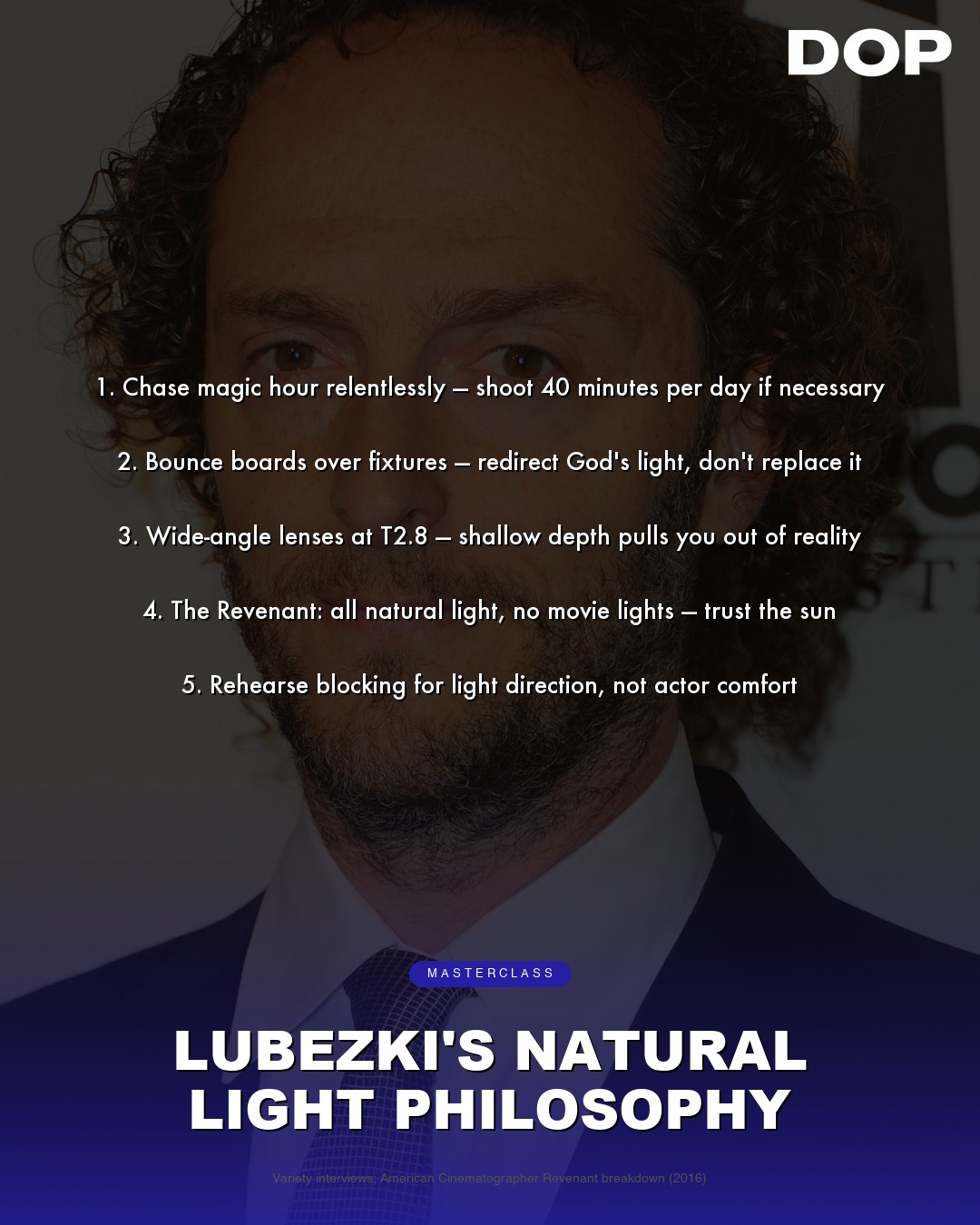
Emmanuel Lubezki, ASC, AMC, affectionately known as 'Chivo,' is a titan of contemporary cinematography. His work transcends mere image-making, forging an immersive, often visceral connection between audience and narrative. The recent distillation of his 'Natural Light Philosophy' into five core tenets offers not just insights into his process, but a profound meditation on the very essence of visual storytelling. For DPs and cinephiles alike, these principles are not just guidelines; they are a manifesto for a cinema deeply rooted in authenticity and emotional resonance.
The first and perhaps most iconic tenet is Lubezki's relentless pursuit of magic hour. "Shoot 40 minutes per day if necessary." This isn't merely a practical scheduling note; it's a philosophical commitment to leveraging nature's most ethereal light. Consider the breathtaking opening sequence of The Revenant, where the amber glow of a setting sun paints the harrowing landscape, or the golden hour intimacy of The Tree of Life. Chivo's dedication to this fleeting period speaks to a deep understanding of light's psychological impact. It's about capturing a specific emotional texture that only natural light can provide, rather than trying to recreate it artificially. This often necessitates immense logistical planning and a willingness to prioritize light over conventional shooting schedules, a testament to his unwavering vision.
The Art of Redirection: Bouncing God's Light
Lubezki's second principle, "Bounce boards over fixtures – redirect God's light, don't replace it," underpins his entire approach to illumination. This isn't to say Lubezki never uses artificial light; rather, it indicates a preference, almost a reverence, for natural sources. His work often features expansive, soft light that feels entirely unmanufactured. In films like Gravity, even in the artificial environment of space, the light often mimics the vastness and subtlety of natural phenomena. The use of bounce boards – often large, diffuse surfaces – allows him to shape and extend the reach of ambient light, filling shadows gently and organically. This technique maintains the integrity of the natural source, preserving its directionality and quality, and avoiding the often-tell-tale harshness of direct artificial illumination.
"Redirect God's light, don't replace it."
This philosophy also extends to his choice of camera and lenses. While he has famously embraced digital cinematography with cameras like the ARRI Alexa (often in conjunction with wide, fast prime lenses like the Leica Summilux-C or ARRI Master Primes), his objective is rarely hyper-realism in a clinical sense. Instead, the high dynamic range and low-light capabilities of these sensors allow him to capture the nuanced gradients of natural light, particularly in the shadows, without resorting to excessive artificial fill. The lenses, with their inherent character and ability to render light beautifully, further contribute to this organic aesthetic, often exhibiting a subtle falloff and gentle flaring that enhances the natural feel.
The Rhythmic Breath of the Viewer: Continuous Shots and Exposure
The third and perhaps most audacious tenet is, "One continuous shot changes how the audience breathes – plan for duration." Lubezki's mastery of the long take is legendary, from the harrowing invasion sequence in Children of Men to the entire, seemingly unbroken odyssey of Birdman. These extended takes are not mere technical flexing; they are carefully orchestrated ballets of camera, actor, and environment, designed to immerse the viewer so completely that the traditional rhythm of cuts is abandoned. The absence of cuts forces the audience to live within the moment, creating a heightened sense of real-time experience and emotional immediacy. This requires incredible precision in camera operation, often utilizing Steadicam, cranes, or complex wire rigs, and a deep understanding of blocking and spatial relationships.
Principle four, "Expose for the highlights, let shadows open in grade – protect the sky," is a cornerstone of digital cinematography. In the digital realm, preserving highlight information is paramount, as clipped whites are often irretrievable. Lubezki's approach ensures that the most luminous parts of the image – the sky, bright reflections – retain detail and texture, allowing for greater flexibility in post-production. This strategy, combined with the wide dynamic range of modern digital cinema cameras, allows him to capture scenes with extreme contrast, knowing that the rich information within the shadows can be gently lifted and shaped in the color grade. It's a pragmatic yet artistic approach that acknowledges the technical capabilities of the medium while serving his naturalistic vision.
Movement as Emotion: The Handheld Heartbeat
Finally, "Movement is emotion – handheld heartbeat versus locked-off distance" encapsulates Lubezki's kinetic style. His camera is rarely static for long, often acting as a character itself, breathing and reacting alongside the protagonists. The intimate, often shaky handheld work in films like The Tree of Life or the intense, almost panicked POV in The Revenant creates a visceral, subjective experience. This isn't just arbitrary camera movement; it's a deliberate choice to convey internal states, urgency, or connection. Conversely, a locked-off shot, when eventually employed, gains immense power through its contrast, providing a moment of stillness or objective observation. This dynamic interplay of movement and stillness is a sophisticated tool in his arsenal, allowing him to sculpt the emotional landscape of his films with unparalleled sensitivity.
In essence, Lubezki's five tenets are more than technical advice; they are a philosophy for seeing and feeling. They challenge cinematographers to look beyond artificial solutions, to embrace the inherent beauty and emotional power of the natural world, and to wield the camera as a direct conduit to the audience's heart. His legacy is not just in the stunning images he creates, but in the profound way he inspires us to reconsider the very act of cinematic observation.
This article contains affiliate links. We may earn a small commission at no extra cost to you. Learn more.