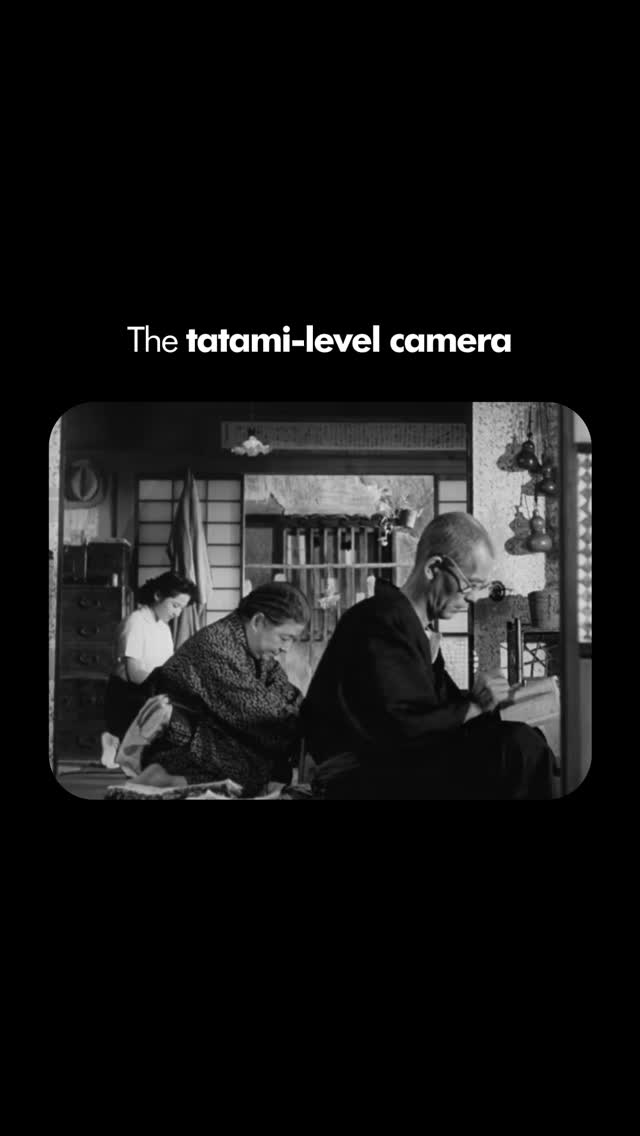
In the pantheon of cinema history, few films command the quiet reverence reserved for Yasujiro Ozu's 1953 masterpiece, Tokyo Story. Photographed by long-time collaborator Yuharu Atsuta, the film represents the absolute apex of a visual philosophy stripped of modern vanity. While Western contemporary cinema of the 1950s was obsessed with grand camera movements, sweeping Technicolor vistas, and dramatic crane shots, Ozu and Atsuta looked inward. They constructed an unflinching, hyper-disciplined visual language that broke almost every established rule of Hollywood continuity, yielding a work of transcendent emotional resonance.
At the core of Tokyo Story is a single, radical compositional decision: the camera height. For nearly every interior frame in the film, the lens sits approximately two feet off the ground. This was not a gimmick, but a deliberate philosophical stance. Known as the 'tatami shot,' this placement places the optical center at the eye level of a person seated on a traditional Japanese straw mat. Where Western operators positioned their cameras at standing height, imposing an omniscient, floating perspective, Atsuta anchored the frame in the modest, ground-level reality of domestic Japanese life.
The Tatami Rig and the Architecture of Below-Eye Level
Executing this low-perspective rigor required purpose-built hardware. Atsuta utilized a custom-designed low tripod, often referred to on set as the 'Ozu tripod', which allowed the heavy Mitchell 35mm camera to rest just inches above floor level. Paired almost exclusively with a 50mm lens, a focal length that closely mirrors the natural field of human vision without unnatural compression or wide-angle distortion, the camera maintained an unyielding horizon line. Ceilings, door frames, and architectural crossbeams dominated the upper third of the frame, transforming ordinary home interiors into tight geometric grids.
Furthermore, Atsuta and Ozu famously rejected camera movement. In Tokyo Story, the camera is entirely static. There are no pans, no tilts, and no tracking movements to follow action. The camera stands as an unwavering observer while the actors enter, cross, and exit the frame. This places the burden of dynamism entirely on internal staging, blocking, and deep-focus composition. The frame does not chase the subject; the subject must earn its place within the frame.
Defying the Axis: The 360-Degree Spatial System
Perhaps most startling to classical Hollywood DPs was Ozu and Atsuta's casual, systematic destruction of the 180-degree rule. In traditional visual storytelling, the camera stays on one side of an imaginary axis of action to preserve spatial continuity between cutaways. Atsuta ignored this completely, opting instead for a full 360-degree approach to coverage. He routinely shot conversations straight-on, placing the camera directly on the line of sight between two actors.
By placing the lens at tatami height and shooting directly along the axis of conversation, Atsuta transformed the viewer from a voyeur into a seated, respectful guest in the domestic sphere.
When cutting between two characters conversing in Tokyo Story, the actors look almost directly into the center of the glass. The background flips 180 degrees, defying geographic continuity but creating an intense, direct intimacy with the audience. To classical editors, this should cause instant spatial disorientation. Yet in the hands of Atsuta, calibrated by the precise placement of foreground elements and architectural lines, it creates a hypnotic, hypnotic visual rhythm that brings the viewer into absolute proximity with the character's internal life.
Pillow Shots: Negative Space as Cinema
Between narrative scenes, Tokyo Story regularly pauses for what film scholars term 'pillow shots' (or ma, the Japanese concept of negative space). Atsuta's camera rests on seemingly mundane, unoccupied spaces: a stack of laundry drying on a line, an empty hallway, a distant smokestack, a vase sitting in a sunlit corner, or a train pulling out of a station. These frames carry no explicit narrative momentum; they do not advance the plot.
Functionally, these cutaways serve as visual palate cleansers, offering the viewer space to digest the unspoken grief and subtle cruelty playing out within the family narrative. Mechanically, they are masterclasses in black-and-white tonal separation. Atsuta's lighting setup for these still lifes relied on soft, indirect ambient light, highlighting textural nuances in wood, fabric, and iron. The result is a cinema of stillness, where a static frame of an empty room carries as much emotional weight as a close-up of a weeping protagonist.
For modern cinematographers saturated in handheld energy, motorized sliders, and infinite focal shifts, Tokyo Story stands as an enduring monument to radical self-restraint. Atsuta and Ozu proved that true cinematic power is not measured by where the camera can move, but by the conviction required to keep it still.
This article contains affiliate links. We may earn a small commission at no extra cost to you. Learn more.