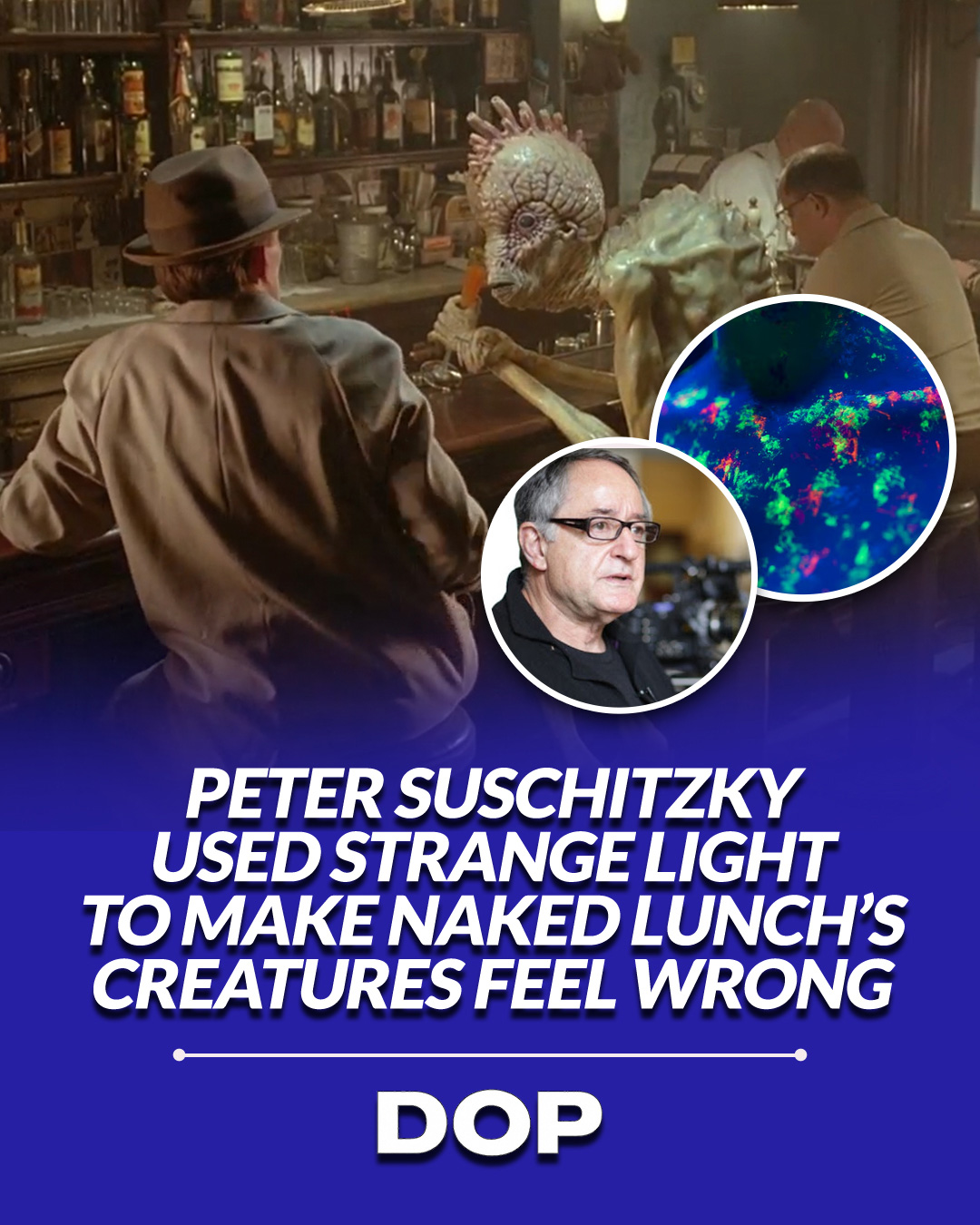
Adaptations of William S. Burroughs’ seminal novel Naked Lunch were long deemed impossible, but David Cronenberg’s 1991 cinematic interpretation succeeded precisely because it translated literary surrealism into physical, bodily reality. At the center of this achievement was director of photography Peter Suschitzky, ASC, BSC, whose long-standing collaboration with Cronenberg yielded some of modern cinema's most unsettling visual grammar. Rather than leaning on standard dark-and-fog horror tropes, Suschitzky approached the film's grotesque animatronic creatures, from the unsettling Mugwumps to the talking beetle-typewriters, with a clinical yet visceral lighting philosophy.
Shooting on 35mm film with Arriflex cameras and vintage Cooke prime lenses, Suschitzky eschewed the soft, forgiving diffusion often used to hide the seams of practical special effects in the early 1990s. Instead, he treated Chris Walas’ practical creature builds with an unforgiving, tactile reality. By opting for Kodak 500T 5296 stock, Suschitzky captured deep shadow tones while preserving maximum detail in high-contrast key lights, allowing every fold of latex, layer of slime, and strange, organic membrane to register with disturbing clarity.
Textural Tactility: Rims, Low Keys, and Slime
Conventional wisdom in visual effects lighting often dictates hiding practical puppets in deep shadow or blurring them with heavy haze to conceal mechanical movement. Suschitzky flipped this paradigm on its head. He positioned hard, low-angle tungsten key lights close to the animatronics, deliberately carving out the rough, uneven topography of their surfaces. These harsh, low keys emphasized the physical sweat, wetness, and coarse skin of the Mugwumps, making them feel clammy rather than glossy or plasticized.
Lighting, not just puppet design, is what stops a practical effect from looking like a synthetic prop and starts it feeling like a living infection.
To complete the illusion, Suschitzky made extensive use of tight side lighting and intense specular backlights. By catching the fine hairs, wet bumps, and translucent ridges of the puppets, these rim lights separated the creatures from their environment while stressing their organic grossness. The specular highlights bounced off wet latex surfaces not as clean studio reflections, but as sweat-soaked, feverish glints that convinced the viewer’s brain that these entities possessed working vascular systems.
The Color Science of the Diseased Spotlight
Suschitzky’s color palette in Naked Lunch is equally instrumental in building Interzone’s hallucinated reality. Working with tungsten fixtures gelled with sickening ambers, bruised cyans, and jaundiced greens, he consistently bathed creatures in a kind of diseased spotlight. Backgrounds were allowed to fall off into murky, uncalibrated color fields, isolating the puppets in painterly pools of light while keeping the surrounding architecture abstract and dreamlike.
This approach relied heavily on precise ratio control. By letting the surrounding set fall two to three stops below the creature’s key light, Suschitzky created a focal funnel. The creature became an unavoidable point of interest, half-revealed in its grotesque detail and half-submerged in atmospheric shadow. The color choices echoed the psychological decay of protagonist William Lee, blurring the line between physical manifestation and drug-induced delirium.
For modern cinematographers navigating an era dominated by digital cleanup and post-rendered creatures, Suschitzky’s work on Naked Lunch remains a masterclass in practical craft. It demonstrates that believable practical effects rely less on hiding flaws and more on bold lighting choices that treat non-human subjects with the same character-driven rigor as human actors. Through deliberate texture emphasis and atmospheric color control, Suschitzky elevated practical effects into hauntingly tangible art.