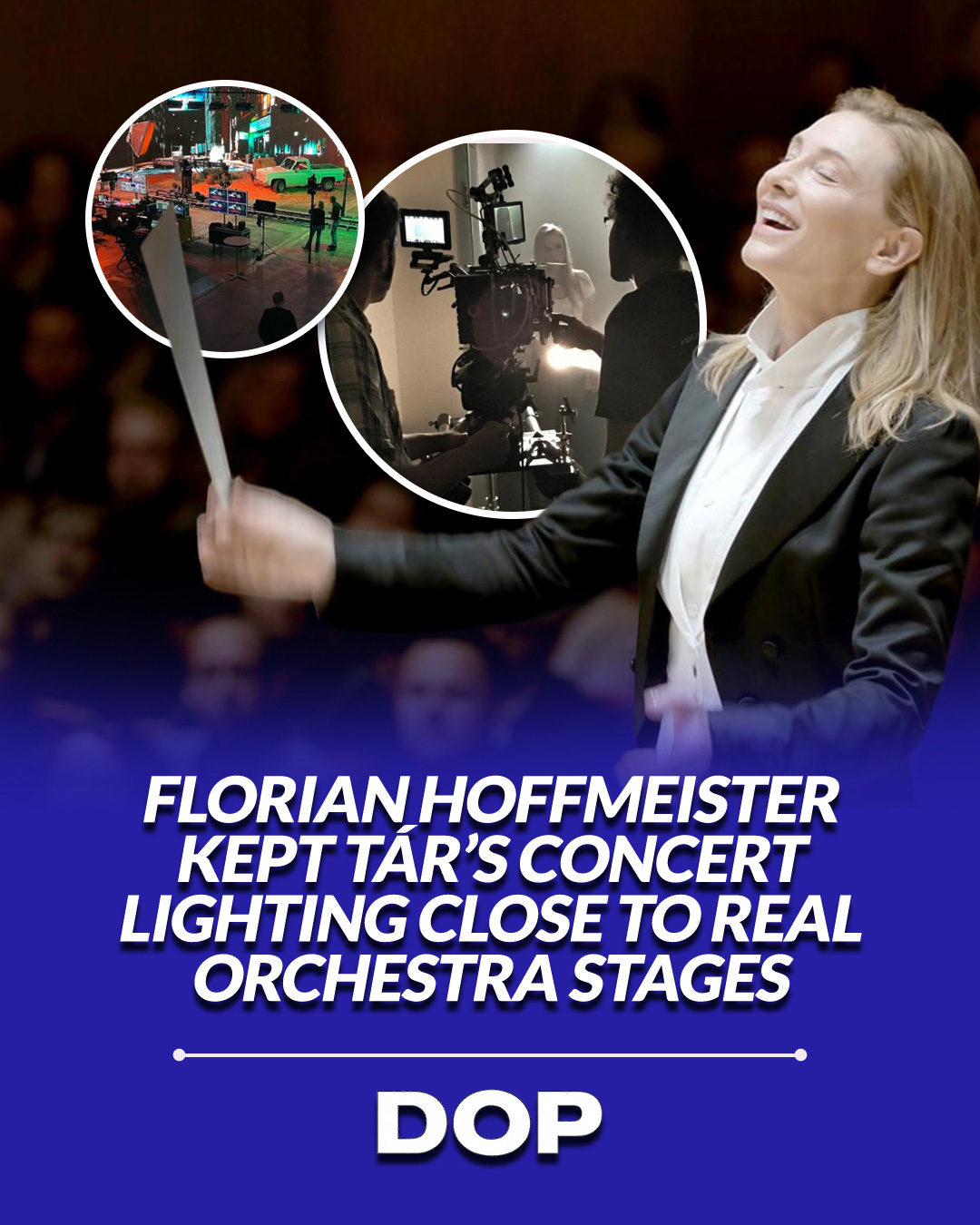
Todd Field’s Tár is an uncompromising examination of power, artistic obsession, and self-destruction. But beyond Cate Blanchett’s tour-de-force performance, the film’s narrative force is quietly dictated by its visual grammar. Shot by German cinematographer Florian Hoffmeister BSC, Tár avoids the romanticized, polished aesthetic typical of modern high-budget dramas. Instead, Hoffmeister embraces an authentic, almost clinical lighting philosophy that respects the real-world spaces classical musicians inhabit daily.
In classical concert halls and rehearsal spaces, lighting is designed for utility and performance, not for flattering cinematic close-ups. Hoffmeister translated this reality directly to the screen. Rather than deploying heavy softboxes or flattering beauty dishes to wrap Blanchett’s face in soft glow, he utilized strong, direct keys mounted in overhead grids and sharp follow spots focused squarely on the conductor’s podium. The result is a steep exposure gradient where light falls off rapidly into a deep, cavernous audience space.
Authenticity Over Glamour: The Stage as a Visual Battlefield
To capture this brutalist visual clarity, Hoffmeister selected the ARRI Alexa LF paired with ARRI Signature Prime lenses. The large-format sensor gave him a wide, clean canvas with exceptional dynamic range, which was critical for managing the intense highlights of lit sheet music against the deep, unlit shadows of the hall. The Signature Primes provided a crisp, naturalistic rendering without the heavy flares or vintage optical distortions that might break the film’s rigorous immersion.
This technical rig allowed the lighting to double as psychological metaphor. When Lydia Tár steps into her light on the podium, she dominates the frame while the surrounding musicians dissolve into dark, negative space. The light acts as a physical mantle of authority, isolating her from the very ensemble she seeks to control. By refusing to over-soften her features, Hoffmeister lets every nuance of Blanchett’s physical strain and intensity show through, grounding the spectacle in authentic stage illumination rather than movie star glamour.
Cinematographer Florian Hoffmeister BSC treats stage illumination not as a decorative element, but as an austere physical force that defines the boundaries of power.
Islands of Light in Domestic and Institutional Spaces
What makes Tár so visually cohesive is how Hoffmeister extends this concert hall logic into private spaces. In Lydia’s brutalist Berlin apartment and the sterile administrative offices of the orchestra, the lighting relies heavily on isolated pockets of brightness. Large, cool daylight sources push through high windows, creating sharp pools of light on concrete floors, while low-wattage practical lamps offer small islands of warmth amidst shadowy interiors.
This approach echoes Hoffmeister’s previous visual work on projects like Terence Davies’ A Quiet Passion and AMC’s The Terror, where light is treated as an organic, atmospheric element rather than an artificial fill. In Tár, there is rarely a visual safety net of ambient bounce. Rooms feel cold and spacious because the shadows are allowed to exist un-supplemented, forcing the viewer’s eye to search the frame just as Lydia’s paranoia begins to narrow her world.
The color science further reinforces this discipline. Working with colorist Tim Masick at Company 3, Hoffmeister crafted a muted, low-saturation palette dominated by slate grays, deep teals, and stark whites. Highlights are meticulously preserved, especially the crisp paper of score sheets and the pale skin of conductor hands, while the midtones are kept lean and reserved, preserving a striking contrast ratio throughout.
For directors of photography, Tár stands as a masterclass in restraint and visual honesty. By respecting the lighting culture of the real world, how light actually bounces off orchestra risers and cuts through concrete loft spaces, Hoffmeister built a cinematic landscape that feels at once documentary-exact and psychologically claustrophobic. It proves that sometimes the boldest lighting choice a DP can make is simply allowing the dark to stay dark.
This article contains affiliate links. We may earn a small commission at no extra cost to you. Learn more.