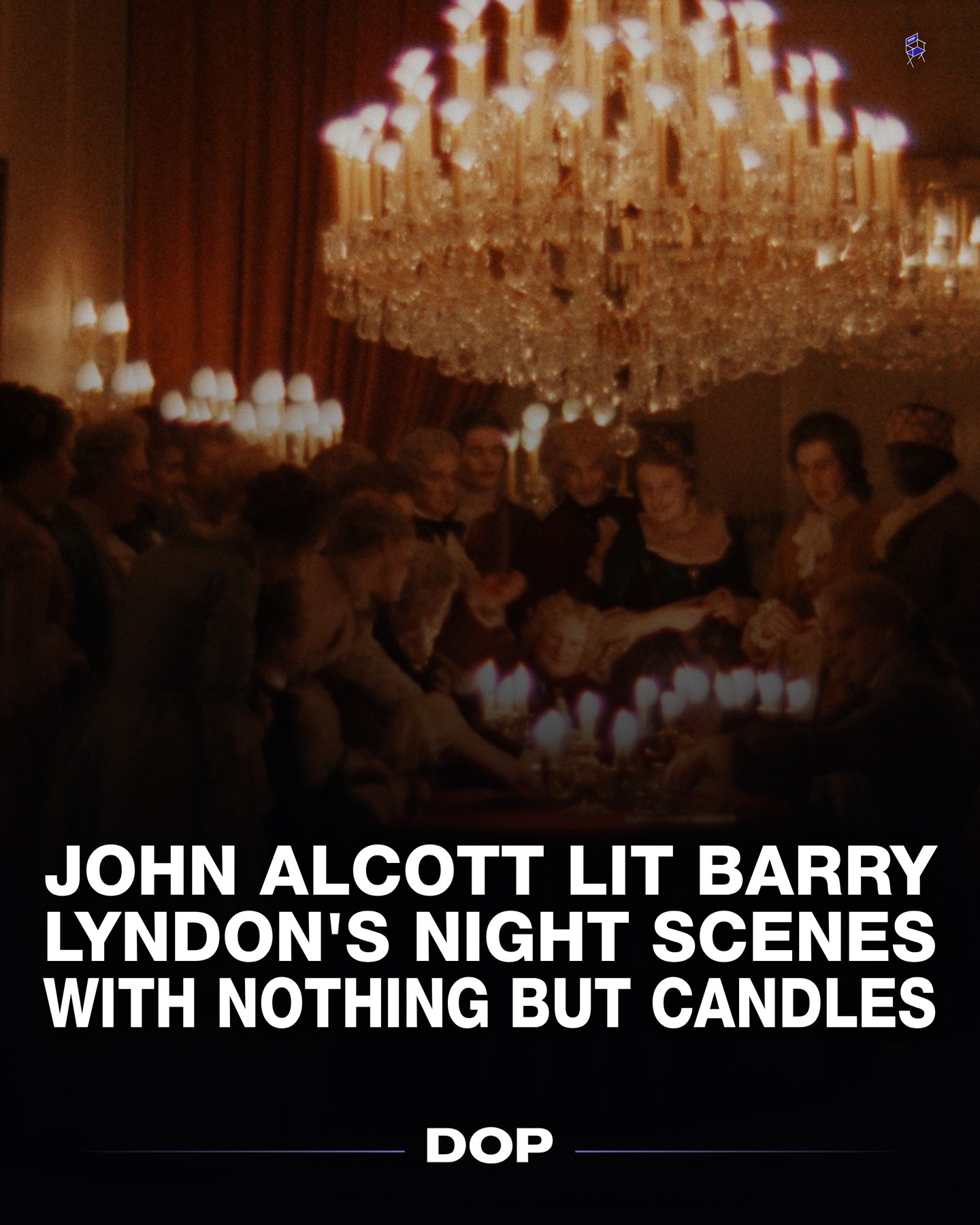
When Stanley Kubrick set out to adapt William Makepeace Thackeray's picaresque 18th-century novel into Barry Lyndon (1975), he established an uncompromising aesthetic mandate: zero artificial film lighting in the interior night scenes. For director of photography John Alcott, BSC, this wasn't merely a stylistic preference, it was an audacious technical challenge that defied the physical limits of 1970s film emulsion.
The NASA Glass That Changed Motion Picture History
Standard cinema primes of the era typically bottomed out around T1.4 or T2.0. Coupled with Kodak's 100 ASA Eastman Color Negative 5254 stock, shooting solely under genuine candle illumination was an exposure impossibility. Kubrick refused to compromise by hiding inkies or hidden practical kickers out of frame; he demanded that the luminaires on set be the sole light sources generating the negative's latent image.
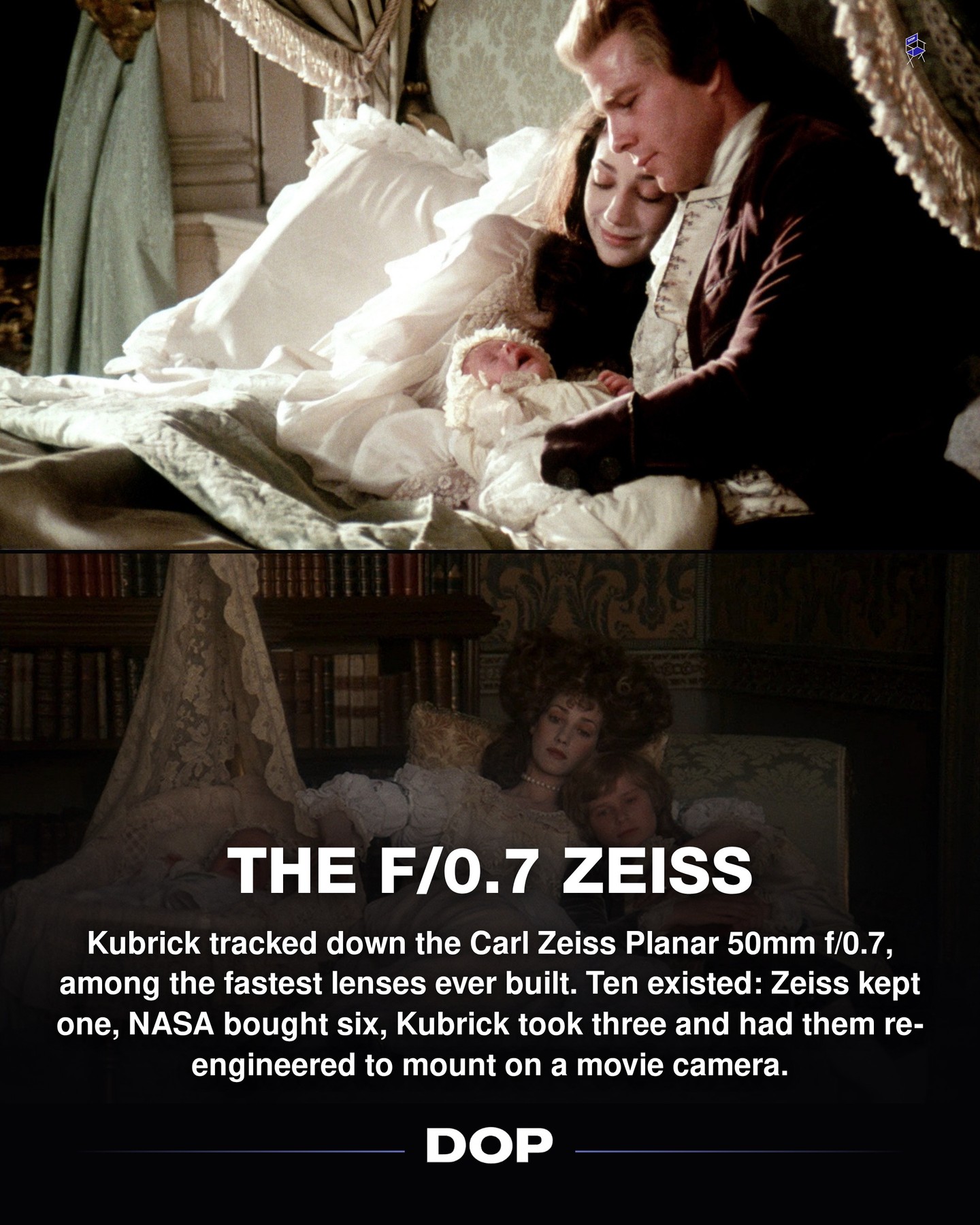
The breakthrough came when Kubrick tracked down the ultra-rare Carl Zeiss Planar 50mm f/0.7 lenses. Developed in the mid-1960s for NASA’s Apollo lunar program to photograph the dark side of the moon, only ten of these optical behemoths were ever fabricated. Zeiss retained one, NASA secured six, and Kubrick purchased the remaining three. To make these massive still-photography lenses viable for 35mm motion picture acquisition, Kubrick collaborated with Ed DiGiulio of Cinema Products Corporation.
The depth of field was measured in millimeters. An actor leaning forward just two inches meant total focus loss, turning the entire sequence into an unforgiving technical high-wire act.
DiGiulio’s team had to heavily modify a non-reflexed Mitchell BNC camera, machining down the housing to seat the rear element of the Planar lens mere fractions of a millimeter from the camera shutter. To expand the focal range, DiGiulio retrofitted a Kollmorgen telecentric optical adapter, effectively transforming one of the 50mm primes into a 36.5mm wide-angle lens while miraculously retaining the blazing f/0.7 transmission speed.
The Intricacies of Candlelight Exposure
Wide open at f/0.7, the optical performance was razor-thin. Depth of field shrank to fractions of an inch, requiring focus puller Douglas Milsome to utilize closed-circuit video monitors and an intricate triangulation system with tape measures to track actors as they moved. Actors were instructed to pace their blocking slowly and deliberately to keep within the paper-thin focal plane.
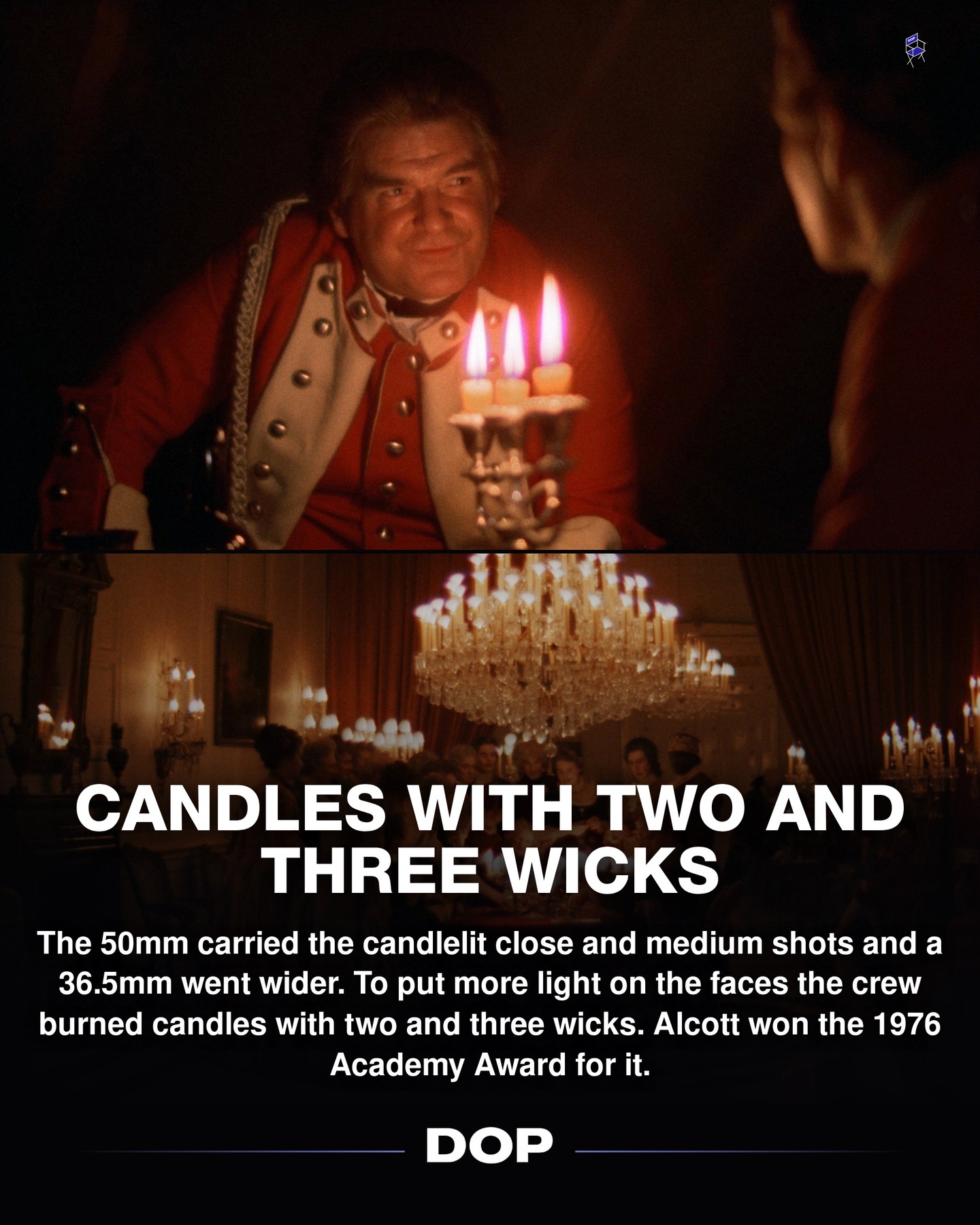
To squeeze every remaining foot-candle out of the sets, Alcott worked closely with the art department to deploy specially formulated multi-wick candles featuring two to three wicks apiece, generating roughly double the standard luminous output. Overhead, concealed metal heat shields and reflective surfaces bounced the rising warmth safely while scattering a soft, ambient fill across the period tapestries and gilded woodwork.
Painterly Naturalism and Enduring Legacy
Alcott pushed the 5254 stock one stop in laboratory processing, boosting the effective speed to roughly 200 ASA. While pushing introduced additional grain, the texture harmonized flawlessly with the period aesthetic, mimicking the oil paintings of Thomas Gainsborough, William Hogarth, and George Stubbs. The resulting imagery possessed a rich, painterly halation and golden color temperature that modern digital sensors still struggle to replicate organically.
The audacious technical gambit paid off. Alcott took home the 1976 Academy Award for Best Cinematography, cementing Barry Lyndon as a masterclass in optical experimentation. Decades later, Alcott and Kubrick’s radical commitment to naturalistic illumination remains a seminal benchmark for cinematographers navigating the delicate balance between optical engineering and pure visual poetry.