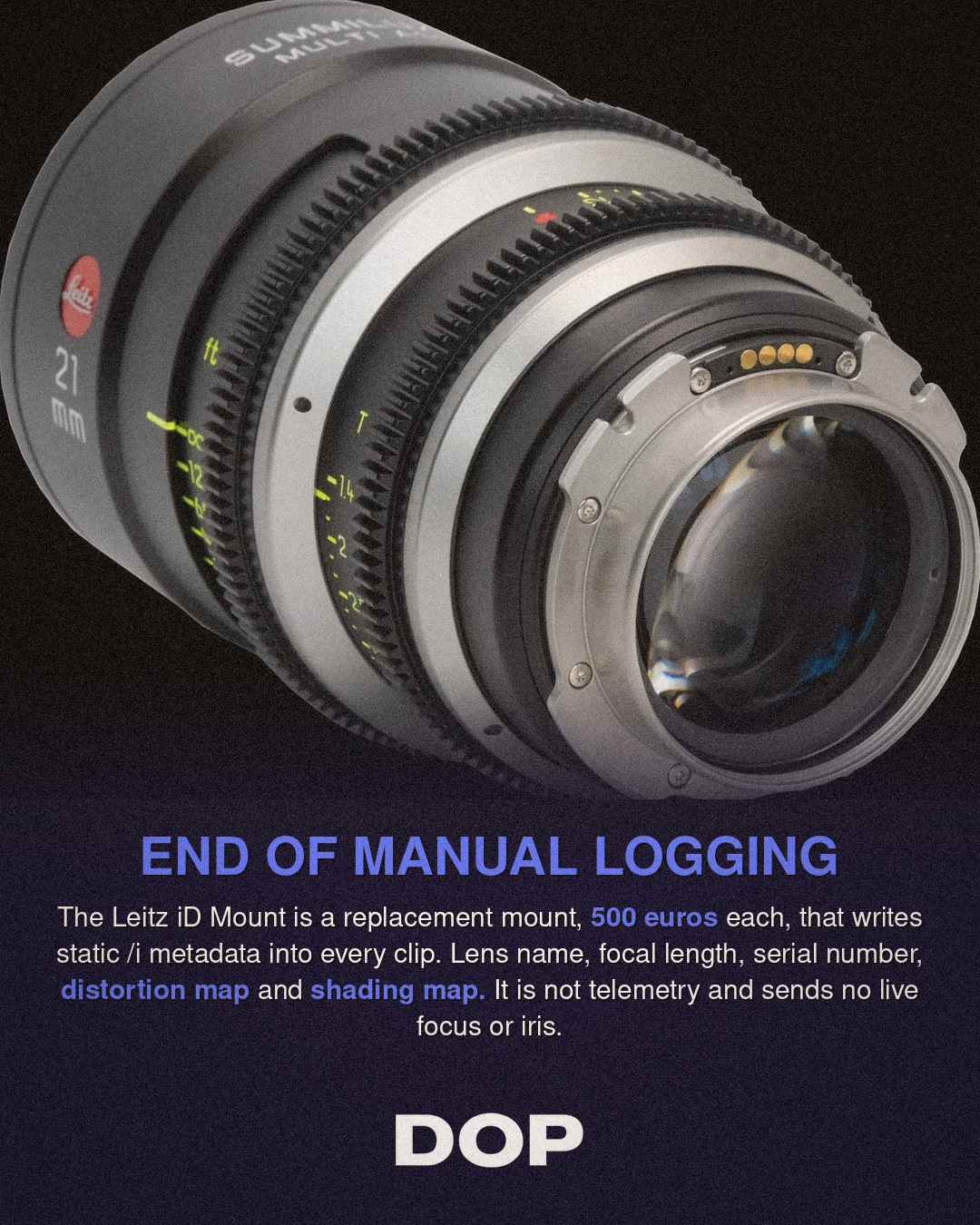
In an era where modern post-production pipelines and virtual production stages demand an unbroken digital paper trail, vintage and legacy cinema glass often creates a stubborn friction point. Cinematographers love the optical soul of legacy designs, but VFX supervisors and DITs dread the missing telemetry. Leitz Cine has answered this operational headache with an elegantly simple hardware update: drop-in replacement mounts for the Summilux-C and Hugo prime series that inject static optical metadata directly into every recorded frame.
Priced at €500 per mount, alongside a dedicated €320 programming base, the upgrade provides a bridge between purist mechanical optics and the rigors of contemporary workflows. Rather than over-engineering an invasive internal encoder system with optical potentiometers, Leitz focuses on foundational data integrity. The new mounts broadcast static parameters into camera systems via standard lens-mount contacts, packaging lens name, focal length, serial number, and crucial factory-calibrated distortion and shading maps into each clip’s container.
Pipeline Hygiene Without the Mechanical Baggage
For DPs who cut their teeth on the legendary Summilux-C primes, glass celebrated for its velvety skin tones and surgical resolution on seminal digital features like David Fincher and Jeff Cronenweth’s The Social Network and The Girl with the Dragon Tattoo, the lack of integrated lens data has long been an accepted compromise. Modern productions using Cooke /i Technology or ARRI LDS-2 have spoiled post-production departments with automated clip ingestion. Without dynamic or static data, matchmove artists must still shoot distortion grids and rely on manual slate logging to identify whether a plate was captured on an 18mm or a 21mm.
Injecting factory distortion and shading maps directly into the camera clip eliminates the guesswork that has plagued post-production houses since the dawn of digital cinema.
While the new Leitz mounts omit live focus and iris telemetry, the value of static metadata cannot be overstated. Knowing the exact serial number and factory shading profile of an individual optic dramatically accelerates automated camera solving inside software like Foundry Nuke, 3DEqualizer, and Unreal Engine. Vignetting and barrel distortion can be neutralized or matched across multiple camera bodies instantly, eliminating hours of forensic prep in turnaround-heavy television and commercial pipelines.
Form Factor, Mount Ecosystems, and Mechanical Caveats
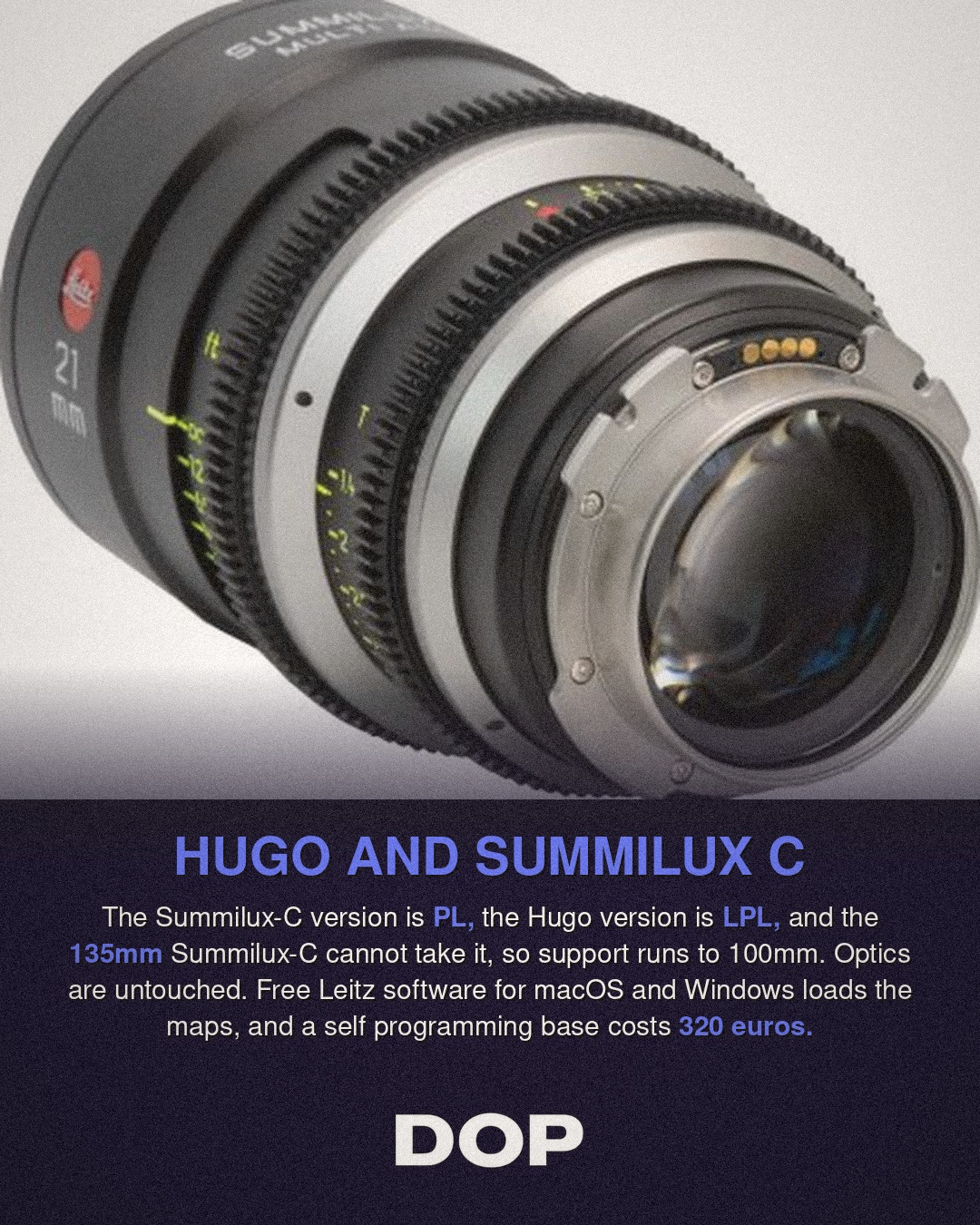
Leitz has tailored the solution specifically around the operational standards of each lens family. The Summilux-C units are built as classic PL mounts, preserving compatibility across industry-standard sensor gates from Super 35 to calibrated large-format windows on cameras like the ARRI ALEXA 35, Sony VENICE 2, and RED V-RAPTOR. Meanwhile, the Hugo series, which rehouses Leica M full-frame still photography glass into precision cinema housings, receives LPL mounts, honoring the larger image circle and shallow flange depths native to full-frame coverage.
There is, however, one notable exception in the Summilux-C lineup: the 135mm prime cannot accept the retrofit mount. Due to the deep rear optical construction and mechanical clearance inside the lens base, the electronics package physically cannot be accommodated without compromising optical integrity. For the rest of the focal lengths, the internal optics remain entirely untouched, ensuring the unique chromatic aberration control and gentle roll-off that define the Leitz look remain pristinely preserved.
Field Serviceability on the Prep Floor
Crucially for rental houses and owner-operators, the installation workflow does not require shipping lens sets back to the factory in Wetzlar. Swapping the mount is a localized, mechanical procedure requiring only clean bench hygiene and a standard backfocus check using an optical collimator or projection room. Lens technicians calibrate the flange focal depth with standard shim packs, ensuring proper witness mark alignment before setting the optic back out on a job.
With the optional programming base station, rental facilities can quickly address, flash, and verify mount firmware and serial data in-house. By keeping the price point accessible and the installation straightforward, Leitz offers an intelligent compromise for DPs who refuse to trade tactile mechanical feel for metadata compliance. It is a pragmatic, production-minded evolution that keeps celebrated glass relevant on high-tech sets for decades to come.
This article contains affiliate links. We may earn a small commission at no extra cost to you. Learn more.