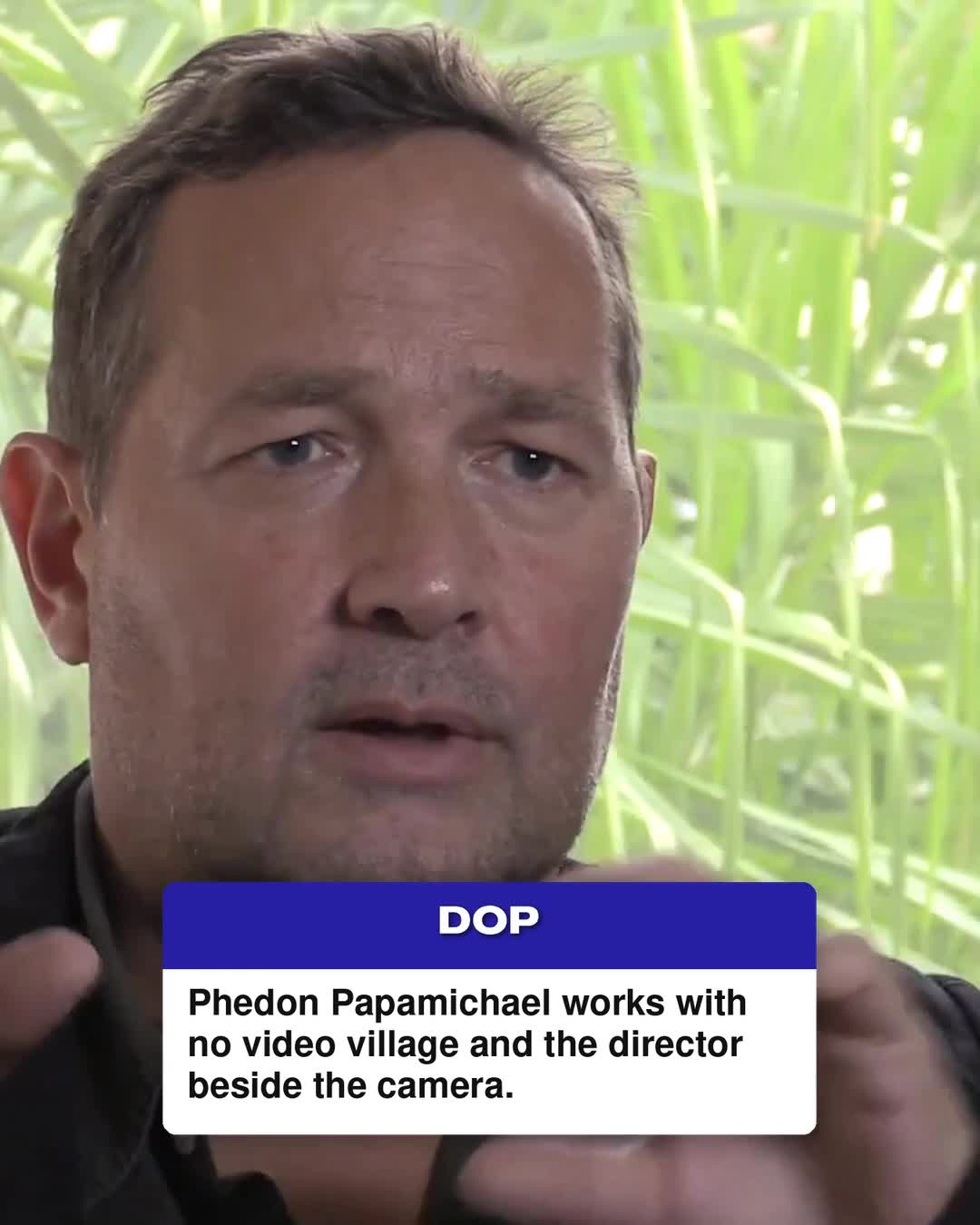
On the modern feature set, the gravitational center of production has drifted inexorably away from the matte box. What once took place within arm’s reach of the lens is now routinely mediated through calibrated 24-inch OLED monitors, high-gain wireless transmitters, and a sprawling encampment known colloquially, and often begrudgingly, as video village. For Phedon Papamichael ASC, GSC, that distance represents the slow death of organic performance. When shooting intimate, character-driven road pictures, Papamichael strips away the technological clutter to reinstate cinema’s most sacred triangle: the director standing beside the lens, the operator behind it, and the actors directly in front.
Papamichael is no stranger to scale. Between the roaring, multi-camera kineticism of Ford v Ferrari and the franchise weight of Indiana Jones and the Dial of Destiny, he has commanded the largest technical footprints Hollywood can assemble. Yet his masterwork collaborations with director Alexander Payne, from the sun-bleached vineyards of Sideways to the stark, desaturated monochrome landscapes of Nebraska, rely on an operating ethos that is radically austere. No playback rigs. No video village. An onboard monitor mounted directly to the camera cage, and nothing else.
The Intimacy of Operating A-Camera
Operating the camera himself is foundational to Papamichael’s visual language. When a cinematographer surrenders the fluid head or wheels to a dedicated operator, an inevitable layer of translation is introduced. By keeping his eye against the eyepiece or glued to a compact onboard monitor, Papamichael can register micro-expressions and shifts in actor blocking in real time, reacting with organic intuition rather than calculated marks.
This physical proximity fundamentally alters the psychology of the set. When the take ends, an actor’s gaze doesn’t drift toward a dark tent forty yards away where an unseen committee debates their performance. Instead, they look up into the direct, human gaze of their director and their DP. This feedback loop is immediate, tactile, and devoid of the clinical anxiety that wireless monitors cultivate.
When there is no village, the set collapses into a sacred triangle: the actor living the moment, the director observing with naked eyes, and the operator breathing with the frame.
Engineering the Lean Footprint
Working this stripped-down requires deliberate technical discipline. For road movies confined to automobile interiors and cramped roadside motels, camera package selection dictates blocking freedom. Pairing compact digital cinema bodies, such as the ARRI Alexa Mini or Alexa LF in stripped-down run configurations, with vintage glass gives Papamichael both modern latitude and tactile character. In Nebraska, capturing raw digital frames through Panavision C-Series anamorphics allowed the glass’s inherent aberrations, gentle fall-off, and elliptical bokeh to soften the clinical sharpness of digital sensor capture before arriving at its high-contrast black-and-white finish.
Optical choices dictate proximity. Papamichael frequently favors wider focal lengths nestled close to his subjects over distant telephoto compression. A 35mm or 40mm anamorphic placed inches from an actor’s face captures perspective, environmental context, and visceral presence. It forces the camera crew to physically occupy the same space and air as the characters, turning the physical camera into an emotional participant rather than an objective spectator.
Lighting for 360-Degree Freedom
A bare-bones operating approach instantly collapses if the lighting package traps the actors on half-inch marks. To facilitate a set where the director and actors move without friction, Papamichael’s lighting methodology pivots toward holistic environment design. Rather than sculpting every close-up with dedicated key, fill, and hair lights, he lights the space from the outside in.
Large fixtures pushed through natural architectural apertures, diffused 18K HMIs or modern high-output LED arrays bounced through window frames, establish a believable, motivated base stop. Inside the practical location, small soft sources, whether hidden ribbon LEDs, Astera tubes, or strategically placed practical incandescent bulbs, elevate ambient levels just enough to hold shadow detail within the sensor’s dynamic range. This approach grants the performers total spatial freedom, enabling Papamichael to pivot the camera 180 degrees without calling a forty-minute re-light.
In an era where digital monitoring encourages micromanagement and technical over-refinement, Papamichael’s stripped-down sets serve as an urgent reminder of what actually matters in visual storytelling. Cinema is not engineered at a calibration cart; it is captured in the fragile, unrepeatable tension shared between a lens and a human face.
This article contains affiliate links. We may earn a small commission at no extra cost to you. Learn more.