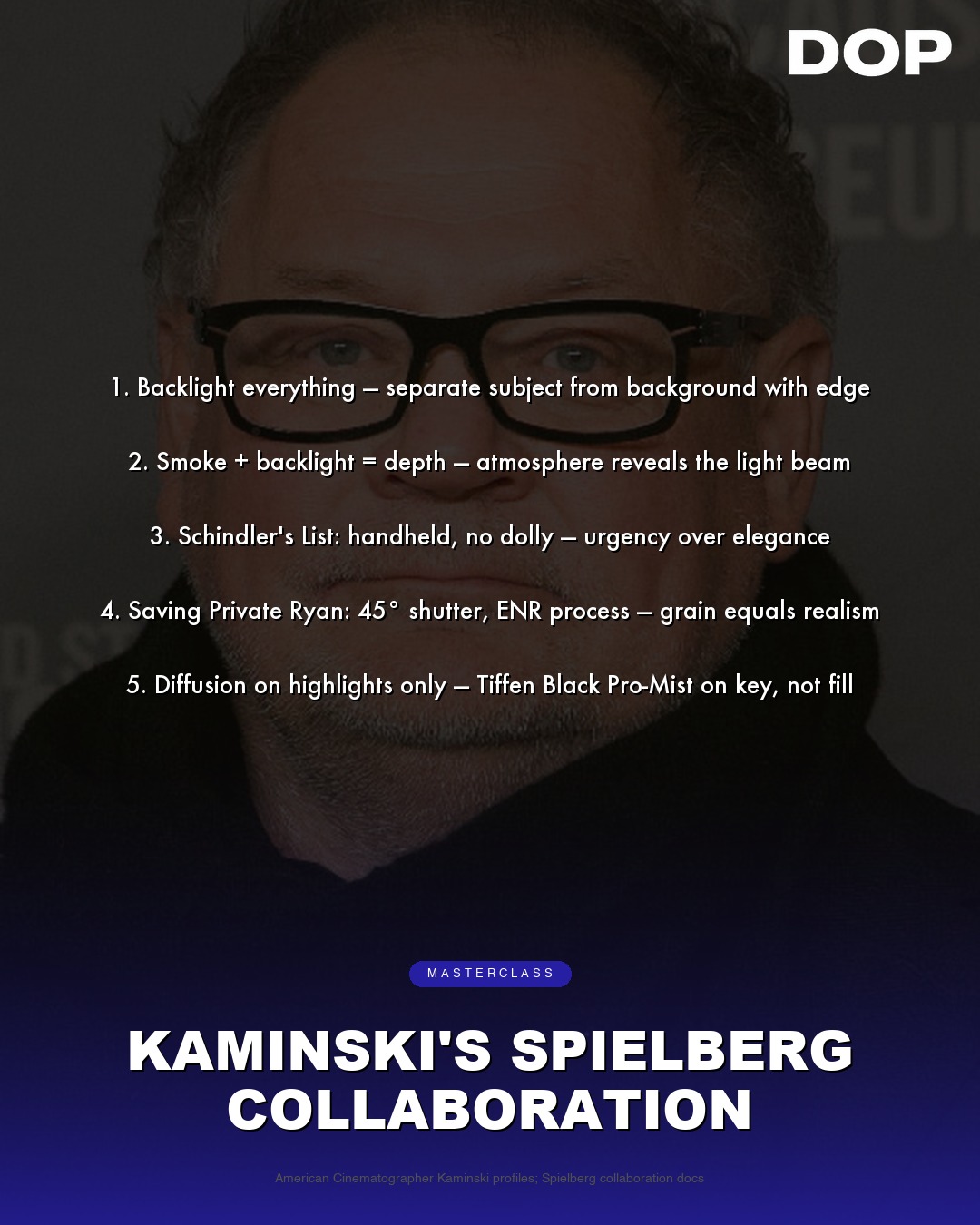
Janusz Kaminski. The name alone evokes a cinematic language instantly recognizable, inextricably linked with the iconic visual tapestry of Steven Spielberg's most profound works. For nearly three decades, this unparalleled collaboration has redefined historical epics, war dramas, and sci-fi marvels, consistently pushing the boundaries of visual storytelling. When a master of Kaminski's caliber shares his insights, it's not merely a list of tips; it's a profound peek into the philosophy that underpins some of cinema's most indelible images. His recent masterclass revelations offer a roadmap, not just for aspiring DPs, but for anyone seeking to understand the meticulous craft behind the magic.
At the heart of Kaminski's philosophy lies a profound understanding of light as a narrative tool. His first directive, "Backlight everything - separate subject from background with edge," is a cornerstone of classical cinematography, yet Kaminski elevates it to an art form. This isn't just about creating dimensionality; it's about imbuing subjects with an almost ethereal presence, literally highlighting their significance within the frame. Think of the intense character separation in Schindler's List or the dramatic silhouettes in Saving Private Ryan. This technique, often achieved with powerful HMIs or LEDs positioned strategically behind the subject, carves them out from their environment, drawing the viewer's eye and adding a sculptural quality to the composition. It's a deliberate choice that emphasizes emotional weight and visual clarity, ensuring that key characters always command attention.
The Art of Atmosphere and Exposure
Kaminski's second and third points, "Smoke + backlight = depth - atmosphere reveals the light beam" and "Overexpose 1 stop and desaturate - bleached look anchors historical texture," are intrinsically linked, forming a powerful tandem for generating mood and period authenticity. The judicious use of atmospheric haze or smoke, when kissed by a powerful backlight, transforms negative space into a palpable entity. It creates visible light rays, adding a tangible sense of depth and a poetic quality to the scene. This technique is particularly evident in the dusty, ethereal battlefields of Saving Private Ryan, where shafts of light pierce through the smoke and debris, guiding the eye and amplifying the horror and beauty simultaneously. This isn't about obscuring; it's about revealing the very air that characters breathe, making the environment an active participant in the story.
"Light isn't just about illumination; it's about emotional resonance. It's about guiding the audience's eye and feeling their way through the narrative."
The instruction to "Overexpose 1 stop and desaturate" speaks volumes about Kaminski's approach to color and texture. This isn't a blanket rule for every film, but a specific technique employed to achieve the distinctive, often melancholic or stark, aesthetic seen in many of his collaborations with Spielberg. By overexposing slightly, Kaminski pushes details into the highlights, creating a softer, sometimes dreamlike quality, while desaturation strips away vibrant hues, lending a timeless, almost archival feel. This 'bleached bypass' look, often associated with films like Saving Private Ryan and Minority Report, roots the narrative in a raw, historical reality or a dystopian future, enhancing the gravitas of the subject matter. It's a deliberate manipulation of the digital or chemical negative to achieve a specific emotional and thematic resonance, often utilizing custom LUTs or extensive color grading in post-production to refine the desaturation and contrast curves.
Shutter, Emotion, and the Earned Glow
His fourth insight, "Shutter angle is emotion - wide shutter for chaos, narrow for precision," highlights the often-underestimated power of the camera's mechanical or digital shutter. A wide shutter angle (closer to 180 degrees or higher) allows for more motion blur, which can convey speed, frantic action, or disorientation – perfect for the visceral chaos of a battlefield or a chase sequence. Conversely, a narrow shutter angle (e.g., 45 or 90 degrees) reduces motion blur, resulting in sharper, more precise individual frames, ideal for conveying controlled movements, intense focus, or a sense of clinical detachment. Kaminski masterfully employs this technique to manipulate the audience's perception of time and action, making the very fabric of the image contribute to the emotional beats of the scene. Consider the jarring, staccato movements in the D-Day landing sequence, achieved with a narrow shutter and often combined with specific frame rates, or the fluid, dreamlike sequences where a wider shutter might be employed.
Finally, Kaminski's dictum, "God rays are earned - motivate every shaft of light through a practical," is a testament to his commitment to realism and narrative integrity. Those breathtaking shafts of light piercing through windows or forest canopies, often dubbed 'God rays' or 'volumetric light,' are never arbitrary in a Kaminski frame. They are meticulously motivated by a visible light source – a window, a door, a gap in the clouds – and are painstakingly crafted using smoke, haze, or even carefully positioned diffusers to catch and sculpt the light. This principle underscores a broader philosophy: every visual element must serve the story. The light doesn't just look beautiful; it emanates from a believable source, guiding the eye, revealing detail, or symbolizing a deeper meaning. It's a testament to the meticulous pre-production and on-set precision that defines his work, often involving extensive rigging and light placement to achieve these seemingly natural phenomena.
Janusz Kaminski’s contributions to cinematography are immeasurable. His collaboration with Steven Spielberg has not only produced some of cinema's most revered images but has also consistently demonstrated that technical mastery, when coupled with a profound understanding of storytelling, can elevate film to an art form capable of moving, challenging, and inspiring audiences across generations. These five maxims are not just technical guidelines; they are the distillation of a master's artistic vision, a blueprint for crafting images that resonate deeply and endure in the collective cinematic consciousness.
This article contains affiliate links. We may earn a small commission at no extra cost to you. Learn more.