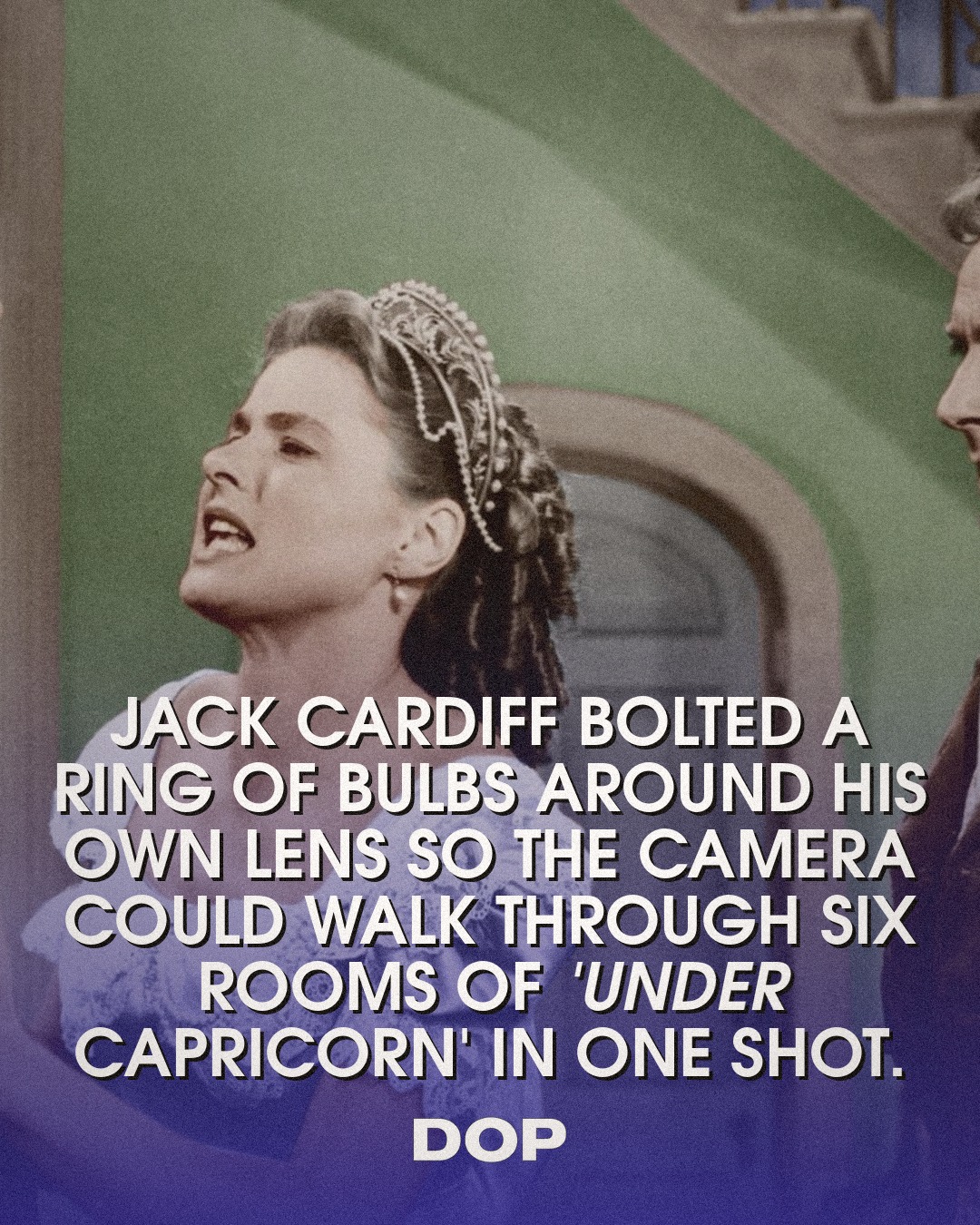
In the annals of cinematography, certain films stand as monuments not just of storytelling, but of technical audacity. Alfred Hitchcock’s 1949 drama Under Capricorn, lensed by the legendary Jack Cardiff, ASC, is one such film. What began as Hitchcock’s insistence on unprecedented long takes and fluid camera movement evolved into a masterclass in lighting innovation, forcing Cardiff to engineer solutions that defied the conventions of his era.
Hitchcock, ever the orchestrator of tension and visual narrative, envisioned sequences where the camera would glide through an entire house, unbroken by cuts. This directorial decree, while artistically compelling, presented an existential challenge to Cardiff and his lighting team. The fundamental problem was fill light. If the camera was perpetually in motion, so too must be its illumination. A static fill light would inevitably lead to uneven exposure, harsh fall-off, and a distracting patchwork of light and shadow as the camera traversed the meticulously crafted sets.
The Genesis of Moving Light: Cardiff's Ingenuity
Cardiff’s solution was nothing short of revolutionary. He conceived and implemented a system where the fill light literally traveled with the camera. The Instagram caption succinctly captures the essence of this: a ring of photofloods rigged directly around the matte box of the Technicolor camera’s blimp. This ingenious contraption ensured that wherever the camera's eye gazed, a consistent, soft fill light followed, maintaining the delicate balance of exposure and mood crucial for Technicolor's demanding three-strip process.
“He rigged a ring of photofloods around the matte box of the Technicolor blimp, so the fill went where the camera went.”
This wasn't merely a small ring light; it was a sophisticated, purpose-built apparatus designed to integrate seamlessly with the bulky Technicolor camera. The choice of 35mm lenses for these expansive, flowing shots, combined with the extreme close-ups, Ingrid Bergman’s face captured from a mere 18 inches, demanded an unprecedented level of control over light. The fill had to be soft enough to flatter, yet strong enough to lift shadows without flattening the image. Cardiff, a master of lighting for the human face, particularly in color, understood this nuance implicitly. His prior work on films like Black Narcissus (1947), where he conjured vibrant, almost ethereal landscapes and deeply emotional portraits, showcased his profound understanding of light's psychological impact.
Beyond the Ring: A Symphony of Illumination
While the matte box-mounted fill was the star of the show, it was part of a larger, incredibly complex lighting setup. The caption mentions “over 200 lamps sat on cranes, dollies and converted microphone booms.” This speaks to the sheer scale of the operation. Key lights, backlights, and practicals all had to be dynamically managed. Imagine the choreography: not just the camera and actors moving, but gaffers and grips deftly repositioning large units, often on mobile platforms, all while staying out of frame and maintaining precise light levels. This was a ballet of heavy machinery and delicate adjustments, a testament to the collaborative artistry required on a 1940s film set.
The infamous dining table, cut into 14 sections, is another vivid illustration of the lengths to which the crew went to facilitate Hitchcock's vision. This wasn't just about moving the camera; it was about removing any physical obstruction that might impede its path. The entire set design had to be rethought, becoming a malleable, dynamic space that could transform to allow the camera's unimpeded journey. This level of set modification underlines the symbiotic relationship between cinematography and production design, where the pursuit of a specific visual style permeates every department.
Cardiff’s work on Under Capricorn, particularly in its innovative approach to moving fill light, foreshadowed techniques that would become standard decades later. While modern LED panels and remote-controlled lighting rigs offer greater flexibility, the fundamental principle, that light must adapt to camera movement, remains sacrosanct. Cardiff, working with the cumbersome technology of his time, laid crucial groundwork. His ability to blend technical prowess with artistic sensibility, creating images that were both technically perfect and emotionally resonant, cemented his status as one of cinema’s true pioneers. His legacy continues to inspire cinematographers to push the boundaries of what is possible, reminding us that sometimes, the most elegant solutions arise from the most intractable problems.