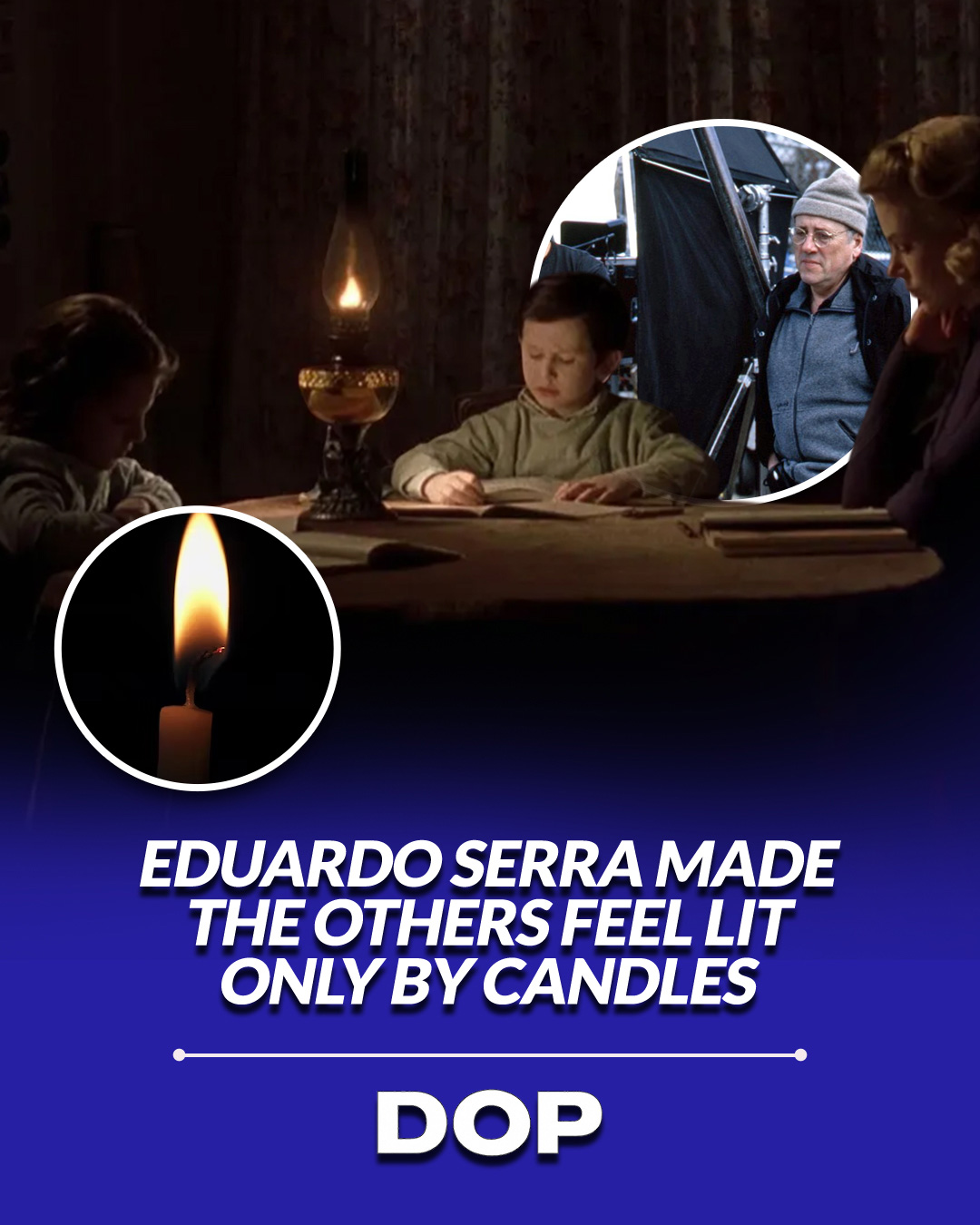
When Alejandro Amenábar’s gothic horror masterpiece The Others hit theaters in 2001, audiences were immediately entranced by its suffocating, fog-bound atmosphere. Set in a secluded mansion on the Isle of Jersey in 1945, the story centers on a mother who must keep her light-sensitive children in near-total darkness. For cinematographer Eduardo Serra, AFC, ASC, this narrative constraint posed a unique technical and artistic challenge: how do you light a feature film where the characters actively shut out the sun?
The result is a masterclass in low-key period lighting. While the movie appears to be illuminated by little more than dying embers and handheld candles, Serra carefully cheated reality to maintain exposure while preserving a hauntingly soft, tactile visual language. Rather than relying on pure naturalism, Serra engineered a system of invisible augmentation that respected both the script's strict rules and the technical demands of 35mm film motion picture stock.
The Illusion of the Flame: Augmenting Practical Light
Lighting convincingly with candles is one of the classic traps of cinematography. Real flame provides warmth and organic motion, but rarely produces enough foot-candles to achieve a clean exposure without pushing film stocks to their grainy limits. Serra, known for his subtle work on period dramas like The Wings of the Dove and later Girl with a Pearl Earring, understood that the key to atmospheric realism lies in motivation rather than literal execution.
On the soundstages where the interior of the mansion was constructed, real candles were placed throughout the frame to act as visual motivators. To build workable light levels, Serra flew large, soft overhead sources, such as customized softboxes equipped with tungsten lamps on dimmers, and brought them down to sit just above the ambient candle level. By gelling these fixtures with warm CTO and straw packs and running them through thick diffusion like grid cloth, he turned harsh flicker into a subtle, gentle wrap on the actors' faces.
The trick to believable period lighting isn't relying strictly on practical candles, but in building invisible augmentation that inherits their physical behavior.
Crucially, Serra aligned the vectors of these hidden soft sources with the practical flames on set. Every key highlight across Nicole Kidman’s face or the ornate woodwork behind her directly corresponds to an visible flame within the frame, deceiving the audience's eye into believing the candle is doing all the heavy lifting.
Protecting the Shadows: Black Levels and Film Latitude
Because The Others spends so much time in twilight and shadow, maintaining dynamic contrast without falling into a muddy grey void was essential. Serra opted to shoot on 35mm film using Arriflex cameras paired with soft, Cooke S4 lenses. To ensure the image retained depth, he carefully managed the toe of the exposure curve, the region of the film stock where shadow detail begins to compress into complete black.
Rather than letting background elements fall into pure, underexposed blackness, Serra kept subtle fill light on set walls and distant corridors. By lifting the shadow detail just a fraction above pure black, the mansion feels deep, vast, and three-dimensional, avoiding the flat, two-dimensional feel that often plagues improperly exposed dark scenes. This technique gave the film print a rich, velvety shadow texture rather than harsh, empty darkness.
Lessons in Invisible Lighting for the Modern DP
In an era dominated by high-ISO digital sensors capable of seeing in near-total darkness, Serra's approach on The Others remains a vital lesson for contemporary cinematographers. Just because a camera can expose under a single candle flame does not mean that light is flattering, directional, or cinematic. Sensitivity is no substitute for shape.
Serra’s philosophy demonstrates that true mastery of light is about control and narrative intent. By using practicals as the narrative anchor and building invisible, soft augmentation that behaves in harmony with those sources, DPs can create moody, immersive worlds that feel entirely grounded in reality while giving the camera exactly what it needs to craft a rich image.
This article contains affiliate links. We may earn a small commission at no extra cost to you. Learn more.