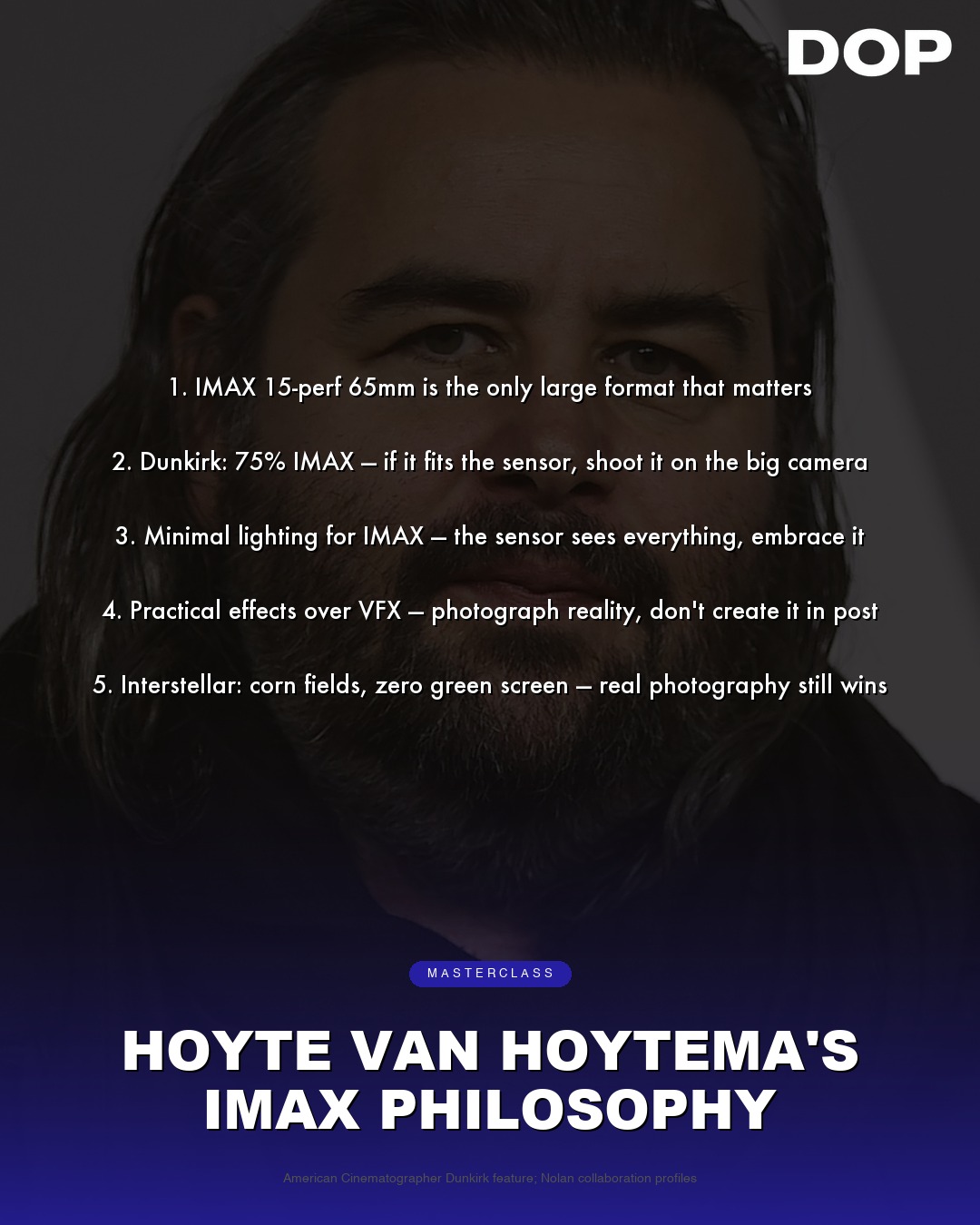
Hoyte van Hoytema, ASC, FSF, NSC, is not just a cinematographer; he’s a cinematic architect, meticulously crafting visual universes that resonate long after the credits roll. His recent masterclass insights, distilled into five potent points, offer a rare glimpse into the philosophy that underpins his groundbreaking work on films like Interstellar, Dunkirk, and Oppenheimer. For those of us who live and breathe the art of cinematography, these aren't just tips; they're commandments from a high priest of the moving image.
The IMAX Imperative: When the Frame Demands It
Van Hoytema’s first dictum, “IMAX 15-perf 65mm captures what no other format can - use it when the frame demands it,” is a testament to his belief in matching format to narrative ambition. This isn't about using the biggest hammer for every nail; it's about understanding the unique visual language of IMAX. The sheer resolution and expansive aspect ratio of 15-perf 65mm film don't just offer more pixels; they create an immersive experience that transcends traditional cinema. It’s a format that demands to be filled, to be lived in, and to convey a sense of scale, awe, or claustrophobia that smaller formats simply cannot replicate. Think of the vastness of space in Interstellar or the overwhelming sensation of war in Dunkirk – these are not merely shots, but experiences amplified by the IMAX canvas. This approach speaks to a deep understanding of the medium's psychological impact, recognizing that the choice of format is a crucial storytelling device.
His follow-up, “Dunkirk: 75% IMAX - if it fits the sensor, shoot it on the big camera,” further solidifies this commitment. For Dunkirk, the decision to push the boundaries of IMAX usage wasn't arbitrary. It was a calculated move to immerse the audience directly into the visceral, relentless tension of the evacuation. This meant adapting the massive IMAX cameras—often perceived as unwieldy—to situations previously thought impossible, such as handheld sequences on beaches or mounted on fighter planes. The camera, often a modified Panavision System 65 housing a 65mm IMAX film magazine, became an extension of the unfolding drama, capturing unparalleled detail and presence. This isn't just about technical capability; it's about the courage to innovate and to bend the tools to the will of the story.
The Enduring Soul of Film: Texture, Grain, and Presence
“Film over digital when texture matters - grain is not a flaw, it's presence.” This statement should resonate deeply with any DP who understands the nuanced difference between a digitally clean image and the organic fidelity of film. Van Hoytema is a staunch advocate for celluloid, particularly for its inherent character. The grain structure of film, far from being a technical imperfection, imparts a tactile quality, a sense of history, and a subtle imperfection that makes the image feel more alive, more real. It's the visual equivalent of a human fingerprint. For Oppenheimer, shooting primarily on large format film – including black-and-white IMAX – was critical to evoking the period, the scientific rigor, and the immense moral weight of the story. The choice of KODAK VISION3 500T 5219 and 250D 5207, alongside the custom black and white stock, was not just aesthetic; it was an integral part of the film's DNA, contributing to its timeless yet immediate feel. This philosophy challenges the pervasive pursuit of digital pristine, reminding us that sometimes, the imperfections are what make an image perfect.
"Grain is not a flaw, it's presence. It's the visual equivalent of a human fingerprint."
Practicality and Pacing: In-Camera Effects and Lens Choices
Van Hoytema’s practical approach extends to his lighting and camera rigging: “Practical rigs on camera for space - Interstellar's cockpit lights were all in-camera.” This speaks to a preference for authenticity and the tangible. In Interstellar, the decision to light the spacecraft cockpits with practical fixtures built directly into the sets, rather than relying on external sources or heavy post-production, created an incredibly believable and immersive environment for the actors. This not only enhances realism but also provides a more organic interaction between light and performance. It’s a philosophy that values the integrity of the physical space and the light within it, understanding that the camera captures not just light, but the way light interacts with surfaces and textures.
Finally, his insight into lens choice, “Longer lens compresses time - wide opens it; choose your temporal relationship,” is a masterclass in visual grammar. This isn't merely about focal length for framing; it's about understanding the psychological and temporal effects of different lenses. A longer lens, by flattening perspective and isolating subjects, can create a sense of urgency, compression, and accelerated time, drawing the viewer into a tightly focused moment. Conversely, a wide-angle lens expands space, offering a broader context, slowing down the perceived pace, and allowing the viewer to take in more information. This discerning approach to lens selection transforms a technical decision into a powerful narrative tool, guiding the audience's perception of time and space within the frame. Whether he's wielding a custom Panavision Sphero 65mm or adapting an ARRI Alexa 65 for specific sequences, van Hoytema's choice of glass is always intentional, always serving the story's emotional and temporal rhythm.
Hoyte van Hoytema’s insights are a clarion call for cinematographers to be deliberate, to be bold, and to always prioritize the story above all else. His work is a powerful reminder that the tools of our trade—be they massive IMAX cameras or a specific film stock—are not ends in themselves, but conduits for profound visual storytelling. Embrace the grain, understand the emotional weight of your chosen format, and let the narrative dictate your technical courage. This is the Hoytema way.
This article contains affiliate links. We may earn a small commission at no extra cost to you. Learn more.