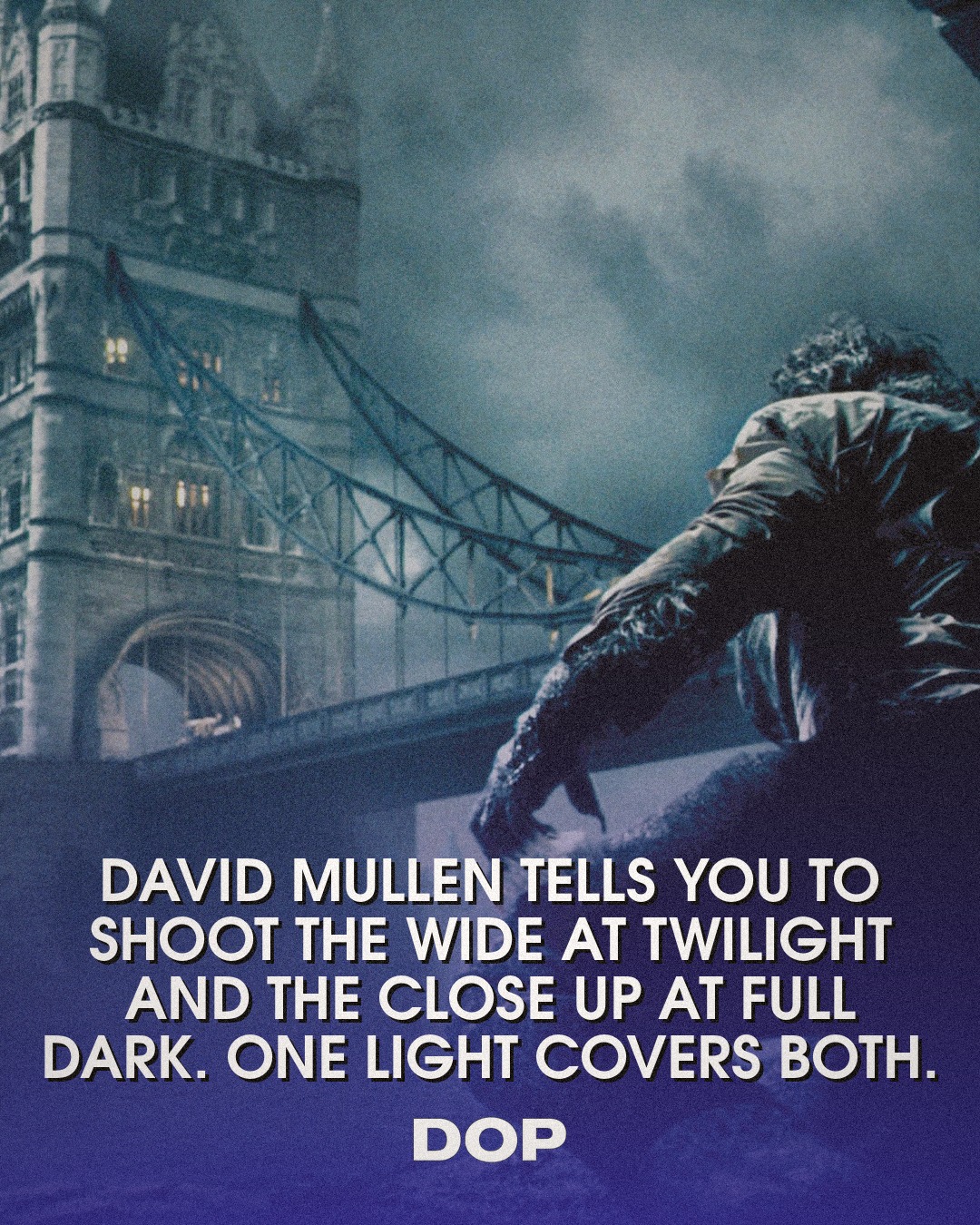
Lighting an exterior forest at night has historically demanded massive production resources: construction cranes, high-output HMIs, miles of banded cable, and generator trucks idling just out of earshot. But when an indie filmmaker armed with a Sony FX3 and a single 300-watt LED fixture posed the challenge of lighting deep woods on the Roger Deakins forum, David Mullen, ASC offered a masterclass in economy, optical physics, and production scheduling.
Mullen, whose prolific career spans the technicolor rigor of The Love Witch to the Emmy-winning sweep of The Marvelous Mrs. Maisel, is renowned across the cinematography community for his generous technical transparency. Rather than dismissing the micro-budget limitation, Mullen proposed two distinct operational strategies that leverage modern sensor sensitivity alongside classic visual trickery.
The Twilight Split: Exploiting Sky Ambient
Mullen's primary tactical recommendation revolves around time management: splitting the shooting schedule between nautical twilight and pitch blackness. The sheer square footage of a forest creates an insurmountable inverse-square falloff problem for low-powered point sources. A single 300-watt fixture simply cannot push enough foot-candles across a deep expanse of dense canopy without instantly looking like a localized, unmotivated spot.
By shooting wide establishing frames during blue hour, just after the sun has dipped below the horizon, the camera captures natural fill from the sky, preserving silhouette detail in tree trunks and atmospheric depth in the background. The low-light performance of modern full-frame sensors, particularly the FX3's dual native ISO at 12,800, allows cinematographers to register usable exposure values deep into twilight with minimal digital noise.
"Shoot the wides at twilight to capture the scale of the landscape, then return at full dark to stage close-ups against bounced, controlled light."
Once deep night falls, the production transitions into tighter coverage. For mediums and close-ups, Mullen advises bouncing the 300-watt lamp into a large frame, such as an 8x8 or 12x12 Ultrabounce or unbleached muslin. This transforms a hard point-source into a soft, wrap-around ambient key or gentle top-skate that blends seamlessly with the twilight wide shots, keeping the light off the deep background where its limited output would break the illusion.
Atmospheric Depth and Motivated Practical Illumination
Mullen’s second approach leans heavily on texture, silhouette, and in-frame motivation. Instead of attempting to simulate a broad moonlight source from high above, the DP suggests placing the fixture, or a series of smaller low-wattage accent lights, behind a natural ridge or hill, firing directly back toward camera through a layer of atmospheric haze.
Backlighting suspended particles transforms a low-powered unit into an expansive, luminous glow. The haze captures the beam angle, silhouetting the dense vertical lines of the trees and establishing immediate three-dimensional separation between the foreground actors and the dark environment. This technique echoes Mullen's atmospheric work on projects like The Wolf, where strategic rims and volume compensate for raw lumen count.
To complete the look, Mullen incorporates in-frame practicals, specifically actor-carried flashlights or lanterns. When actors sweep beams across misty tree trunks, the bouncing hotspot acts as an organic, dynamic fill light. By leaning on the high dynamic range and clean shadow roll-off of contemporary sensors, the smallest practical source can carry the narrative weight of a multimillion-dollar lighting package.
This article contains affiliate links. We may earn a small commission at no extra cost to you. Learn more.