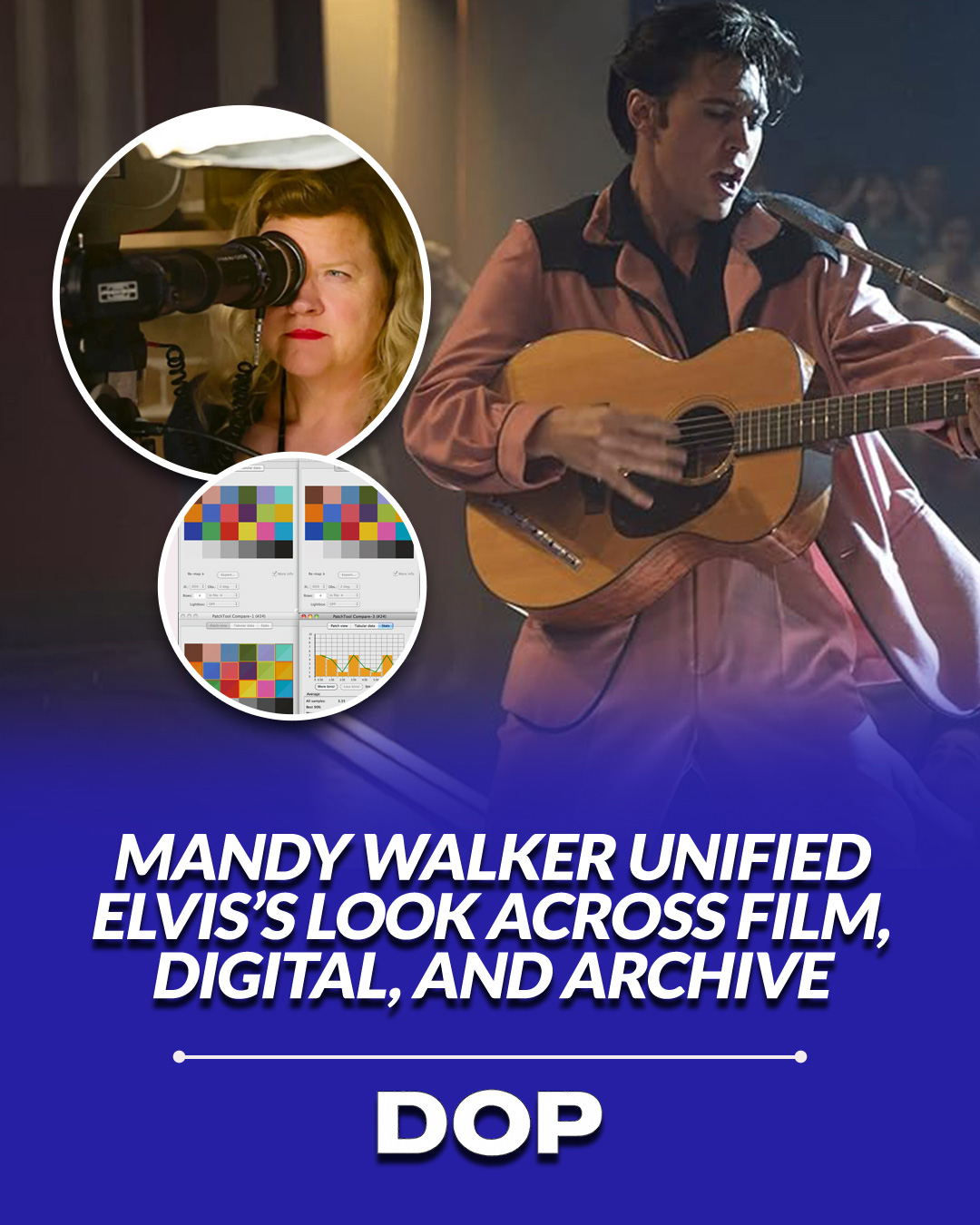
When capturing the life of the King of Rock and Roll, director Baz Luhrmann demanded a visual style as flamboyant, kinetic, and transformative as Elvis Presley himself. To execute this audacious vision, cinematographer Mandy Walker ASC, ACS faced an extraordinary technical hurdle: creating a cohesive visual tapestry out of radically disparate visual mediums. The film required seamlessly stitching together newly shot 35mm film, high-resolution digital cinema, and decades of low-fidelity archival broadcast media without collapsing into an incoherent collage.
In lesser hands, jumping across decades, aspect ratios, and medium formats could feel jarring or gimmicky. Walker’s Oscar-nominated achievement on Elvis stands as a definitive blueprint for modern camera operators and cinematographers navigating multi-format productions. Through meticulous optical testing, custom color science, and hyper-accurate period lighting, Walker established a visual harmony that bridges reality and legend.
The Color Pipeline and Custom LUT Science
The core challenge of mixing digital cameras with analogue film and archival archival tapes lies in highlight roll-off and color response, particularly when rendering skin tones under aggressive stage lighting. Walker worked alongside senior colorist Yvan Lucas to construct a unified testing pipeline and custom look-up tables (LUTs) long before principal photography began.
Using the ARRI Alexa 65 and Alexa LF as her digital workhorses alongside 35mm Kodak motion picture stock, Walker subjected each format to identical lighting conditions and color charts. The bespoke LUTs were engineered to soften the digital sensor’s sharp highlight clipping, matching the gentle, organic roll-off characteristic of 35mm print stock. By aligning the color science, ensuring that rich magenta stage gels and natural skin tones reacted consistently across digital and emulsion formats, the camera team allowed Luhrmann to cut fluidly between different eras without breaking the audience's immersion.
"We weren't just recreating history; we were matching the visual memory of an era while maintaining a singular emotional narrative."
To further bridge the textures of digital and analogue capture, Walker opted for custom-tuned Panavision Sphero 65 vintage glass and specially modified T-Series anamorphic lenses. These optics introduced organic imperfections, subtle spherical aberrations, blooming highlights, and gentle edge fall-off, that stripped away modern digital sterility and grounded the Alexa sensors in the tactile visual language of 1950s and 60s cinema.
Lighting as the Connective Tissue
Beyond color science and lens selection, lighting served as the ultimate connective tissue between real history and cinematic recreation. Walker and her gaffer painstakingly recreated period-accurate lighting setups, matching the precise foot-candle outputs, color temperatures, and throw distances of vintage television studio glare, harsh carbon arc follow spots, and complex 1970s Las Vegas tungsten concert rigs.
When cutting from authentic archival footage of Elvis Presley directly to close-ups of Austin Butler, the direction, quality, and intensity of the light remained perfectly contiguous. By duplicating the specular highlights on Butler's skin to match historical newsreels and performance recordings, Walker tricked the eye into perceiving both sources as part of the exact same physical space.
A Blueprint for the Modern Music Biopic
For modern cinematographers, Elvis offers a masterclass in structural discipline within high-concept filmmaking. Rather than relying entirely on post-production fixes, Walker’s proactive approach, combining strict pre-production testing, custom LUT design, and historical lighting fidelity, demonstrates that radically different visual tools can live harmoniously in a single narrative universe.
Walker's work proves that visual continuity isn't about using a single camera package or a uniform color space. Instead, it comes from a deep, technical understanding of how light, optics, and sensors interact, empowering directors to move across time and format without ever losing the beat.
This article contains affiliate links. We may earn a small commission at no extra cost to you. Learn more.