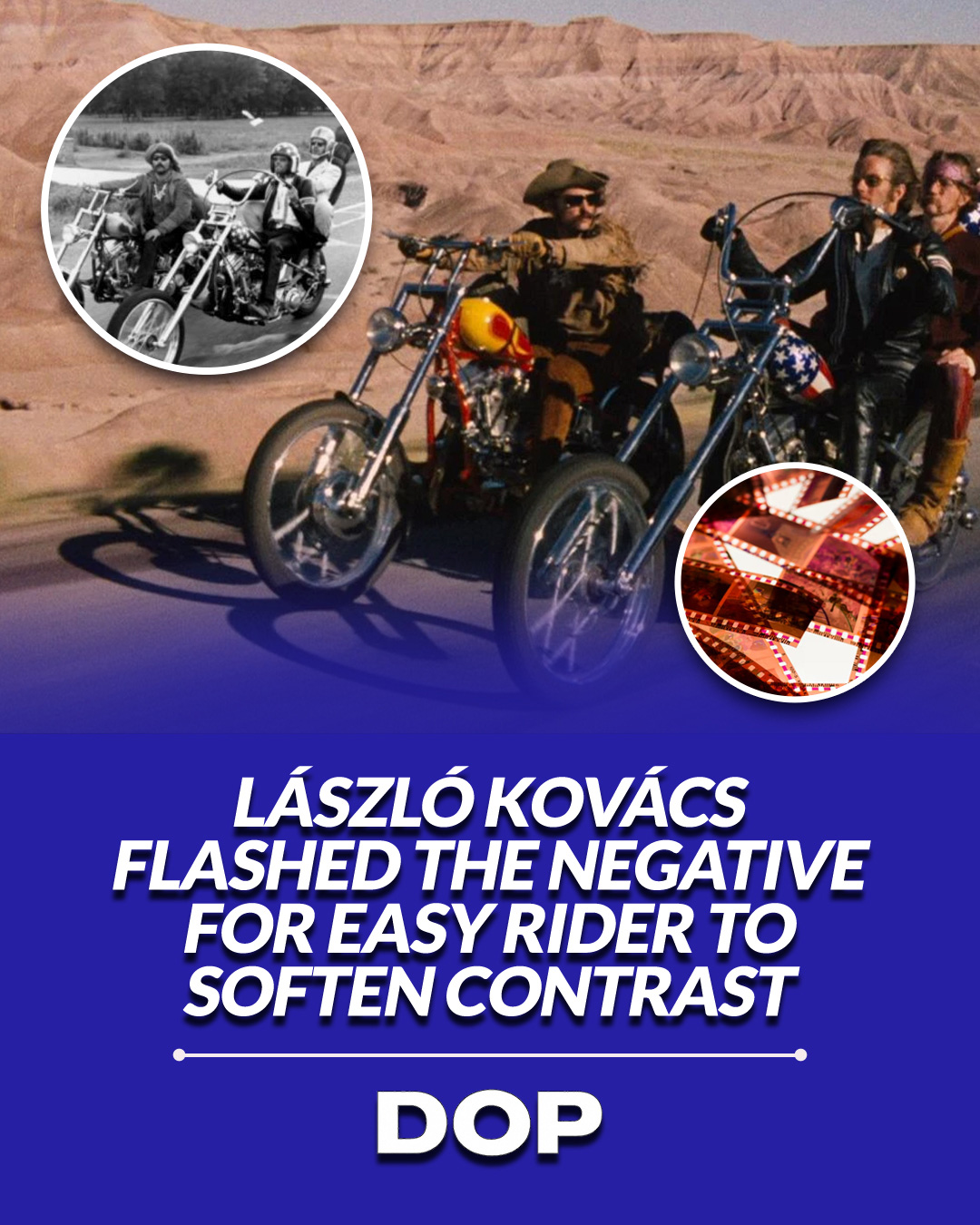
When Easy Rider arrived in theaters in 1969, it did more than just signal a cultural revolution, it completely dismantled the slick, polished studio visual grammar that had dominated Hollywood for decades. Directed by Dennis Hopper and shot by the legendary Hungarian cinematographer László Kovács, ASC, the film embodied the free-wheeling spirit of the New Hollywood movement. However, achieving its iconic, sun-bleached, atmospheric visual identity required far more than simply pointing a camera at motorcycles rolling down Route 66. It demanded a radical, technical intervention at the emulsion level.
Faced with the grueling logistical reality of shooting high-contrast daylight exteriors across expansive southwest landscapes on a shoestring budget, Kovács could not rely on heavy truck-mounted tungsten generators or massive arc light setups to fill deep shadow areas. Bright desert skies threatened to blow out completely, while high-noon sun cast impenetrable shadows across the faces of stars Peter Fonda and Dennis Hopper. To bridge this extreme dynamic range, Kovács turned to an ingenious, pre-exposure technique known as pre-flashing on the freshly introduced Eastman Color Negative 5254 stock.
Mechanizing the Lift: The Physics of Pre-Flashing
Pre-flashing involves exposing unexposed film negative to a precise, uniform, low-level source of light prior to principal photography. In chemical photography, an emulsion requires a minimum threshold of light energy, the inertia point of the film’s characteristic H&D curve, before silver halide grains begin to form a latent image. Under normal conditions, shadow areas beneath this exposure threshold simply fall off into pure, detail-less black.
By administering a controlled, uniform pre-exposure across the raw negative, Kovács effectively primed the emulsion, bumping the shadow areas just above that critical inertia threshold. When the actual scene was exposed onto the pre-flashed stock, the subtle ambient shadow detail compounded with the pre-flash light, lifting the toe of the characteristic curve without significantly altering the midtones or overexposing the highlights. This process reduced overall contrast at the capture stage, allowing faces under wide-brimmed hats and rugged desert topography to sit comfortably within the latitude of the film negative.
Flashing is a masterclass in intent, a reminder that a cinematographer can fundamentally alter how a medium responds before ever rolling tape or film, rather than fighting crushed blacks and clipped highlights in post-production.
Visual Atmosphere and the 5254 Character
Introduced by Kodak in 1968, Eastman 5254 was a 100 ASA tungsten-balanced stock praised for its richer color saturation and improved latitude compared to its predecessor, 5251. When exposed outdoors with a 85B daylight conversion filter, the stock possessed a natural warm density. However, Kovács’ decision to pre-flash 5254 imparted a unique visual artifact: a delicate, milky veil across the lower exposure values that seamlessly complemented the film’s drifting, counterculture tone.
Paired with lightweight Arriflex 35 IIC cameras and simple hand-held rigs, Kovács transformed technical necessity into poetic style. The lifted shadows and muted black points created a dreamlike, sun-soaked atmosphere that felt organic, intimate, and lived-in. Rather than relying on laboratory printing tricks or extreme optical push-processing later in post-production, Kovács baked a consistent, expressive low-contrast baseline directly into his original negative.
Translating the Technique to the Digital Era
Kovács’ mastery on Easy Rider, a philosophy he would refine on classics like Five Easy Pieces and Paper Moon, holds vital lessons for modern digital cinematographers. Today, digital sensors behave with starkly linear sensitivity, often rendering high-contrast direct sunlight with harsh clipped highlights and aggressive shadow falloff if improperly managed. While modern digital cinema cameras boast impressive dynamic range, relying entirely on RAW recording and post-production color grading can deprive an image of immediate texture and character.
Cinematographers seeking Kovács’ textured, low-contrast aesthetic can achieve similar results organically on set. Modern optical accessories like the Arri VariCon or Tiffen UltraCon low-contrast filtration introduce controlled ambient light directly into the lens port, lifting shadow values optically before the sensor digitizes the signal. Alternatively, custom in-camera look-up tables (LUTs) adjusted with lifted offset curves and lower shadow contrast allow DPs to bake in a soft, filmic toe. Ultimately, Kovács’ work proves that proactive exposure control on set yields a far more cohesive, soulful image than reactive adjustments in modern color suites.