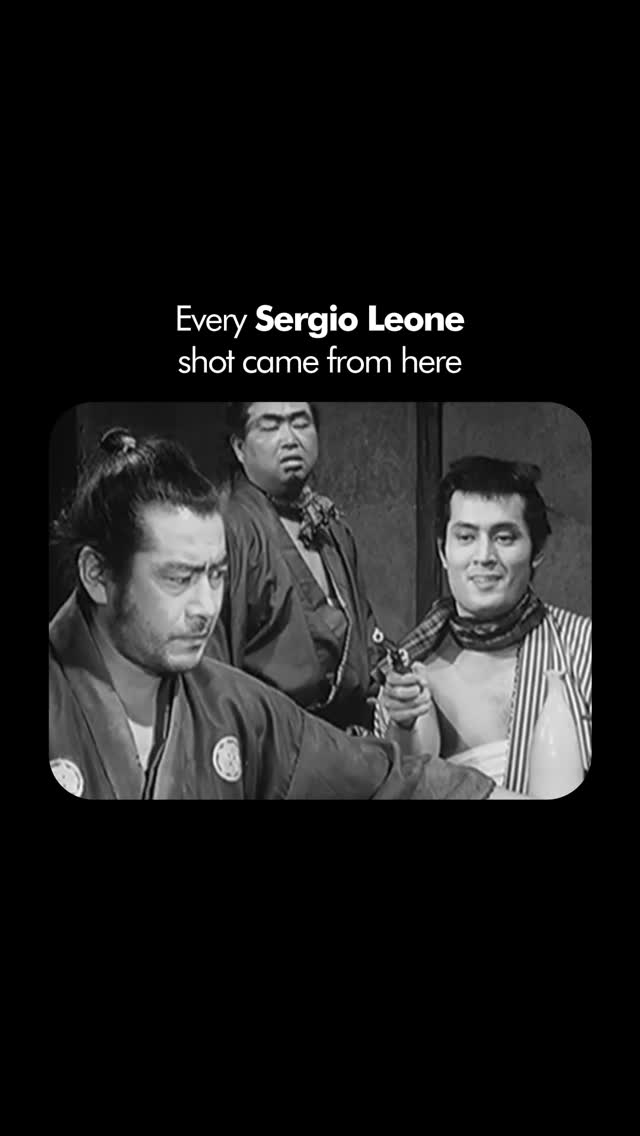
When Sergio Leone released A Fistful of Dollars in 1964, it announced a radical, gritty transformation of the Western genre. Yet behind the dust, the squinting antihero, and the tense geometry of the standoffs was a visual template copied almost frame-for-frame from Akira Kurosawa’s 1961 masterpiece, Yojimbo. The structural similarities were so undeniable that Kurosawa’s production company successfully sued Leone, securing international distribution rights and royalties. To understand why Leone fought so hard to copy Yojimbo, one must look directly at the lens choices, spatial composition, and atmospheric mastery of cinematographer Kazuo Miyagawa.
Miyagawa, already legendary for his fluid camera movement in Rashomon and delicate tone in Ugetsu, approached Yojimbo with a bold new philosophy tailored to the 2.35:1 Tohoscope anamorphic format. Rather than treating the wide aspect ratio as a traditional stage, Miyagawa and Kurosawa utilized the extra horizontal real estate to craft dynamic, multi-layered compositions that reshaped visual storytelling. They established a kinetic grammar that bridged feudal Japan and the American frontier, forever altering action filmmaking.
Atmosphere as an Antagonist and the Power of Negative Space
From the opening frames in the windswept village, Miyagawa constructs an environment that feels actively hostile. He utilized high-powered wind machines to drive dust, dried leaves, and debris across the frame, keeping the air saturated with constant motion. By aggressively backlighting these atmospheric elements with hard key lights, Miyagawa transformed clear air into a tangible, choking texture. Against this swirling backdrop of kinetic noise, the ronin Sanjuro (Toshiro Mifune) stands as the singular anchor of stillness, a calm center within a world dissolving into chaos.
Miyagawa’s framing relied heavily on asymmetric weight and deliberate negative space. By placing solitary figures off-center at the extreme edges of the anamorphic frame, he allowed vast, empty expanses of dusty street or dilapidated woodwork to dominate the shot. This visual technique isolates the characters, creating palpable psychological tension long before a blade is drawn. Empty frame space wasn't just decorative; it was an expression of total lawlessness and dread.
Miyagawa did not merely light a set; he rendered the air itself as an active antagonist, turning dust, wind, and negative space into visceral narrative forces.
Telephoto Compression and Wide-Angle Distortion
To capture the tense geometry of the village, Miyagawa and Kurosawa pioneered the aggressive use of long telephoto lenses in widescreen action cinema. Lenses in the 250mm to 500mm range were deployed to compress spatial depth, flattening the distance between opposing factions standing at opposite ends of the street. This focal compression pulled foreground figures and distant rivals into the same focal plane, heightening confrontation and making the environment feel claustrophobic despite its open setting.
Conversely, when moving into close-ups, Miyagawa frequently opted for wider focal lengths in close proximity to the actors' faces. This technique produced subtle optical distortion, stretching facial features and magnifying expressions, that rendered the town's grotesque criminals deeply intimidating. Decades later, Leone would push this exact optical logic to its absolute extreme with his signature ultra-wide extreme close-ups of eyes and holsters.
Multi-Camera Rigs and High-Contrast Tonal Range
Executing the film’s quick, lethal violence required an innovative approach to coverage. Miyagawa routinely deployed a three-camera setup running simultaneously at different focal lengths and angles. This approach allowed Kurosawa to cut between wide master shots and tight telephoto tracking frames during a single take without disrupting the continuous rhythm of Mifune’s swift swordplay. The technical precision required to maintain consistent exposure and focus across three rolling cameras on a dusty, naturalistic set was unprecedented for the era.
Lighting-wise, Miyagawa embraced a high-contrast black-and-white tonal palette using monochrome film stocks of the era. Indoors, deep shadow zones cut across dark wood interiors, illuminated by single, hard directional key sources that sculpted faces in stark chiaroscuro. When characters step outside into the unyielding daylight, Miyagawa allowed specular highlights on dust and silk to burn bright, creating a sharp, abrasive visual environment.
The visual signature of Yojimbo, born from Miyagawa’s optical mastery, precise anamorphic framing, and evocative atmospheric control, did not merely serve Kurosawa’s narrative. It codified a modern visual language of violence, standoff, and antiheroic isolation. Every iconic shot in the Spaghetti Western canon, and the modern action cinema that followed, owes its fundamental blueprint to the wind-swept, wide-angle frames of Kazuo Miyagawa.