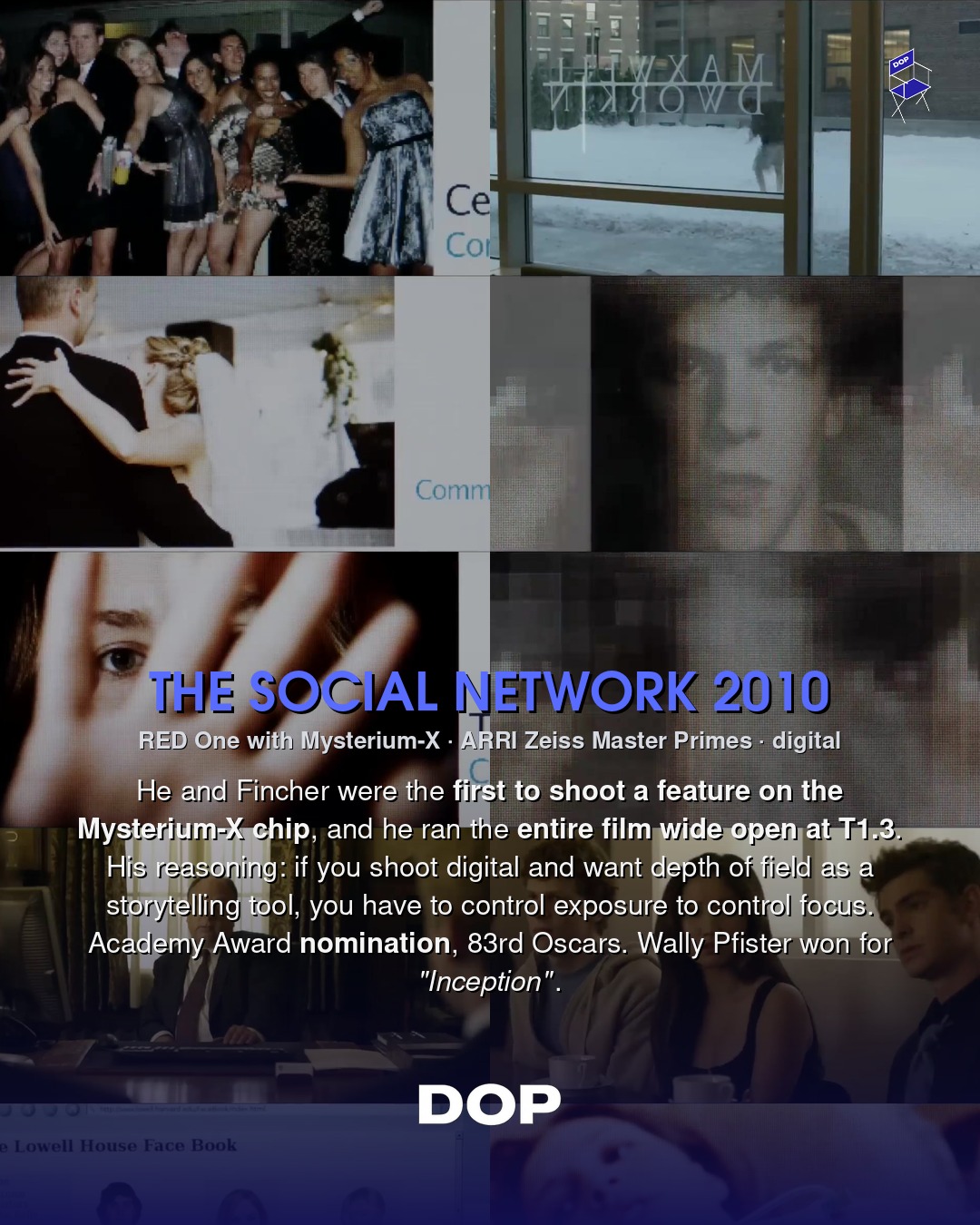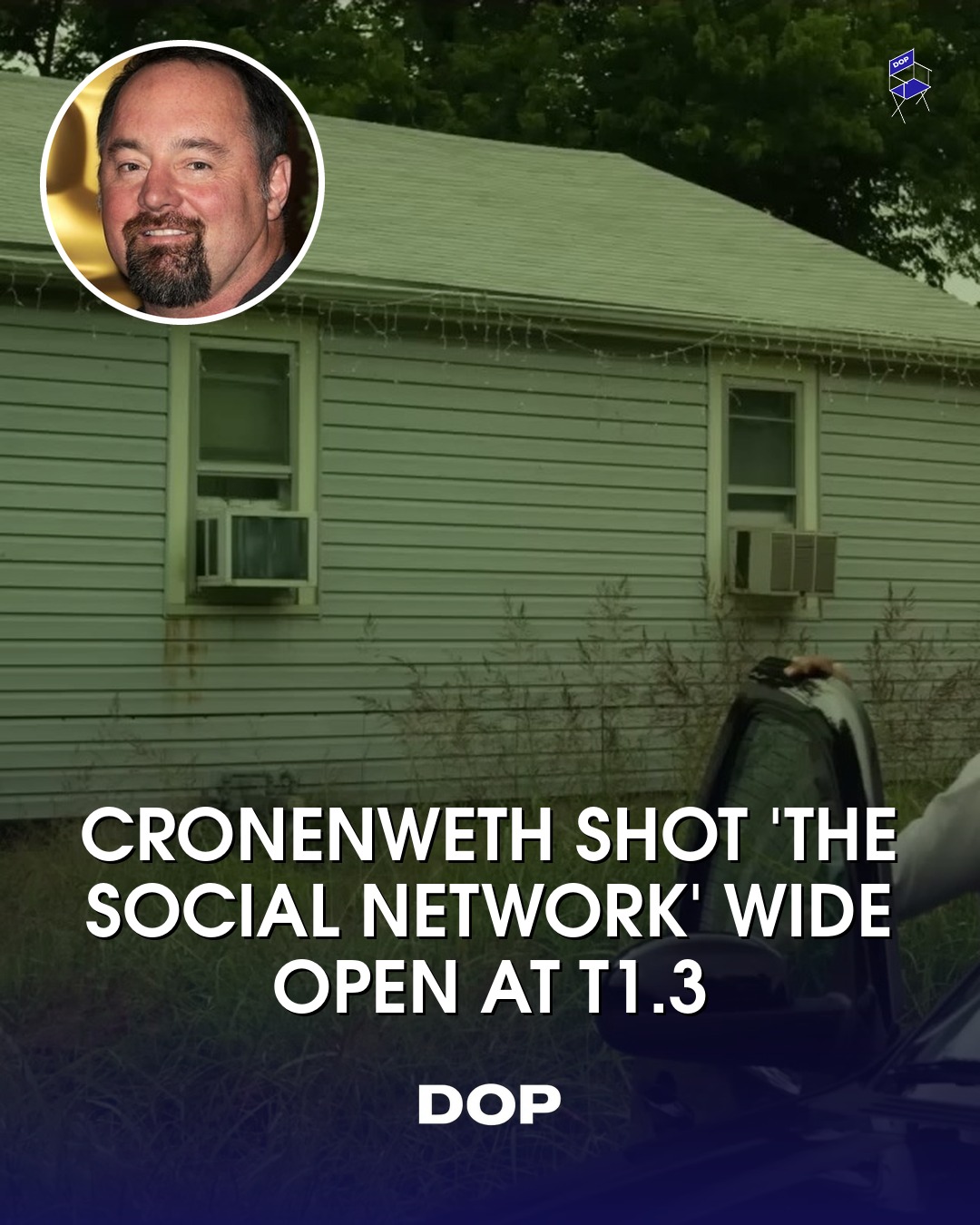
When David Fincher and Jeff Cronenweth, ASC committed to shooting The Social Network on the newly minted RED One Mysterium-X sensor in late 2009, the industry held its breath. Digital cinema was still fighting for credibility in the hallowed halls of major studio features, frequently dismissed by purists as sterile, harsh, and unfilmic. Yet Cronenweth didn’t merely adopt the digital format, he weaponized its optical geometry by shooting nearly the entire feature wide open at a staggering T1.3 on Arri Master Primes.
The choice was neither an accident nor an exercise in low-light bravado. Cronenweth recognized early on that digital sensors possessed an inherent cleanliness that required deliberate optical curation. By pulling the stop all the way open to T1.3, depth of field shrank to mere millimeters. In Fincher’s meticulous, rapid-fire dialogue scenes, this razor-thin focal plane isolated Mark Zuckerberg within his own social universe, throwing Harvard dorm rooms and Silicon Valley boardrooms into an impressionistic, amber-toned bokeh.
The T1.3 Philosophy: Focus as a Narrative Scalpel
Shooting at T1.3 under controlled studio conditions presents a monstrous logistical challenge for camera assistants. With depth of field measured in fractions of an inch, the slightest lean from an actor can destroy critical focus. Cronenweth and his camera team relied on rigorous rehearsal, precise blocking, and the tack-sharp resolving power of the Master Primes, which were engineered to retain contrast and minimize chromatic aberration even wide open.
"If you are shooting digital and you want depth of field working as a storytelling tool, you have to control exposure to control focus."
Rather than stopping down to a forgiving T2.8 or T4 and cranking up lighting units, Cronenweth opted for delicate practical sources, bounce cards, and precise overhead softboxes, sculpting an intimate, tungsten-heavy color palette. The RED One M-X provided the dynamic range and base sensitivity (rated comfortably around ISO 800) to live in those deep, textured shadows without dissolving into digital noise.
A Pedigree of Pure Light: From Blade Runner to Fight Club
Cronenweth’s commanding technical literacy is hereditary. As the son of Jordan Cronenweth, ASC, the legendary eye behind Blade Runner, Jeff spent his formative years loading magazines, pulling focus, and operating on masterclasses of atmospheric lighting. That lineage imbued him with an uncompromising respect for source-motivated hard light, directional backlight, and environmental haze.
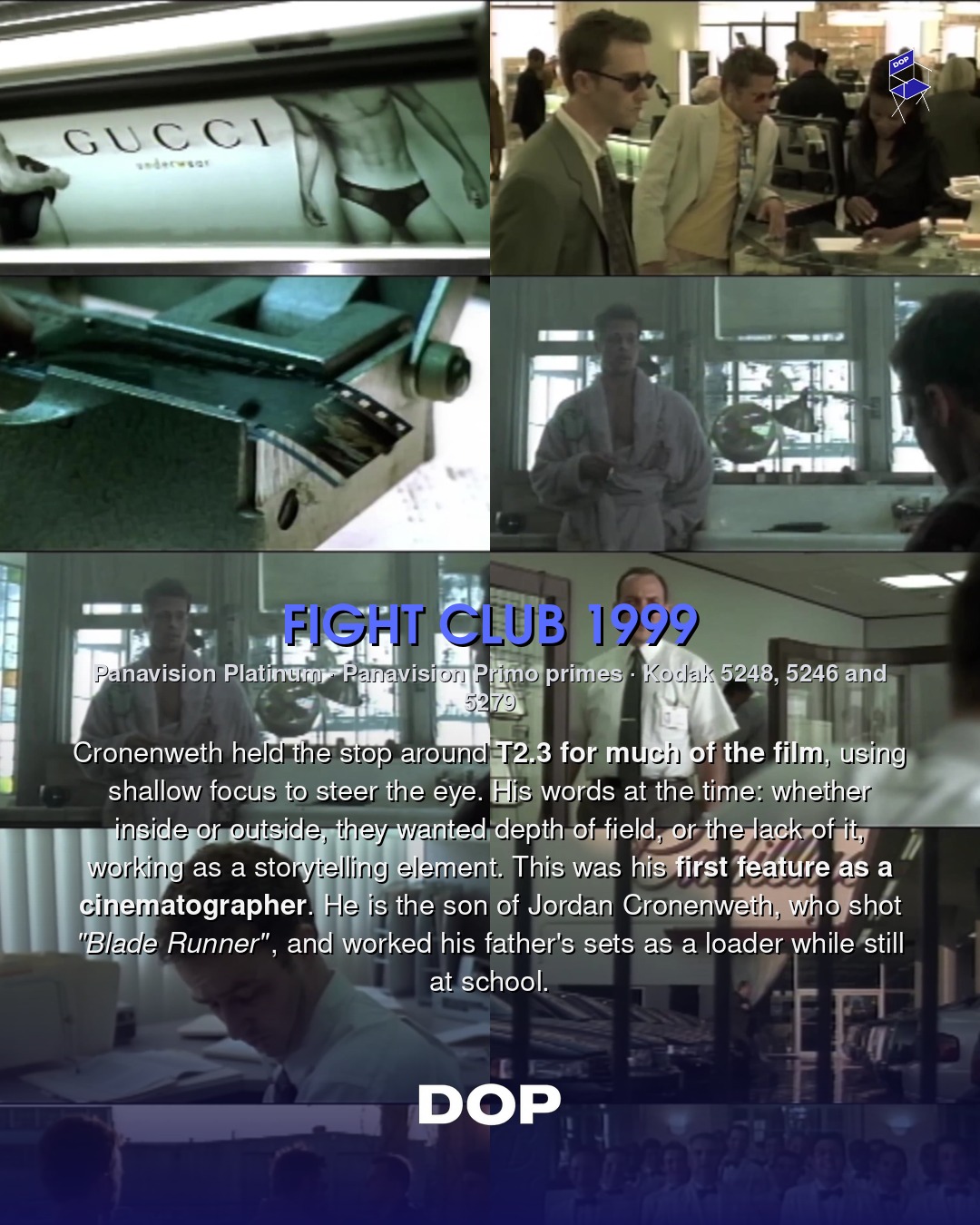
When he graduated to director of photography on Fincher’s 1999 masterpiece Fight Club, Cronenweth demonstrated a masterclass in photomechanical control. Shot on Kodak 35mm stocks with a disciplined stop held around T2.3, the film established the signature Fincher-Cronenweth aesthetic: underexposed shadows, sickly fluorescent greens, and razor-sharp contrast that mirrored the psychological collapse of its protagonist.
Evolving the Sensor: Gone Girl and the 6K Horizon
As sensor technology evolved, so too did Cronenweth’s optical strategy. On 2014’s Gone Girl, the duo pushed the frontier again, delivering the first feature shot entirely in 6K on the RED Epic Dragon. But rather than pairing the ultra-high-resolution 6K sensor with clinically sharp glass, Cronenweth pivoted to Leica Summilux-C lenses. The Leicas provided a creamier skin-tone rendition and natural roll-off, taking the edge off the unforgiving digital capture without sacrificing structural micro-contrast.
Cinematography is rarely just about clean exposure; it is about intent. Through every generational leap from celluloid to 6K RAW capture, Jeff Cronenweth has proven that digital sensors are not sterile canvases, they are precision instruments waiting for a cinematographer willing to push them to their physical thresholds.
This article contains affiliate links. We may earn a small commission at no extra cost to you. Learn more.