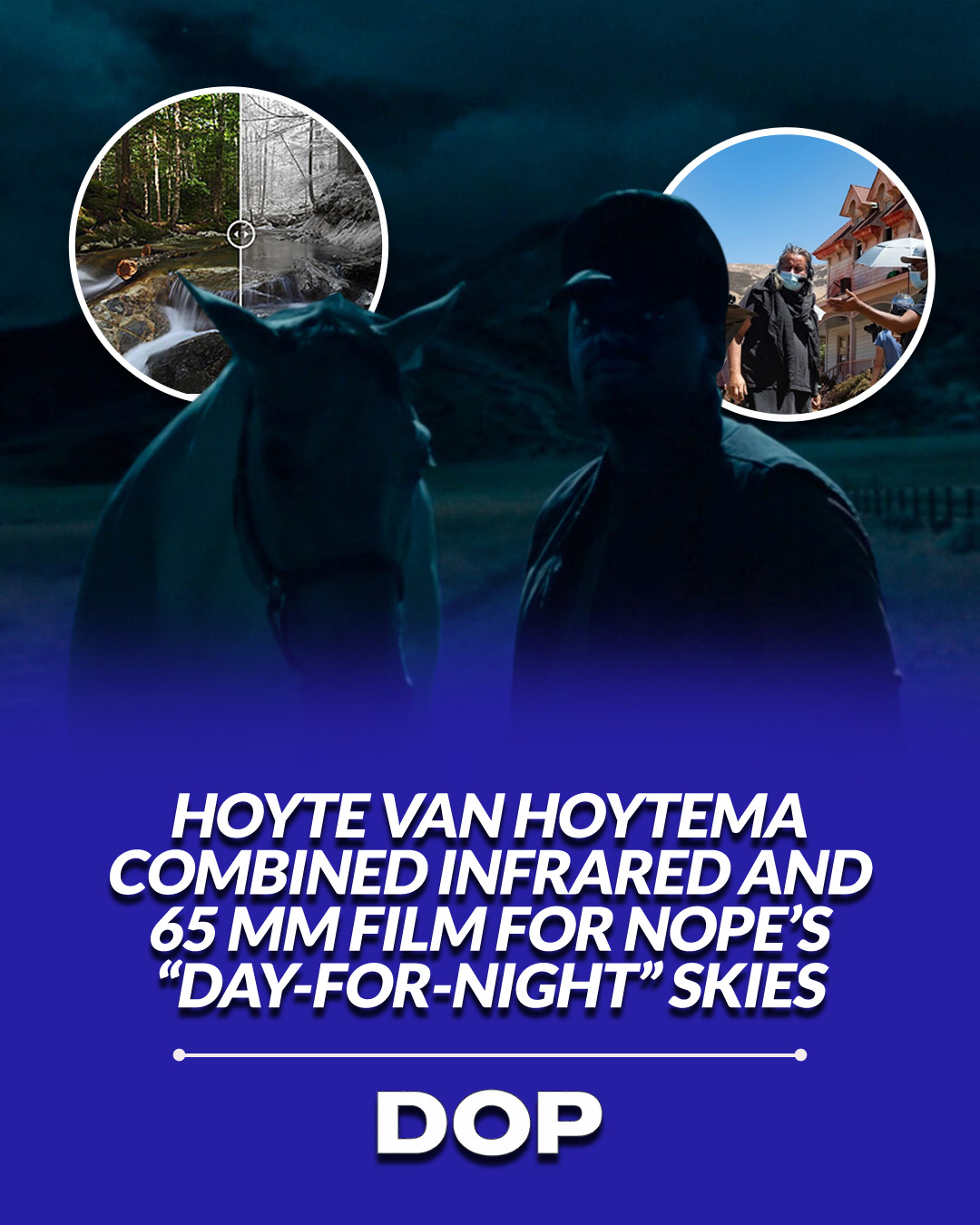
Capturing the pitch-black expanse of the desert night has long been one of cinematography’s most uncompromising hurdles. Standard night exteriors shot on location often require towering moon-box rigs, massive hydra-cranes, and millions of watts of light just to generate exposure across distant hills. When director Jordan Peele and cinematographer Hoyte van Hoytema, ASC, FSK, NSC, set out to shoot Nope in the vast valleys of Agua Dulce, California, traditional lighting setups were immediately rendered impractical. The story demanded wide, uncompromised vistas of a terrifying sky where a predatory threat lurked in the dark, yet classic day-for-night techniques were notoriously incapable of delivering realistic depth.
Historically, day-for-night was achieved by underexposing color negative stock and printing blue, or applying heavy digital LUTs in post-production. While this method successfully drops overall ambient luminance, it yields muddy midtones, blown-out cloud details, and unnatural sky tones that betray the illusion. Van Hoytema, renowned for pushing large-format film to its absolute limits on films like Interstellar, Dunkirk, and Oppenheimer, refused to accept these visual compromises. Instead, he spearheaded the invention of an entirely unprecedented hardware rig that reimagined day-for-night as a multi-spectral capture strategy.
The Physics of the Dual-Camera Rig
To pull off the illusion, van Hoytema and his camera team engineered a custom 3D stereo beam-splitter rig in collaboration with Panavision. The rig mounted two perfectly synchronized camera bodies targeting the exact same optical axis through a dichroic mirror. One side of the rig housed a traditional 65mm film camera loaded with Kodak color negative, while the other held a digital ARRI Alexa 65 that had been customized and modified specifically to capture infrared (IR) light. By shooting in broad daylight under full sun, the two cameras captured simultaneous, perfectly aligned plates that possessed radically different spectral information.
Infrared light sits just beyond the visible spectrum, behaving in ways that directly solve the core issues of day-for-night photography. Because atmospheric Rayleigh scattering affects visible light far more than infrared, blue skies render almost completely black through an IR sensor. Furthermore, foliage and clouds reflect high amounts of infrared light, causing them to glow with bright, crisp contrast. Rather than trying to force a single color image to look like night, van Hoytema obtained a dedicated luminance channel designed purely by atmospheric physics.
Rather than trying to force a single color image to look like night, van Hoytema obtained a dedicated luminance channel designed purely by atmospheric physics.
Merging Film Grain with Digital Infrared
In post-production, the real visual magic occurred by marrying these two distinct captures. The monochrome infrared digital image served as an ultra-detailed contrast and luminance mask, dictating the dark values of the sky while preserving incredible detail in the clouds, distant mountain ridges, and dusty horizons. Meanwhile, the 65mm color film plate provided the rich color information, characterful highlight roll-off, skin tone fidelity, and organic grain structure that cinematographers demand from analog capture.
By compositing the infrared luminance map over the 65mm film plate, the post team at Company 3 could balance skin tones, foreground shadow values, and background skies as entirely separate layers. The resulting images in Nope possess a uncanny, hyper-real atmosphere. Human faces remain natural and readable without appearing washed out or artificially tinted blue, while the night sky appears vast, deep, and menacingly transparent, revealing cloud formations that would normally disappear into digital blackness.
A Blueprint for Multi-Pass Acquisition
The technical triumph of Nope provides a crucial lesson for modern directors of photography. It demonstrates that advanced visual effects and physical camera engineering do not need to exist in opposition to traditional analog filmmaking. Instead, digital sensors can be utilized not as a replacement for film, but as precise analytical tools to extract optical data that film stock cannot capture on its own.
For cinematographers navigating complex location challenges, van Hoytema’s rig stands as a reminder that day-for-night does not have to be a lazy post-production preset or a single-sensor sacrifice. By treating exposure, tone, and spectrum as distinct operational layers at the point of capture, filmmakers can push past the limitations of natural light to construct wholly original visual landscapes.
This article contains affiliate links. We may earn a small commission at no extra cost to you. Learn more.