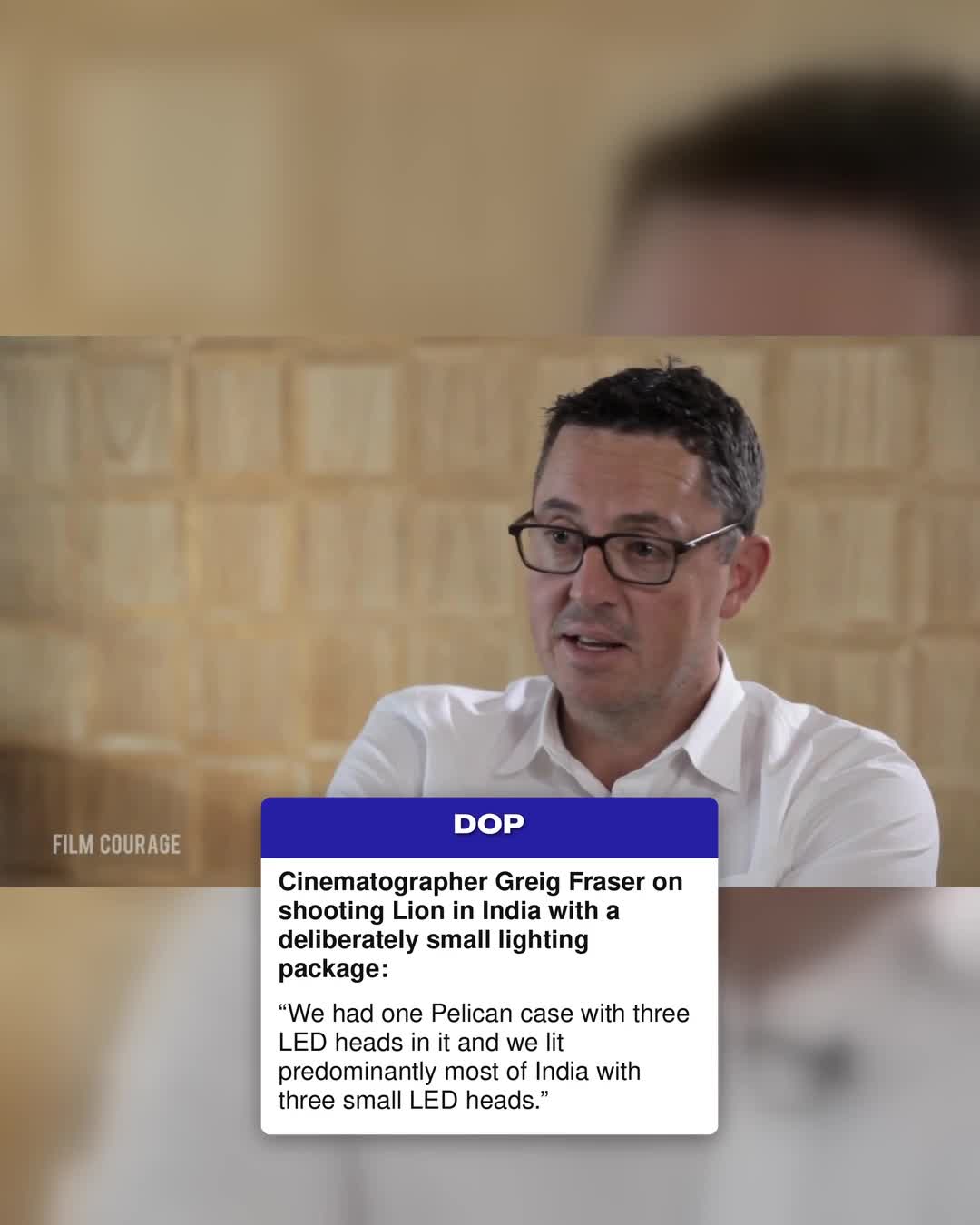
When Greig Fraser, ASC, ACS stepped onto the bustling railway stations and sun-baked alleys of India to shoot Garth Davis’s 2016 biographical drama Lion, the conventional industry wisdom would have demanded a convoy of grip and electric trucks. Productions tackling sweeping international narratives routinely deploy heavy generators, arrays of 18K HMIs, and massive overhead textiles to tame unpredictable daylight. Fraser deliberately chose the exact opposite path: he traveled without a lighting truck, packing an electrical footprint so lean it fit into a single rolling case.
Carrying hundreds of fixtures into the dense urban fabric of Kolkata or rural Madhya Pradesh would have crippled the production’s greatest asset: mobility. Fraser recognized that bulky gear creates an acoustic and spatial footprint that instantly shatters documentary realism, especially when working with five-year-old non-professional actors like Sunny Pawar. Staging elaborate stands and running cable runs across delicate locations would have turned spontaneous human moments into rigid, over-engineered set-pieces.
The Architecture of Available Light
Instead of imposing an artificial visual grammar onto his environments, Fraser adapted an architectural approach to scouting. The mandate was simple: find locations that possessed an inherent, reliable base of natural ambience. If an interior space lacked character or adequate exposure levels, the solution was not to haul in a condor crane with an Arrimax; it was to find an alternate location where the bounce off adjacent stone walls or deep-set verandas already did the heavy lifting.
When interior day scenes required separation or a directional push, Fraser kept interventions minimal and motivated. A small handful of punchy HMI heads, often positioned outside through existing window frames, provided just enough edge and depth to simulate hot exterior daylight penetrating shadowy interiors. Daytime exteriors were captured almost exclusively without artificial fixtures, relying instead on negative fill, unbleached muslin bounces, and the keen placement of actors relative to the sun’s natural arc.
Lighting for speed isn't about cutting corners; it is about protecting the performance by removing the technological barrier between the lens and the subject.
High Sensitivity and Modern Glass
Fraser’s minimalist lighting methodology was heavily supported by his digital capture pipeline. Pairing the ARRI Alexa XT with carefully selected spherical glass allowed him to lean into the sensor’s native ISO 800 and its forgiving, organic rolloff in the highlights. The sensor’s capacity to dig into deep shadow details without generating chromatic noise meant that modest ambient sources provided more than enough exposure latitude for digital intermediate grading.
For keying faces and introducing subtle modeling inside cramped rural dwellings, Fraser’s entire kit relied on just three small LED heads. Long before full-color wireless tubes and high-density mat lights flooded the market, Fraser deployed compact, battery-powered daylight panels for gentle fill, eye lights, and soft wraps. These lightweight units could be handheld by an assistant or rigged to a wall with a single piece of grip tape, allowing the camera to pan nearly 360 degrees without encountering a c-stand or a stray stinger.
A Foundation for Massive Scale
While Fraser is now celebrated for pioneering massive LED volumes and specialized projection techniques on blockbusters like Rogue One: A Star Wars Story, Dune, and The Batman, the foundational ethos remains identical to the stripped-down rigors of Lion. Fraser’s aesthetic is built upon believable source motivation, dark ambience, and subtraction over addition. Whether controlling millions of pixels on a soundstage or working with three small LED panels in an Indian alleyway, the philosophy prioritizes the emotional truth of light.
Ultimately, Fraser’s work on Lion earned him his first Academy Award nomination and an ASC Award win, cementing the production as a case study in modern naturalism. It serves as an enduring reminder to cinematographers at any level: visual mastery is measured not by the tonnage of your lighting package, but by the discernment to know how little you actually need to tell the story.