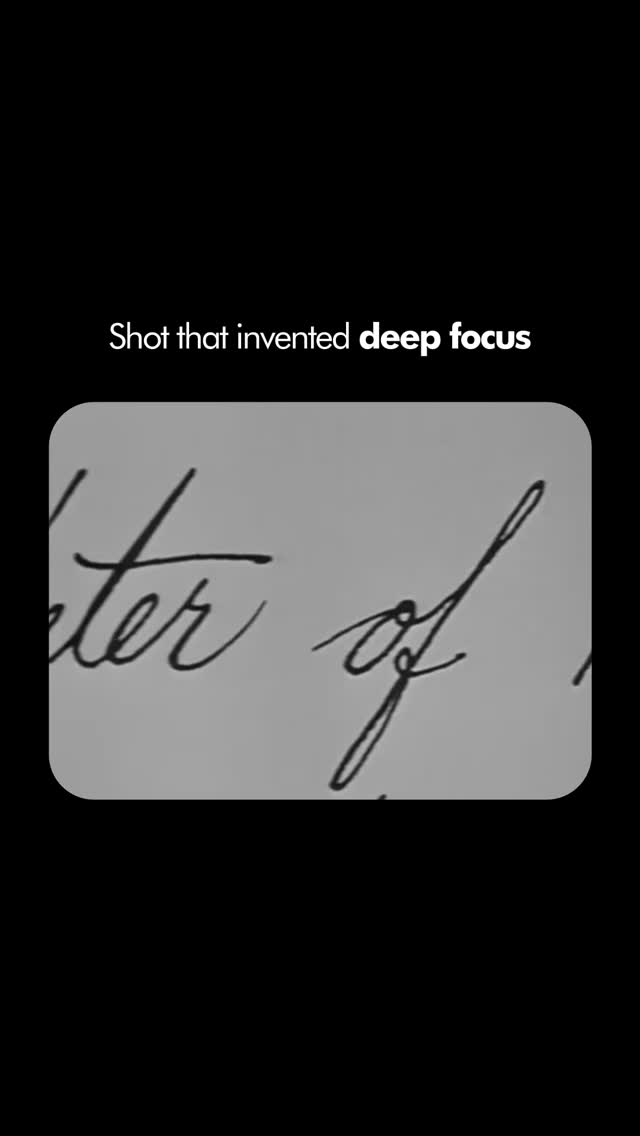
In the studio system of late 1930s Hollywood, cinematography operated under a strict, institutionalized visual hierarchy. The standard operating procedure favored soft-focus backgrounds, neatly separating glossy star close-ups from their environments. Depth of field was an afterthought, constrained by medium-speed film stocks and traditional optical formulas. Enter Gregg Toland, ASC, a master craftsman at the peak of his powers, and Orson Welles, a twenty-five-year-old theatrical prodigy unburdened by cinematic dogma. Together on Citizen Kane (1941), they did not merely make a film; they dismantled the medium’s physical grammar and rebuilt it from the ground up.
Breaking the Focal Plane: The Mechanics of Deep Focus
Before Toland’s breakthrough, directors and DPs were forced to make a fundamental visual compromise: keep the foreground subject sharp while letting the background blur into abstraction, or vice versa. Toland rejected this binary. To achieve deep focus, maintaining razor-sharp clarity across extreme near and far planes simultaneously, he pushed his technical equipment to its absolute physical limits. Utilizing the newly developed Mitchell BNC camera, Toland paired high-speed Kodak Super-XX black-and-white film with newly antireflective-coated optics, predominantly wide-angle lenses treated with the Vard Opticoat process to eliminate internal optical flare.
Stopping down his lenses to f/8, f/11, or even f/16 required immense, unprecedented levels of illumination. Toland imported powerful Mole-Richardson carbon arc lamps, traditionally reserved for the light-hungry Technicolor process, to drown monochrome sets in brilliant key light. The visual results were revolutionary. Consider the famous scene at the Colorado boarding house: in the foreground, Agnes Moorehead negotiates away young Charles Foster Kane's future; in the midground, his father stands helpless; through the distant window in the far background, young Charles plays joyfully in the snow. Every focal plane is pin-sharp, forcing the spectator to actively read the frame rather than passively accepting a single focal point.
"Toland’s deep focus didn't just alter optics, it democratized the frame, forcing the audience to become active participants in reading the visual landscape."
Where optical physics reached their natural boundary, Toland and special effects pioneer Linwood Dunn turned to trickery. For shots demanding impossible focal depth, such as the foreground glass of poison next to Susan Alexander’s bed, they employed in-camera split-screen double exposures and optical printing. By exposing the foreground separately from the background on a single strip of negative, Toland created a hyper-real visual density that perfectly mirrored Kane’s larger-than-life ego and fragmented reality.
Lowering the Ceiling: Architecture and Low-Angle Realism
Standard Hollywood soundstage practice called for open rafters, allowing gaffers to suspend heavy light rigs high above the cast. Sets rarely featured actual ceilings, as they restricted light placement and camera mobility. Welles and Toland threw out this convention entirely. To ground the world of Xanadu and the Inquirer newsroom in oppressive realism, Welles demanded real muslin ceilings on set. This structural shift completely redefined Toland's approach to lighting design.
Deprived of overhead rigging, Toland was forced to light sets entirely from below, through floor slots, and from extreme side angles. He placed footlights along baseboards and bounced carbon arcs off the stretched muslin overhead to create soft, indirect room ambiance. Furthermore, to emphasize Kane’s mythic rise and agonizing moral decay, Toland dug trenches directly into the studio concrete floor, dropping the Mitchell BNC below floor level to shoot up at dramatic, extreme low angles.
This downward-to-upward perspective transformed ceilings from decorative set pieces into heavy psychological weights. As Kane grows richer and more isolated, the ceilings appear to press down upon him, turning cavernous mansions into gilded cages. The camera no longer observed characters from a comfortable eye-level neutral plane; it looked up at gods who were slowly suffocating inside their own hubris.
The Enduring Legacy of Toland's Canvas
When Citizen Kane premiered, Toland took the unprecedented step of sharing a title card with director Orson Welles, a testament to the deep collaborative synergy between director and cinematographer. Toland’s pioneering work directly inspired generations of DPs, from Gordon Willis’s shadow-drenched work on The Godfather to Conrad Hall’s painterly naturalism in Road to Perdition.
Citizen Kane remains the ultimate testament to what happens when technical genius aligns with uncompromising artistic vision. Gregg Toland proved that the camera was not merely a passive recording instrument, but a dynamic psychological engine. By shattering the focal plane and embracing structural realism, Toland did not just shoot a masterpiece, he reinvented the visual possibilities of cinema forever.