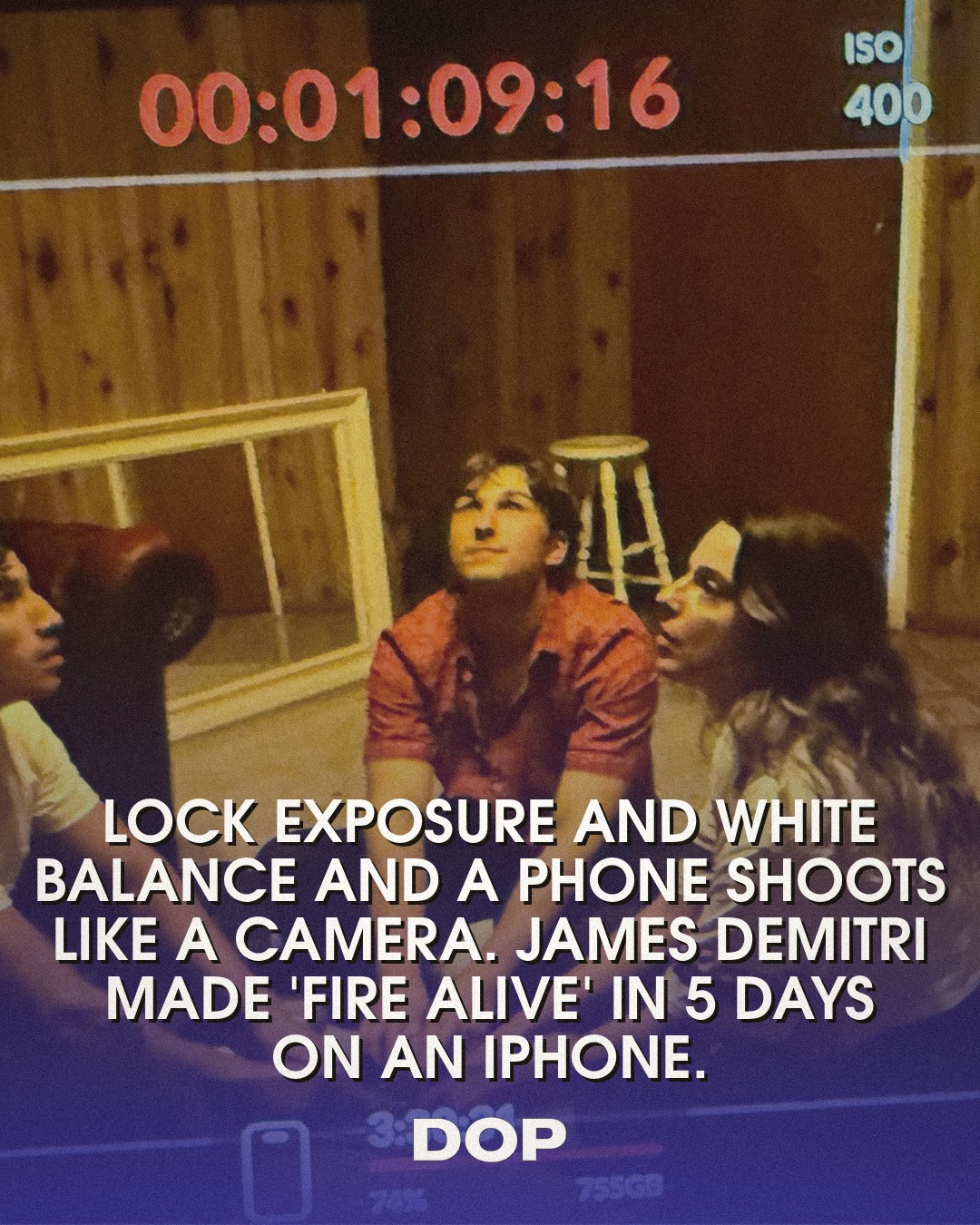
Mobile filmmaking has long evolved past the novelty phase of Sean Baker’s Tangerine or Steven Soderbergh’s Unsane. Today, with the convergence of 10-bit log profiles, ProRes recording pipelines, and dedicated software control, smartphones are no longer merely accessible alternatives, they are distinct visual tools with their own tactile operational advantages. Sydney-based filmmaker and veteran fashion photographer James Demitri demonstrated this potential with his indie feature Fire Alive, captured entirely over five grueling days inside a subterranean, 1970s wood-panelled basement.
Practical Lighting in a Claustrophobic Space
Shooting inside a dimly lit, texture-heavy basement presents notorious photometric challenges, particularly for small-format sensors that demand precise exposure calibration to preserve clean shadow detail. Rather than fighting the physical confinement of the location with bulky cinema fixtures, Demitri leaned heavily into the space’s organic environmental sources, deploying a naturalistic array of tungsten practicals, localized key sources, and strategic shadow falloff.
The deep amber wood grain and vintage architectural materials provided an inherent warmth, but keeping the digital noise floor under control required meticulous contrast balancing. Demitri relied on the wide dynamic range afforded by Apple Log to retain rich highlight rolloff on bare practical bulbs while pushing midtones just high enough above sensor noise thresholds to yield a filmic, textured shadow response in the final color grade.
“Locked exposure and manual white balance beat computational automation every single time when you are working in fluctuating, ultra-low-light environments.”
The Mechanics of Manual Mobile Cinematography
The primary barrier to cinematic storytelling on mobile hardware has historically been the smartphone’s aggressive computational image pipeline, specifically automatic tone mapping, dynamic shutter adjustments, and erratic auto-white balance shifts. To bypass these limitations, Demitri deployed the free Blackmagic Camera app, transforming the iPhone 16 Pro Max into an uncompromising digital cine rig with fixed exposure indices and manual operational parameters.
By locking the shutter speed to a strict 180-degree shutter angle (1/48th of a second at 24fps) and manually pinning the color temperature to complement the location's warm tungsten sources, Demitri eliminated the micro-adjustments that typically betray mobile footage. Recording high-bitrate ProRes internally granted post-production colorists the latitude needed to manipulate curves, balance skin tones, and build a brooding, print-like visual aesthetic without breaking the codec.
Fashion Sensibility Meets Low-Budget Horror
With more than twenty years spent shooting celebrity portraiture and high-fashion editorial spreads, Demitri brought an exacting photographic discipline to the tight indie set. His editorial background informed an acute sensitivity to negative space, edge light, and facial modeling, allowing him to carve dramatic, moody lighting ratios across actors’ faces using minimal fill.
The ultra-compact footprint of the iPhone rig allowed the camera to exist in physical spaces where traditional cinema bodies, such as an Alexa Mini LF or RED V-Raptor outfitted with heavy prime glass, simply could not maneuver without dismantling set walls. The camera operated inches away from actors’ faces, deep inside corner angles, and flush against low ceilings, amplifying the narrative’s claustrophobia.
Fire Alive stands as a compelling case study in intentional cinematography. It proves once again that format choice matters far less than a director of photography’s command over lighting geometry, exposure discipline, and visual economy.
This article contains affiliate links. We may earn a small commission at no extra cost to you. Learn more.