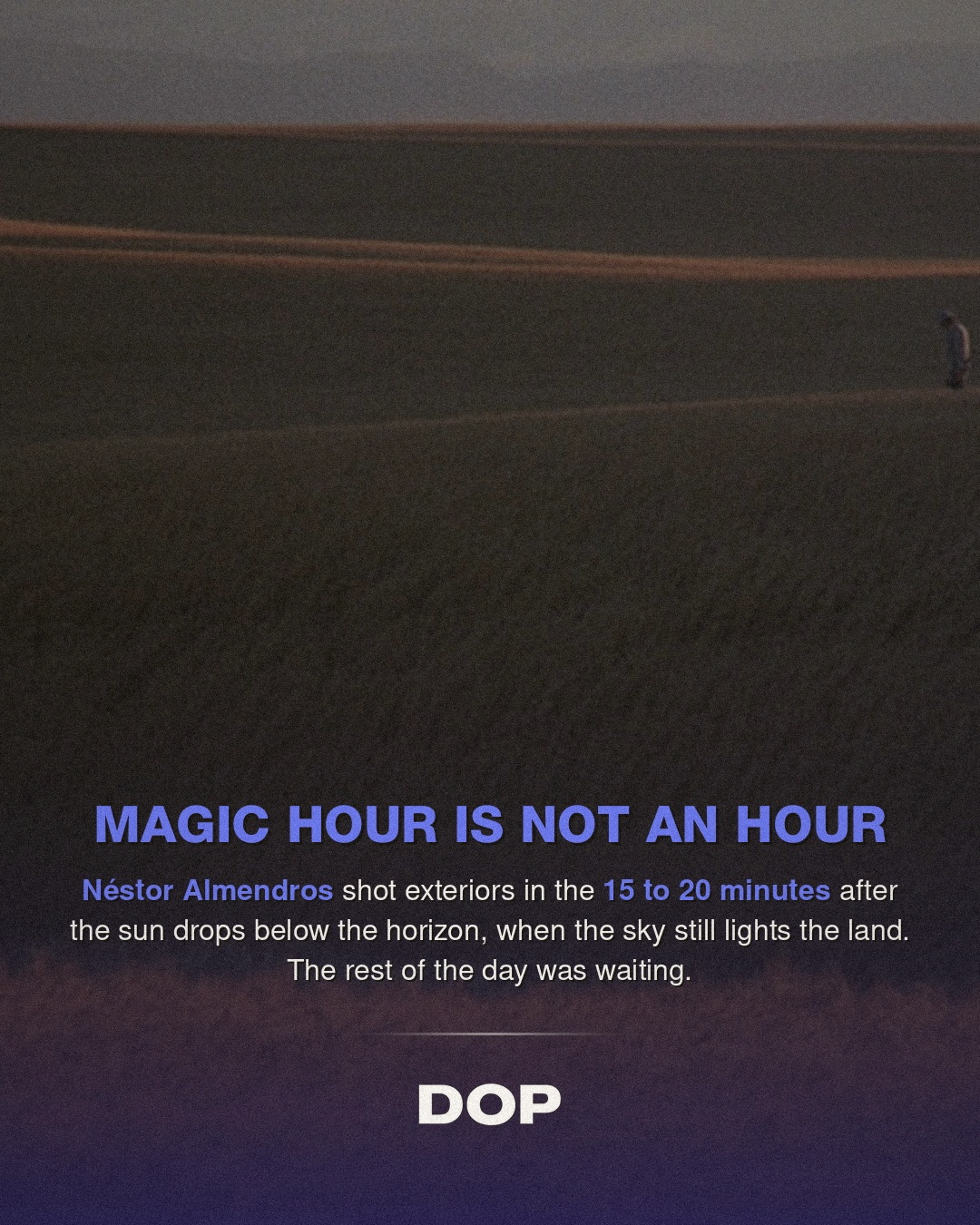
When Terrence Malick’s Days of Heaven arrived in theaters in 1978, it fundamentally disrupted Hollywood’s visual language. At a time when studio productions relied on massive tungsten and carbon-arc packages to overpower natural sunlight and achieve pristine, deep-focus exposures, Spanish cinematographer Néstor Almendros proposed an aesthetic strategy that bordered on career suicide: shoot the film’s vast Texas Panhandle exteriors almost exclusively during the brief twenty-minute window after the sun dips below the horizon.
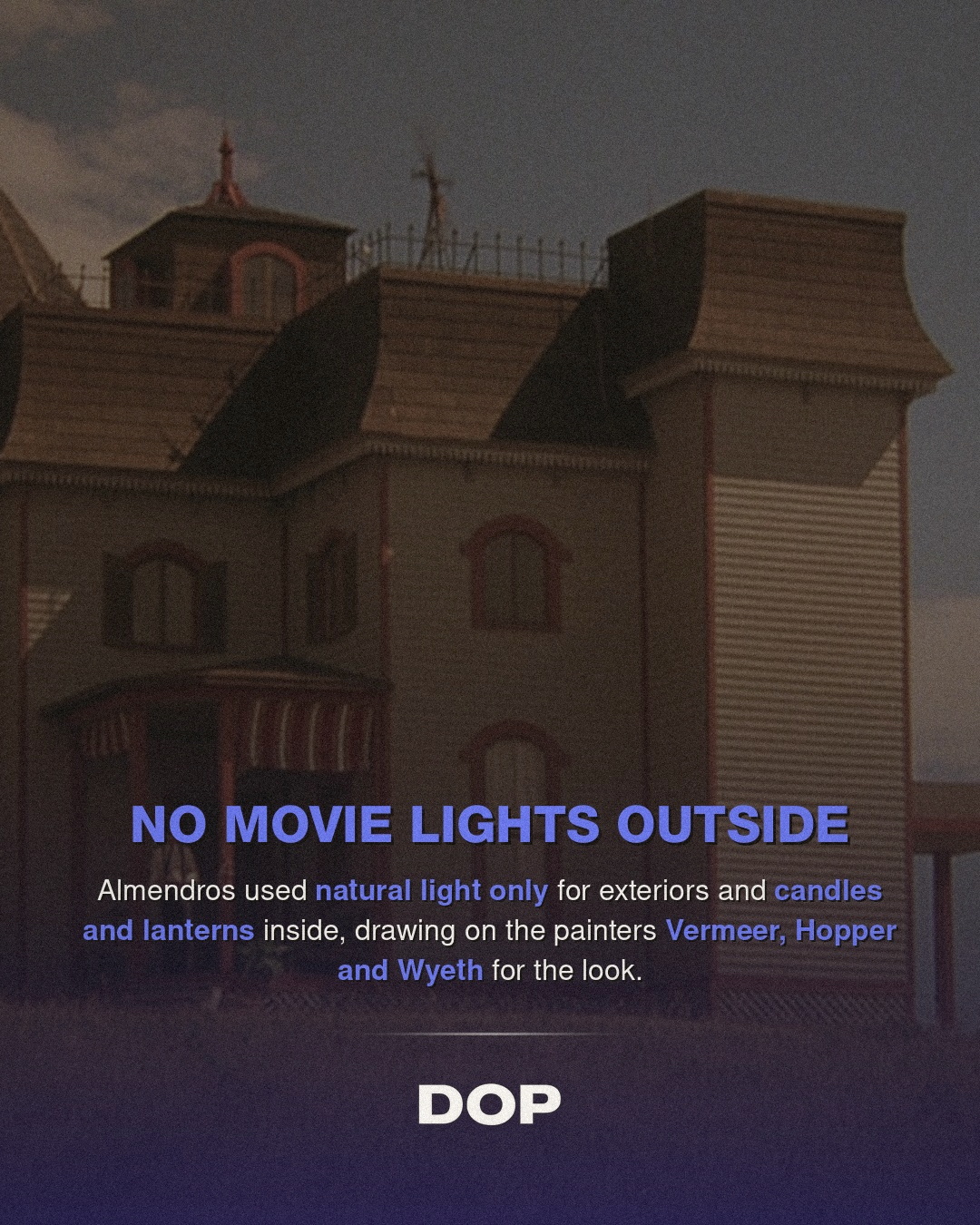
This twilight period, frequently romanticized as 'magic hour' but more accurately described as the blue hour, provided a diffuse, omnidirectional skylight that eliminated harsh shadows and bathed the Alberta wheat fields in a soft, ethereal glow. Almendros, whose sensibilities had been forged in the crucible of the French New Wave alongside Éric Rohmer and François Truffaut, viewed artificial light as a corrupting force when applied to period realism. For Days of Heaven, his visual touchstones were not classical cinema, but the evocative, austere compositions of painters like Edward Hopper, Andrew Wyeth, and Johannes Vermeer.
The Radical Discipline of the 20-Minute Window
Executing this philosophy required an agonizing production schedule. The crew spent hours setting up dolly tracks, framing compositions, and rehearsing movements under the harsh midday sun without exposing a single foot of film. Once the sun slipped beneath the horizon, a frantic, highly choreographed twenty-minute sprint commenced. Almendros rolled multiple cameras simultaneously to capture the fading ambient luminance before the sensor equivalent of the day, photochemical film stock, lost all response to the darkness.
"Almendros stripped away the entire apparatus of classical Hollywood lighting, proving that negative space in exposure could yield more emotional truth than a fully illuminated frame."
The technical hurdles were formidable. Almendros shot on Eastman Kodak 5247 100T color negative stock, which was notoriously slow for low-light applications. To register shadow detail in the wheat fields and the faces of Richard Gere, Brooke Adams, and Linda Manz, the production pushed the 5247 stock one to two stops in processing, effectively rating it at 200 or 400 ASA. Utilizing high-speed Panavision lenses wide open, frequently hovering at T1.4, depth of field collapsed to a razor-thin plane, forcing focus pullers to operate purely on instinct amidst the wheat stalks.
Mutiny in the Wheat Fields
This minimalist approach violently clashed with the expectations of the veteran Hollywood union crew. Accustomed to conventional multi-point key, fill, and backlight configurations powered by roaring generators, the gaffers and camera operators grew frustrated by Almendros' refusal to set up lights. To them, shooting in dying light without fill was an amateurish violation of basic photographic craft that risked underexposed, unusable negative. The friction nearly sparked a full crew walk-off, exacerbated by Malick’s improvisational directing style and reliance on instinct over traditional coverage.
Inside the farmhouse and outbuildings, Almendros remained equally purist. Rather than hiding inkies or tweenies off-camera, he allowed practical lanterns, candles, and actual daylight streaming through untreated windows to serve as the sole illumination. When supplemental light was unavoidable, Almendros bounced small units off muslin or white bedsheets to preserve the organic falloff of practical sources, pioneering techniques that would later become industry standard in the digital age.
The Wexler Hand-Off and Historical Legacy
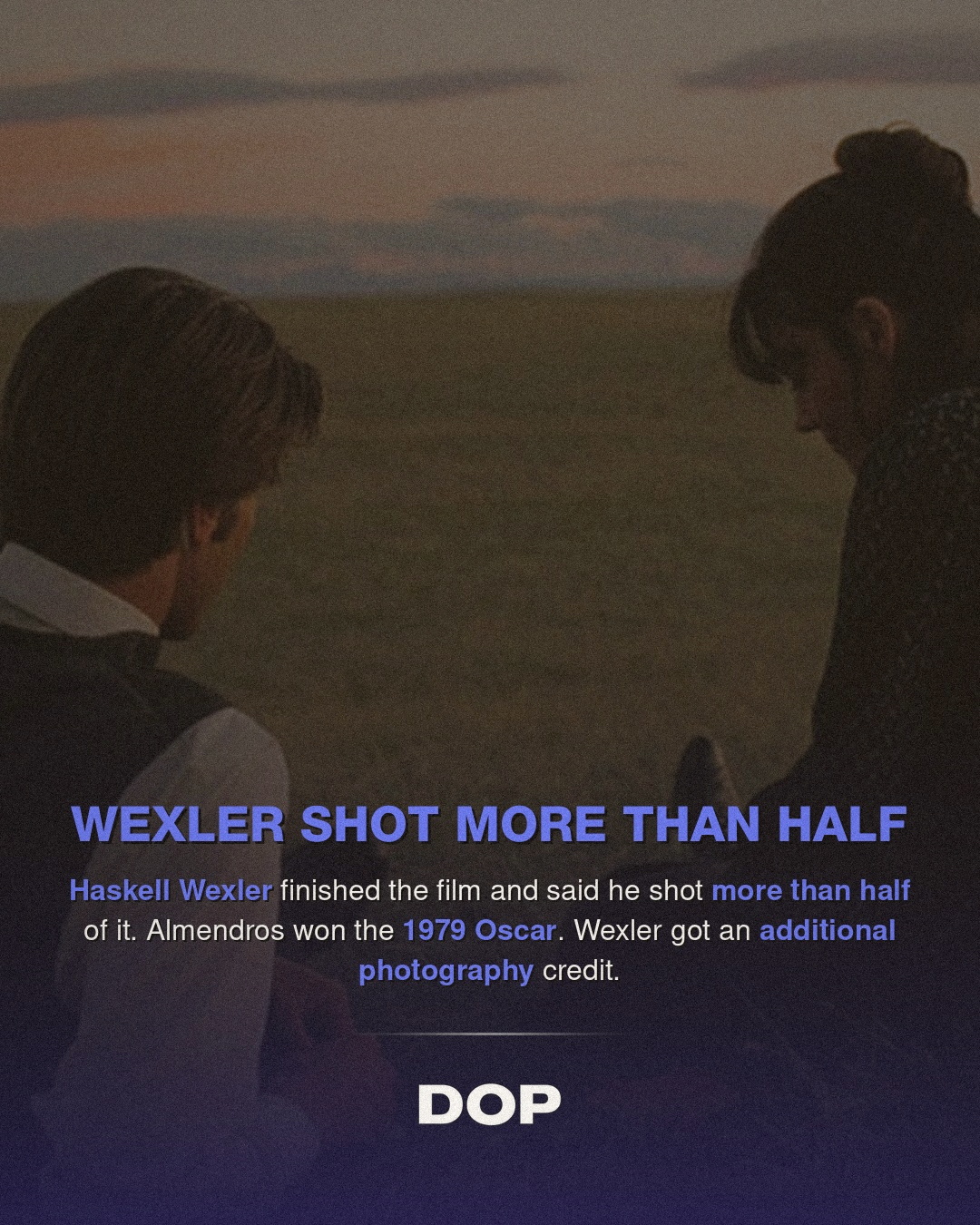
Due to severe production delays caused by the protracted magic-hour schedule, Almendros was forced to leave the shoot before its conclusion to honor a prior commitment to François Truffaut’s The Man Who Loved Women. Enter Haskell Wexler, ASC, a master of socially conscious realism and naturalistic light in his own right (Who's Afraid of Virginia Woolf?, Bound for Glory). Wexler took over cinematography for the final three weeks of principal photography. While Wexler later stated that he shot over half of the completed footage, he meticulously honored the stylistic parameters established by Almendros, ensuring seamless aesthetic continuity across the edit.
Almendros took home the Academy Award for Best Cinematography in 1979 for his work, cementing Days of Heaven as an unassailable benchmark in photographic storytelling. By trusting the sensitivity of pushed photochemical emulsion, embracing wide-open apertures, and submitting to the unforgiving cadence of the setting sun, Almendros and Wexler unlocked a painterly, poetic naturalism that modern DPs still strive to emulate today.