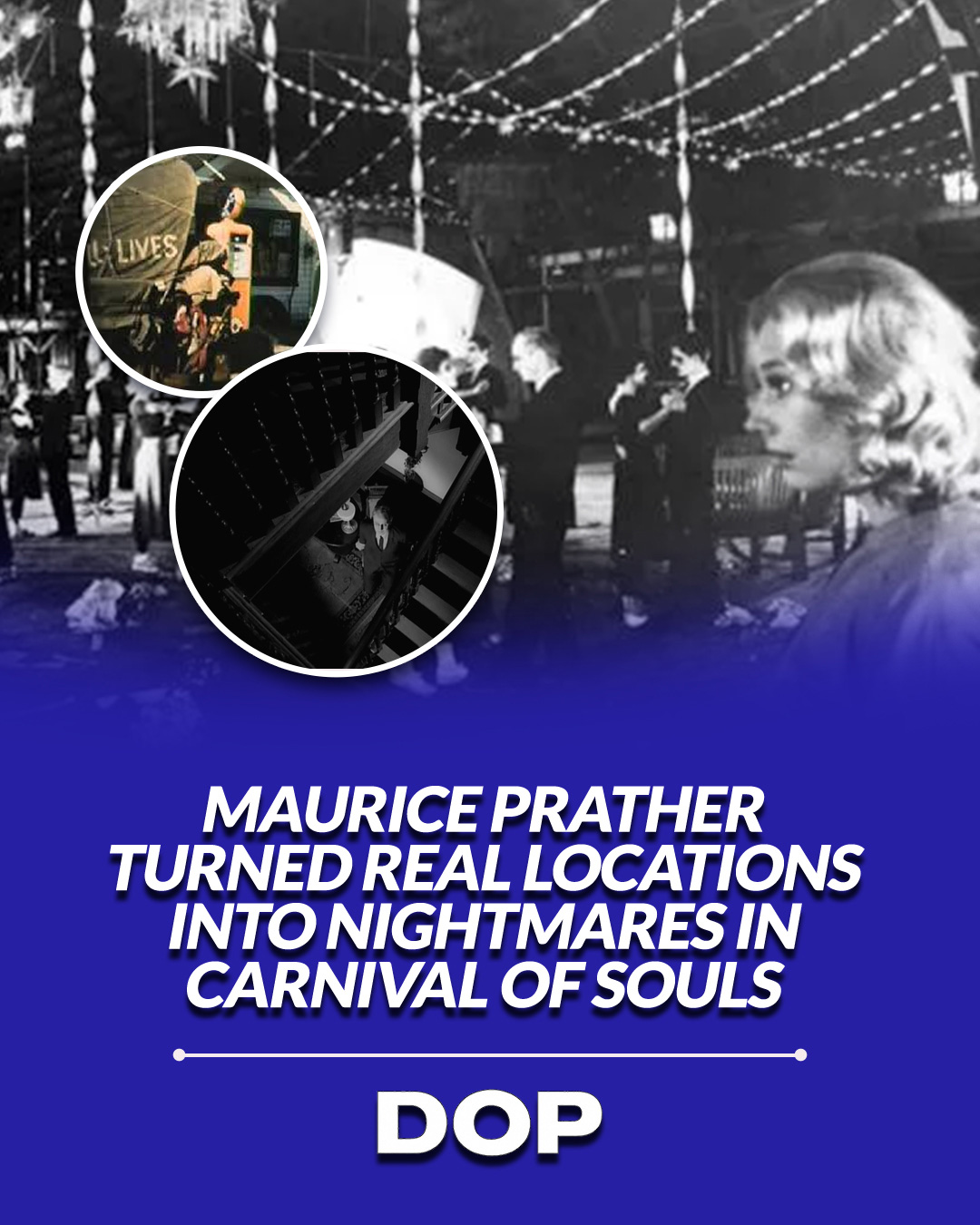
In 1962, industrial filmmaker Herk Harvey and cinematographer Maurice Prather crafted a singular work of American independent horror with Carnival of Souls. Produced on a shoe-string budget of roughly $33,000, the film bypassed Hollywood soundstages in favor of stark, real-world Utah locations, relying on a stripped-down crew and a relentless visual philosophy. Rather than masking its micro-budget limitations, Prather leaned into raw environmental textures, aggressive natural lighting, and high-contrast black-and-white photography to establish an eerie, liminal world that continues to haunt cinematographers today.
The Architecture of Dread and the Saltair Pavilion
At the center of the film's visual identity is the abandoned Saltair Pavilion on the salt flats of the Great Salt Lake. The decaying, Moorish-style resort offered Prather a ready-made set imbued with tragic grandeur and apocalyptic emptiness. Operating with portable 35mm camera packages, primarily handheld Arriflex rigs, Prather framed protagonist Mary Henry (Candace Hilligoss) against vast, vacant expanses. The imposing scale of the pavilion, rendered through wide focal lengths like 28mm and 35mm primes, emphasizes her microscopic scale within an unfeeling physical environment.
Location shooting on a shoestring demands absolute submission to natural light. Rather than fighting the harsh, unsoftened midday sun of the desert, Prather embraced it. By exposing aggressively for the bright highlights on the weathered wood and reflective salt flats, he allowed the shadow regions to crush completely into deep, oppressive blacks. This binary tonal distribution established a feeling of hostile isolation long before any explicitly supernatural elements manifested on screen.
Carnival of Souls proves that if your locations are strong and you commit to bold contrast, you can achieve lasting horror imagery without a truck full of gear.
Hard Light, High Contrast, and Minimal Rigs
Without the capital for substantial tungsten light packages or heavy generator trucks, the lighting design on Carnival of Souls was fundamentally subtractive and directional. For interior sequences, Prather relied on single hard sources, frequently a single incandescent bulb or a small open-face fixture, to cast sharp, geometric shadows across faces and narrow hallways. This hard-light approach was matched in laboratory processing with high-contrast printing, emphasizing sharp edge-light and silhouette over subtle mid-tone gradations.
The film stocks of the era, such as Kodak Plus-X and Tri-X, possessed a tactile grain structure that rewarded severe lighting ratios. Prather utilized negative fill, placing black flags or utilizing naturally dark surroundings, to swallow ambient bounce light, keeping shadows pure and unpolluted. The result was a visual palette where light does not merely illuminate the frame; it carves through darkness like a blade, trapping characters within tight pools of white.
Documentary Realism and Spatial Isolation
Before making Carnival of Souls, Harvey and Prather spent years shooting educational and industrial shorts for the Kansas-based Centron Corporation. This background instilled a pragmatic, documentary-style efficiency in their camera placement and spatial coverage. The camera frequently lingers in quiet corridors, staircases, and empty highways, holding wide shots long after conventional narrative editing would cut away. This observational, newsreel-adjacent perspective creates a disquieting tension, making the viewer feel as though a non-fiction film crew accidentally stumbled onto a haunting.
By pairing deep depth of field with static, observational framing, the spatial geometry itself becomes an active antagonist. The emptiness surrounding the protagonist is not dead space; it is a physical weight pressing down upon her. The simple, unpretentious camera moves, often locked-off wide compositions or simple pans, allow the stark contrast and environmental architecture to perform the narrative heavy lifting.
For modern cinematographers working with constrained budgets and light footprints, Carnival of Souls remains an essential masterclass in visual discipline. It demonstrates that atmosphere is not purchased with massive gear trucks or elaborate rigs. By committing to a unified visual language, selecting locations with innate character, and wielding high contrast with total intent, a DP can turn minimal resources into an enduring masterpiece of visual dread.
This article contains affiliate links. We may earn a small commission at no extra cost to you. Learn more.