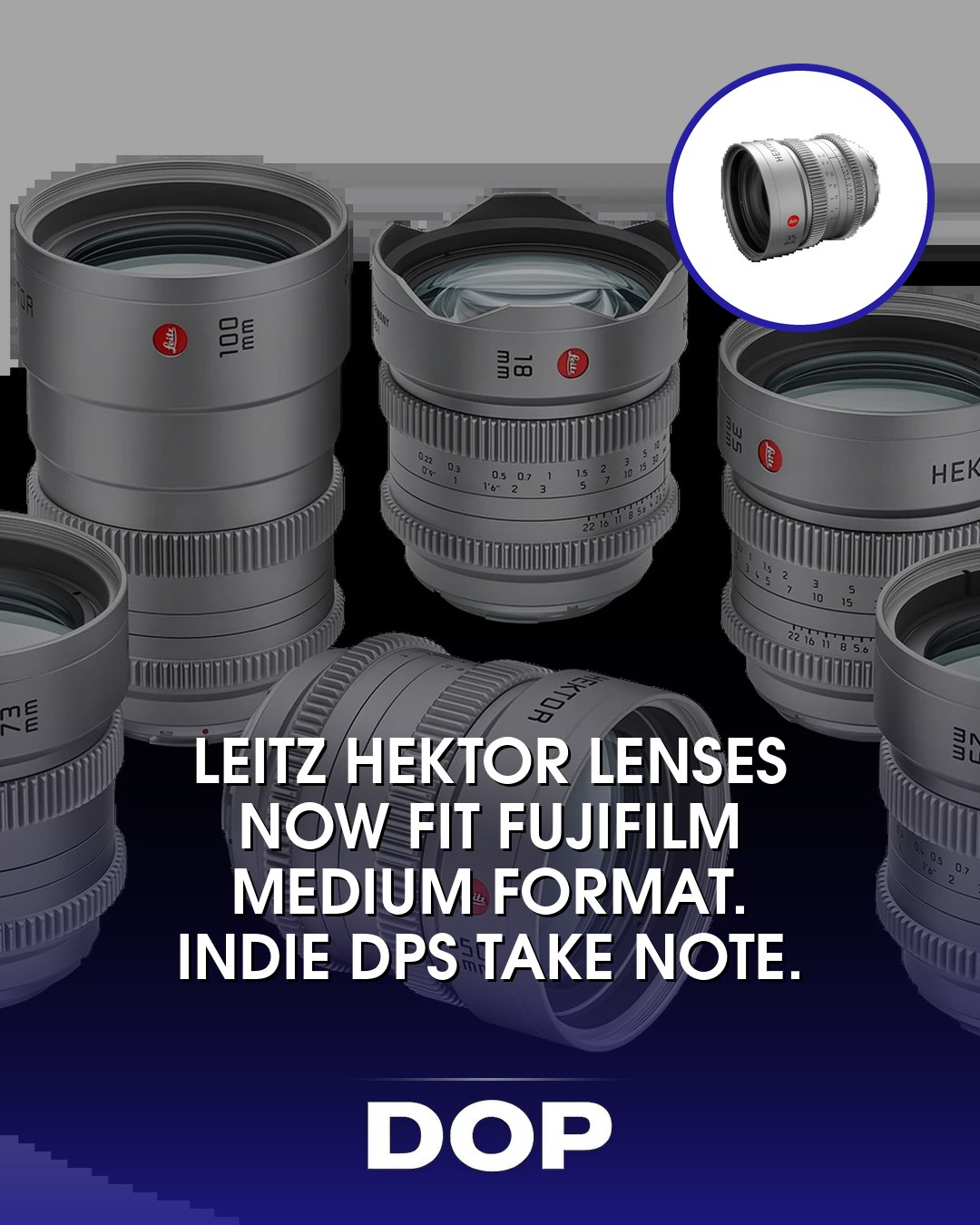
In the ever-evolving landscape of cinematic tools, certain announcements resonate with a particular hum, a frequency understood by those who live and breathe the image. The recent unveiling of a Fujifilm G-Mount option for Leitz Cine's HEKTOR lens line is one such moment. It's not merely an incremental update; it's a strategic fusion that unlocks a potent new combination for cinematographers seeking a distinct visual signature.
The HEKTOR lenses have, in a relatively short time, carved out a formidable reputation in high-end independent cinema. They are not merely tools for capturing light; they are instruments for sculpting it. DPs laud their unique rendering character, a nuanced interplay of micro-contrast and resolution that imbues images with a tangible dimensionality. But perhaps their most celebrated attribute is their exquisite handling of skin tones, particularly at wider apertures. This isn't just about color accuracy; it's about the way light falls across the human face, the subtle gradations that convey texture and emotion, all rendered with a painterly quality that avoids clinical harshness.
The Allure of Medium Format
The marriage of HEKTOR glass with the Fujifilm G-Mount brings these revered characteristics into the realm of medium format cinematography, a domain long eyed by DPs for its distinct aesthetic advantages. What does medium format mean in a cinema context? Primarily, it signifies a significantly larger sensor area compared to the ubiquitous full-frame or Super35. This expansive canvas translates directly into a shallower depth of field at equivalent focal lengths and apertures, but it's more than just 'more bokeh.' It's a different quality of fall-off, a more gradual and organic transition from sharp focus to ethereal blur that can isolate subjects with an almost three-dimensional pop.
"The larger sensor also contributes to a unique tonal quality, a subtle richness and depth that full-frame and Super35, for all their merits, simply cannot replicate."
The larger sensor also contributes to a unique tonal quality, a subtle richness and depth that full-frame and Super35, for all their merits, simply cannot replicate. This isn't just about dynamic range or color science, though those are certainly factors; it's about the way light is gathered and rendered across a greater surface area, influencing everything from highlight rolloff to shadow detail. For cinematographers like Bradford Young, ASC, known for his evocative, often low-light work on films like Arrival and Selma, or Roger Deakins, CBE, ASC, BSC, with his mastery of naturalistic light, the nuances of sensor size and lens character are paramount to conveying mood and narrative.
Practical Implications and Creative Potential
While the allure of medium format is strong, practical considerations have historically limited its widespread adoption in cinema. Sensor coverage is a primary concern; not all lenses designed for full-frame or Super35 can adequately cover the larger medium format sensors without vignetting. Even with dedicated medium format glass, there can be 'coverage caveats' when pairing with extra-large sensors like that found in the Fujifilm GFX Eterna 55. However, the character delivered by this combination, even with potential corner fall-off, remains undeniably compelling for many. The HEKTORs, with their generous image circle, are likely to perform admirably, offering a broad sweet spot of exceptional rendering.
This development is particularly significant for DPs working in commercial advertising, music videos, and narrative features where the imperative is to create an image that feels genuinely different, that stands out in a saturated visual landscape. Think of the sumptuous, hyper-real yet deeply emotional imagery seen in high-end fashion campaigns, or the distinctive visual language of music videos that push aesthetic boundaries. The ability to pair the revered optical character of Leitz HEKTOR with the expansive canvas of Fujifilm's medium format sensors provides a powerful new arrow in the quiver for cinematographers looking to elevate their craft.
This isn't merely a theoretical exercise in lens and camera compatibility; it's a tangible production option available today. It invites experimentation, encourages a deeper exploration of depth of field and tonal rendering, and ultimately, empowers cinematographers to tell stories with an even richer, more distinctive visual voice. The HEKTOR on Fujifilm medium format isn't just a new tool; it's a statement about the ongoing pursuit of cinematic excellence.