Harris Savides. The name alone evokes a certain mood, a visual texture that is simultaneously raw and meticulously crafted. His work, from the haunting beauty of Elephant to the gritty realism of Zodiac, stands as a testament to a cinematographer who understood that true artistry often lies not in clinical perfection, but in a deliberate, controlled embrace of imperfection. Today, we delve into a masterclass of wisdom gleaned from Savides himself, a collection of principles that defined his approach and continue to inspire DPs worldwide. It's a philosophy he famously termed 'controlled imperfection,' a concept that is far more profound than it initially sounds.
Embracing the Digital Imperfection
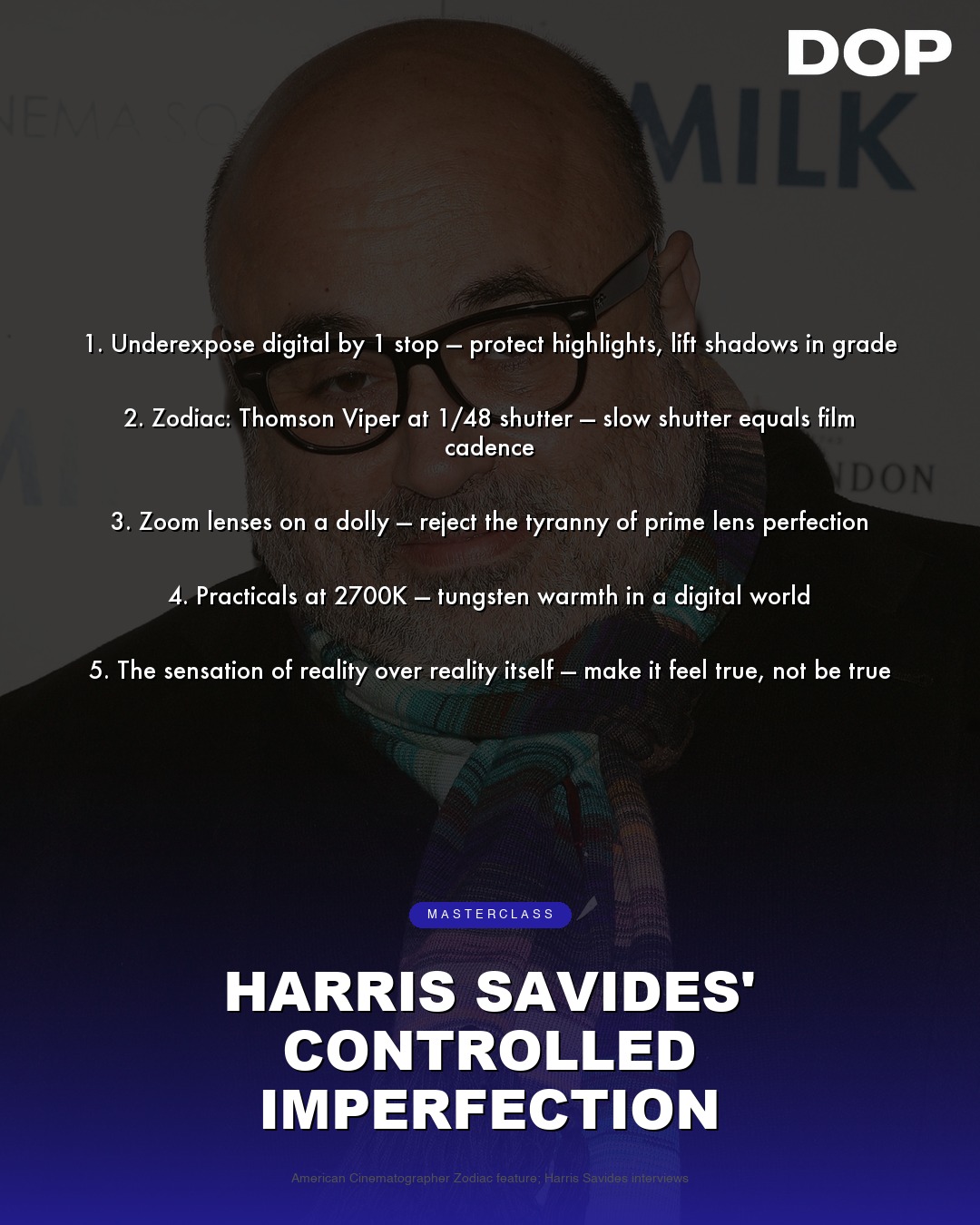
Savides was a pragmatic artist, unafraid to bend the rules of any medium to serve his vision. One of his most striking insights for digital cinematography was to actively underexpose by one stop. This wasn't a mistake; it was a strategic choice. The rationale? To protect highlights, those notoriously unforgiving areas in digital capture, while retaining ample information in the shadows for later manipulation in the grade. This approach, counterintuitive to some, showcases an understanding of digital sensor latitude and the power of post-production. It's a testament to his foresight, recognizing that a slightly underexposed 'negative' offered greater flexibility and a richer, more filmic dynamic range than a perfectly exposed, potentially clipped digital image.
His work on Zodiac, a film often lauded for its groundbreaking digital aesthetic, provides a prime example of this philosophy in practice. Savides shot with the Thomson Viper FilmStream camera, a pioneering digital cinema camera of its time. But it wasn't just the camera; it was how he used it. He famously employed a 1/48th shutter speed. This seemingly minor adjustment had a profound impact, introducing a subtle motion blur that mimicked the cadence and feel of film, softening the often-harsh sharpness of early digital sensors. It was a deliberate choice to infuse digital with an analog soul, a conscious effort to prevent the image from feeling sterile or overly 'video-like.'
"Imperfection is intention – controlled aberration beats clinical precision."
The Art of Intentional Aberration
This brings us to the core of Savides' philosophy: "Imperfection is intention – controlled aberration beats clinical precision." This isn't an excuse for sloppiness; it's a profound statement about aesthetic choice. Savides understood that the human eye often perceives beauty in the slightly askew, in the organic textures and subtle flaws that clinical precision often eradicates. Whether it was allowing for a hint of lens flare, embracing fall-off, or subtly manipulating focus, every 'imperfection' in his frames served a deliberate emotional or narrative purpose. It was about creating a lived-in, believable world, rather than a sterile, technically perfect one. This ethos extended to his choice of lenses, often favoring older glass with character, spherical aberrations, and unique bokeh over optically flawless, modern alternatives.
Another key tenet was his approach to contrast and saturation. Savides advocated for achieving low contrast in-camera where possible, aiming for a 'flat negative' that would provide maximum flexibility in the grade. This wasn't about a dull image; it was about ensuring that the colorist had the broadest possible canvas to sculpt the final look. By restraining saturation on set, he preserved a wider color gamut and prevented irreversible clipping of color information. This strategic restraint in production meant an expansive range in post, allowing for precise control over the final emotional and tonal palette of the film. It's a method that requires immense trust in the post-production process and a deep understanding of color science, but the results speak for themselves in the nuanced, rich imagery of his filmography.
A Legacy of Evocative Storytelling
Savides' work on films like Margot at the Wedding, Greenberg, and Somewhere, all collaborations with director Sofia Coppola, further exemplify his mastery of evocative, understated cinematography. His ability to capture the interior lives of characters through subtle light, selective focus, and a naturalistic palette is unparalleled. He was a master of available light, or more accurately, the artful manipulation of it to appear natural. His lighting setups were often deceptively simple, designed to enhance the existing environment rather than overwhelm it, creating a sense of intimacy and authenticity that drew audiences deeper into the story.
The legacy of Harris Savides is one of a cinematographer who defied convention, not for rebellion's sake, but to achieve a deeper artistic truth. His 'controlled imperfection' is a powerful reminder that technical mastery is a tool, not an end in itself. The true art lies in the intentional choices, the subtle manipulations, and the courageous embrace of aesthetic 'aberrations' that imbue an image with soul. For DPs today, his wisdom serves as a guiding star, urging us to look beyond the pursuit of clinical perfection and instead, to seek the profound beauty in the deliberately imperfect, the intentionally textured, and the evocatively human.