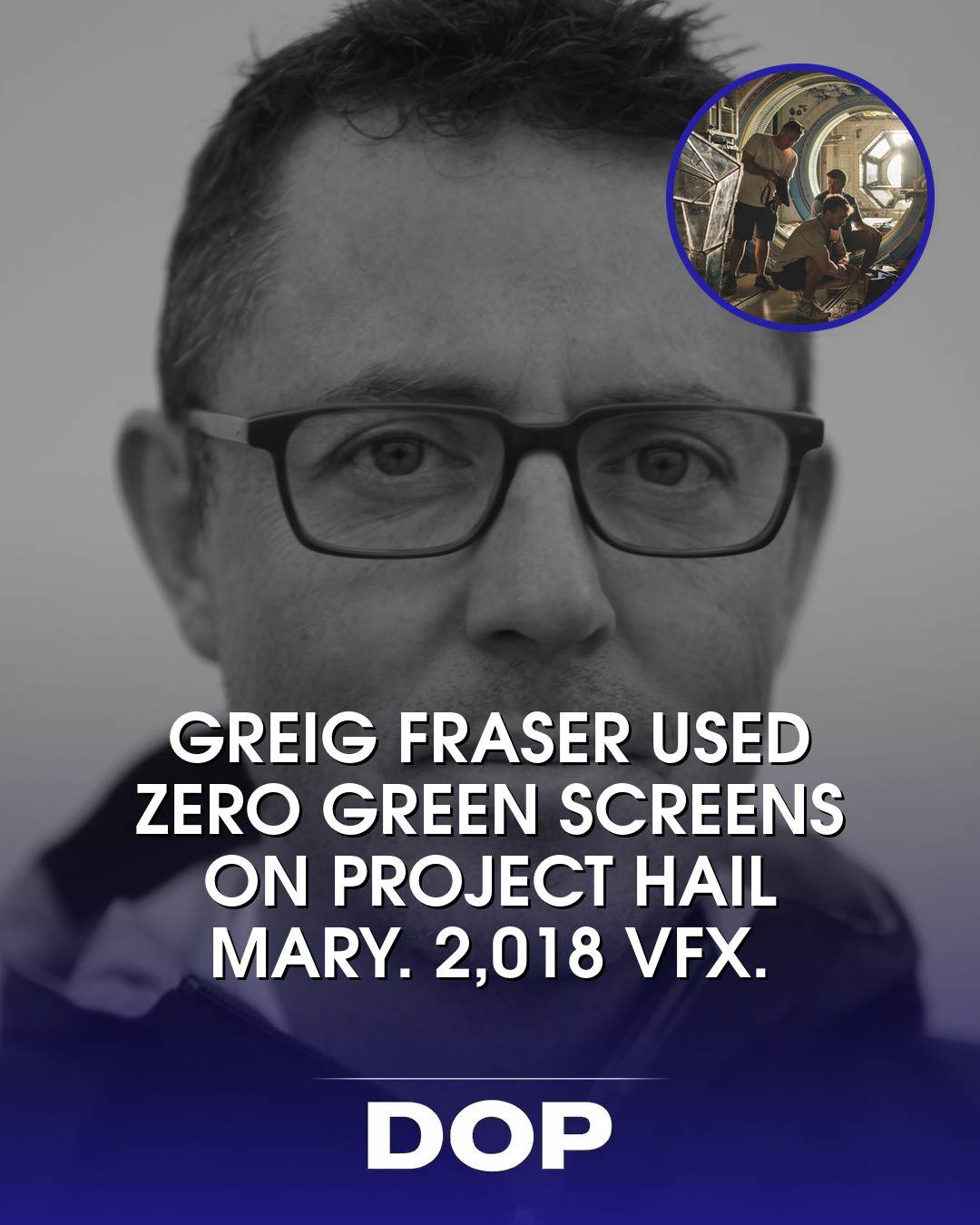
In an era increasingly dominated by virtual production volumes and the ubiquitous green screen, the announcement that Greig Fraser ACS, ASC shot the deep space sequences of Project Hail Mary with an entirely practical lighting approach sent ripples of excitement through the cinematography community. This wasn't merely a preference; it was a profound commitment to craft, a testament to the power of tangible light, and a bold artistic statement from a cinematographer renowned for his meticulous world-building.
The core of this audacious methodology lay in the complete absence of green screen environments for the live-action deep space sequences. Every photon illuminating the actors originated from a physically present source on set, meticulously constructed at Shepperton Studios. This isn't just a technical detail; it's a philosophical pivot. For DPs, the promise of a blank canvas with green screen often comes with the Faustian bargain of sacrificing the tactile reality of light interaction. Fraser, however, chose the harder, more rewarding path, understanding that the quality of light—its falloff, its spill, its inherent imperfections—is paramount to verisimilitude.
Engineering the Stellar Symphony
The logistical undertaking for this practical approach was monumental. Imagine a custom-built tungsten rig, a veritable celestial chandelier, suspended above the main performance areas. This wasn't a standard array of space lights; it was an intricately designed system capable of simulating the distinct light signatures of three different star systems. The programmable intensity levels speak to the nuanced storytelling at play, allowing Fraser to sculpt the emotional and narrative beats through the very nature of the light. Tungsten, with its warm, continuous spectrum, offers a rich, organic quality that can be difficult to replicate digitally, especially when trying to convey the subtle shifts in light from distant suns.
"The quality of light—its falloff, its spill, its inherent imperfections—is paramount to verisimilitude."
This commitment to practical light sources is a hallmark of Fraser's work. From the gritty, textural realism of The Batman, where he masterfully used hard, motivated practicals to carve out Gotham's oppressive atmosphere, to the ethereal, sun-drenched landscapes of Dune, Fraser consistently prioritizes the integrity of light. His choice of large format cameras, such as the ARRI Alexa 65 (for Dune) or the Alexa LF (for The Batman), complements this philosophy by capturing immense detail and dynamic range, allowing the nuances of his practical lighting schemes to truly sing on screen. While the specific camera and lens package for Project Hail Mary deep space remains under wraps, one can anticipate a similar pursuit of resolution and subtle light rendition.
The Actor's Universe: Performance Through Light
The directors, Phil Lord and Chris Miller, were reportedly instrumental in insisting on this practical methodology, driven by a desire to provide lead actor Ryan Gosling with a tangible, physical light environment. This is where the craft of cinematography directly impacts performance. Actors, particularly those working in highly stylized or fantastical settings, often speak of the challenge of reacting to an imagined world. By immersing Gosling in a physically present, responsive lightscape, Lord and Miller empowered him to react authentically. The subtle shifts in illumination, the genuine specular highlights, the deep, enveloping shadows—these are not just visual effects; they are emotional cues that ground the performance in a believable reality, no matter how alien the setting.
Consider the psychological impact: if an actor is meant to be adrift in the vastness of space, illuminated by the distant glow of an alien sun, a practical rig provides that exact, immediate sensory input. It’s a profound difference from staring at a green wall with a key light that is merely a stand-in for a post-production effect. This approach elevates the art of filmmaking by fostering an environment where every department, from set design to lighting to performance, converges in a shared, physical reality.
A Legacy of Reality in the Unseen
Fraser's work on Project Hail Mary reinforces a crucial lesson for cinematographers: even in the most fantastical narratives, the pursuit of practical reality can yield the most compelling results. His lighting philosophy is deeply rooted in observation and a profound understanding of how light behaves in the real world. Whether it's the stark, chiaroscuro beauty he brought to Lion, capturing the harsh realities of India, or the epic scale of Rogue One: A Star Wars Story, where he seamlessly blended practical sets with groundbreaking visual effects, Fraser consistently seeks to anchor his images in a believable, tactile world.
The dedication to building a full-scale, programmable tungsten star system for Project Hail Mary is more than just a technical feat; it's a philosophical statement about the enduring power of practical effects and the irreplaceable magic of light. It's a reminder that sometimes, the most innovative solutions are those that embrace the physical, the tangible, and the beautifully engineered reality of light itself. As DPs, we can learn immensely from this commitment to craft, pushing the boundaries of what's possible on set, and ultimately, delivering a more immersive and believable experience for the audience.