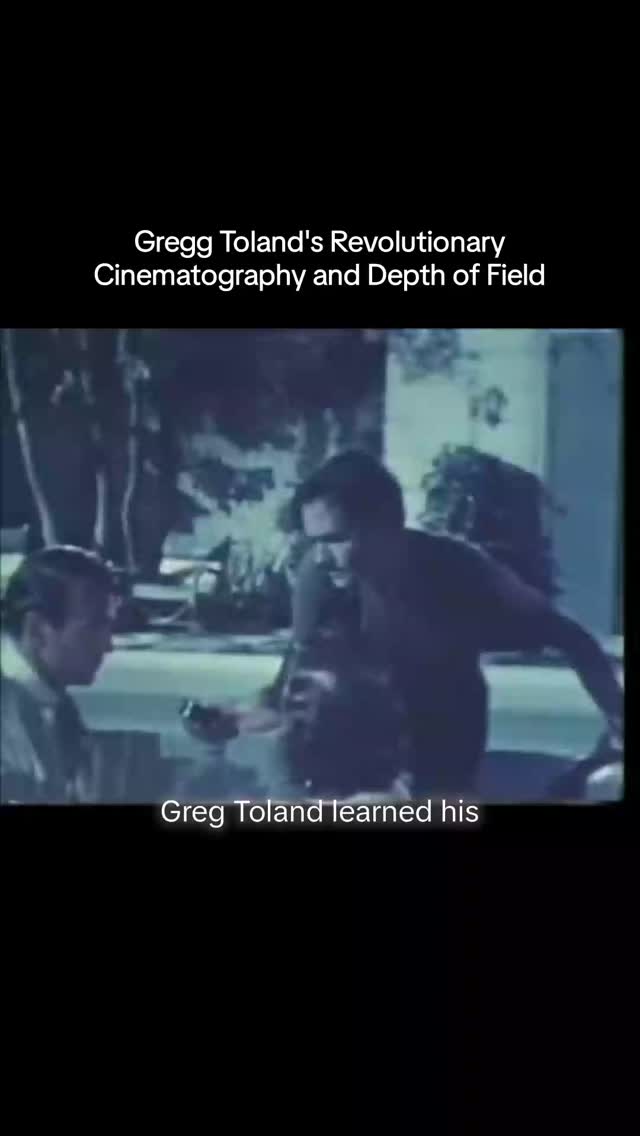
In the annals of cinematic history, few names resonate with the revolutionary impact of Gregg Toland. Often overshadowed by the directorial giants he collaborated with, Toland was a force of nature behind the lens, a craftsman whose audacious vision irrevocably altered the course of cinematography. While his legendary work on Citizen Kane often dominates discussions, it’s in films like John Ford’s 1940 maritime drama, The Long Voyage Home, that we find the fertile ground where his groundbreaking techniques truly blossomed, offering a masterclass in visual storytelling that remains profoundly influential today.
Toland’s journey began under the tutelage of cinematographic pioneers like George Barnes, a solid foundation that instilled a mastery of conventional techniques. Yet, Toland was not content to merely replicate; he was driven by an insatiable curiosity and a desire to expand the visual lexicon of cinema. His fearless embrace of deep focus, a technique that keeps both foreground and background elements in sharp, discernible detail, was nothing short of radical for its time. This was not a mere technical flourish; it was a philosophical statement, allowing audiences to engage with the frame in a more active, interpretive way, mirroring the complexity of human perception rather than guiding it with selective focus.
Mastering Depth and Contrast
The technical hurdles to achieve such profound depth of field in the early 1940s were immense. Films like The Long Voyage Home, shot primarily on 35mm film stock, often necessitated immense amounts of light to stop down lenses to their smallest apertures (e.g., f/16, f/22) and keep everything in focus. Toland, however, was not deterred. He collaborated closely with lens manufacturers, pushing for faster, wider-angle lenses, and worked tirelessly with set designers to ensure that backgrounds were meticulously dressed and lit, even in dimly lit ship interiors. His innovative use of arc lamps and even carbon-arc spotlights allowed him to achieve the necessary illumination without sacrificing the dramatic chiaroscuro that became his signature.
Toland’s deep focus wasn't a mere technical flourish; it was a philosophical statement, allowing audiences to engage with the frame in a more active, interpretive way.
Consider the claustrophobic, smoke-filled cabins of the SS Glencairn in The Long Voyage Home. Toland's camera doesn't just observe; it immerses. We see the weary faces of the sailors in the foreground, the grimy details of their bunks, and the distant, shadowy figures in the background, all rendered with remarkable clarity. This isn't just about sharp images; it's about conveying a sense of oppressive reality, of lives lived in close quarters, where every detail contributes to the atmosphere. This visual density was revolutionary, forcing viewers to actively scan the frame, piecing together information and narrative cues from multiple planes of focus simultaneously.
The Art of Light and Shadow
Beyond deep focus, Toland was a master of high-contrast lighting, a technique he honed to perfection throughout his career. His work on The Long Voyage Home is a prime example of how light and shadow can be wielded as potent storytelling tools. He frequently employed low-key lighting setups, plunging vast areas of the frame into deep shadow, creating a palpable sense of mood, mystery, and foreboding. This wasn't merely about creating a dark image; it was about sculpting with light, using it to define character, emphasize emotion, and guide the viewer's eye to crucial narrative points.
His use of hard, directional light created stark contrasts, emphasizing textures and forms, and adding a dramatic weight to every scene. The play of light on the weathered faces of the sailors, the glint off a metal surface, or the ominous shadows cast by objects in the frame, all contribute to a visual language that is both poetic and brutally realistic. This dramatic lighting, combined with his deep focus, created a visual tapestry that was rich in detail and emotionally resonant, pushing the boundaries of what a camera could capture and convey. Toland's influence extended far beyond his collaborators, inspiring generations of cinematographers to view the camera not just as a recording device, but as an active participant in the storytelling process.
Gregg Toland’s legacy is not just in the films he shot, but in the doors he opened for future cinematographers. He demonstrated that the technical limitations of the medium were merely challenges to be overcome, and that true innovation stemmed from a deep understanding of visual psychology and a courageous commitment to pushing the envelope. His work on films like The Long Voyage Home stands as a testament to a cinematographer who didn't just capture images, but crafted experiences, leaving an indelible mark on the art form and forever changing how we see and interpret cinema.
This article contains affiliate links. We may earn a small commission at no extra cost to you. Learn more.