In the annals of cinematic history, few films command the enduring reverence and analytical scrutiny of Orson Welles’s 1941 masterpiece, Citizen Kane. While Welles’s directorial genius is undeniable, it is the audacious and relentlessly innovative cinematography of Gregg Toland that truly solidified its legendary status, forever altering the visual grammar of filmmaking. Toland wasn’t just shooting a movie; he was conducting a cinematic experiment, pushing the boundaries of what was technically and artistically possible.
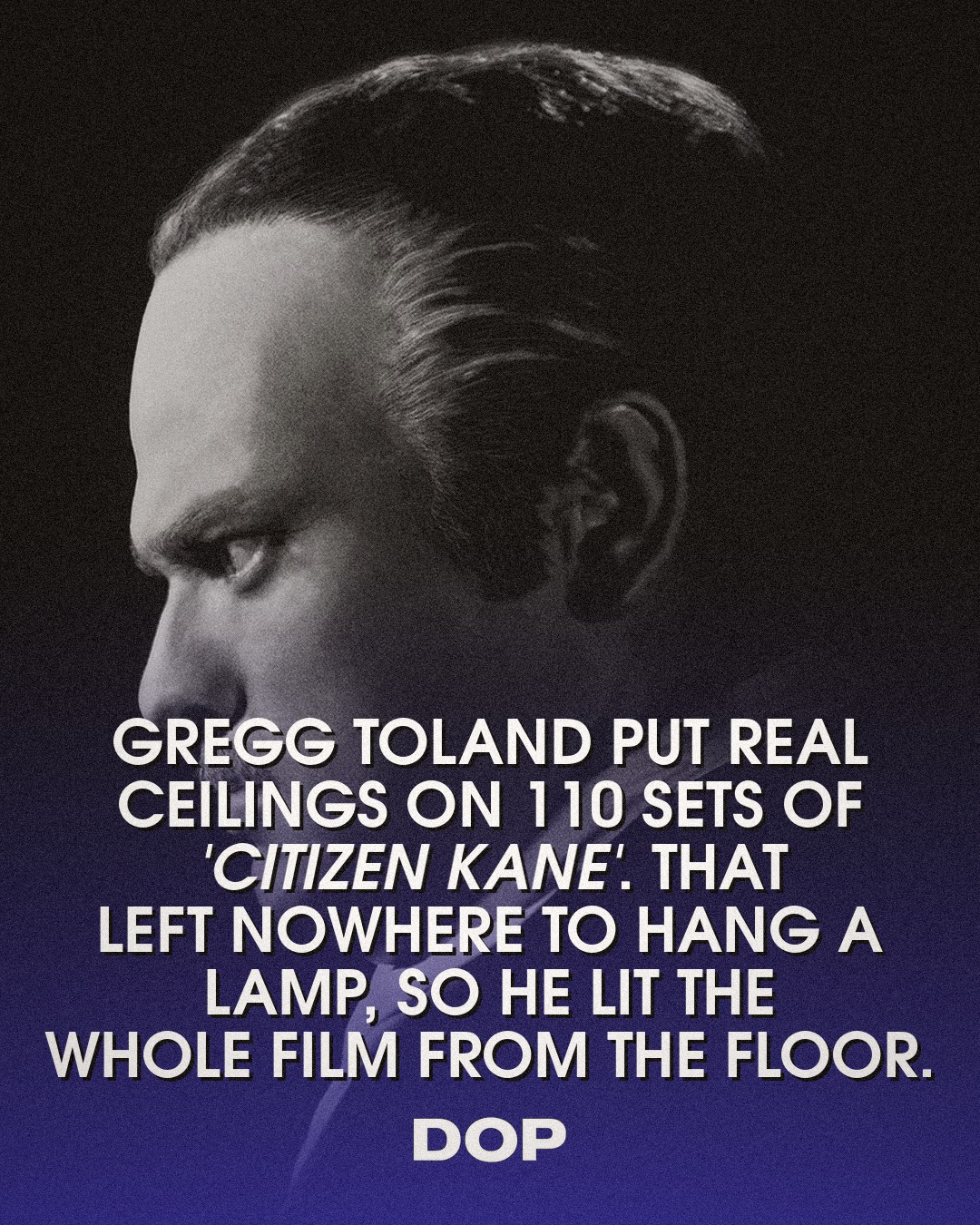
The Instagram caption offers a tantalizing glimpse into Toland’s radical methodology, particularly his defiance of conventional lighting practices. The revelation that “not one of the 110 sets was rigged for overhead light” is, in itself, a seismic shift. For decades, Hollywood's studio system relied heavily on overhead lighting to illuminate expansive sets and actors, a method that often resulted in flat, undramatic imagery. Toland, however, sought to emulate the naturalistic, chiaroscuro effects of German Expressionism and deep-focus photography, understanding that light from below or from specific angles could sculpt faces and environments with unparalleled dramatic intensity. This wasn't merely an aesthetic choice; it was a philosophical statement about how light defines space and emotion.
Rewriting the Rules of Exposure and Depth
One of Toland’s most groundbreaking contributions to Citizen Kane was his relentless pursuit of extreme depth of field, a technique now famously known as 'deep focus.' The caption highlights his audacious f-stop choices: “He shot nearly all of it at f/8 or smaller, some at f/11 and one at f/16.” In an era where interiors were typically shot around f/2.3 to f/2.8 to achieve acceptable exposure with slower film stocks, Toland’s commitment to stopping down the lens was nothing short of revolutionary. This allowed everything from the foreground to the background to remain in sharp focus simultaneously, creating a visual richness that invited viewers to actively explore the frame rather than being led by selective focus. This required an immense amount of light, which he achieved through the use of powerful “arc broadsides” and the then-novelty of coated lenses, which reduced flare and improved light transmission.
To facilitate his deep-focus vision and dynamic compositions, Toland also pioneered innovative camera placement and set design. The detail about “sections of floor lifted out so the camera could sit at ground level” speaks volumes about his commitment to unconventional perspectives. This technique, often referred to as 'low-angle' or 'worm's-eye' view, dramatically exaggerated the stature of characters like Charles Foster Kane, imbuing them with an almost monumental presence, especially when paired with Welles's imposing stature. Such extreme angles, combined with deep focus, created a sense of oppressive power or isolation, perfectly mirroring Kane’s psychological state and narrative arc. Toland’s collaboration with production designer Perry Ferguson was symbiotic, with sets often built with ceilings to allow for realistic lighting and sound, a stark contrast to the open-top sets common for overhead lighting.
The Art of 'Invisible' Lighting and Technical Mastery
“The ceilings were muslin so microphones could hide above them. Toland wrote it up himself in American Cinematographer in February 1941. Not one of the 110 sets was rigged for overhead light.”
The use of muslin ceilings, as noted, was a brilliant stroke of multidisciplinary problem-solving. While primarily intended for sound recording, allowing microphones to be positioned directly above the actors without casting shadows, it also forced Toland to rethink his lighting strategy entirely. Without the option of overhead rigging, he was compelled to light from the sides, from below, and from within the scene itself, often concealing lamps within practical fixtures or behind set pieces. This led to a more naturalistic, directional light that sculpted faces and figures with greater dimensionality, a far cry from the flat, diffuse illumination of his contemporaries. The fact that “several scenes used only five or six lamps” further underscores his mastery of selective and efficient lighting, focusing on impact over brute force.
Toland’s pioneering spirit wasn't limited to lighting and depth of field. His embrace of faster film stock, likely Kodak's then-newest, more sensitive emulsions, was crucial in achieving his deep-focus look without requiring an unwieldy amount of light. The use of coated lenses, a relatively new innovation at the time, significantly improved contrast and reduced internal reflections, contributing to the crisp, detailed images he sought. He understood that every element of the cinematic apparatus, from the emulsion to the glass, played a critical role in realizing his artistic vision. This holistic approach, documented by Toland himself in American Cinematographer, reveals a cinematographer who was not just an artist, but also a relentless technical innovator, constantly pushing the tools of his trade.
Gregg Toland’s work on Citizen Kane remains a towering achievement, a masterclass in visual storytelling that transcended the technical limitations of its era. His willingness to defy convention, to experiment with light, lenses, and camera placement, didn't just create iconic images; it laid the foundation for modern cinematography. His legacy is etched not only in the film's unforgettable frames but in the countless DPs who, inspired by his audacity, continue to challenge the norms and explore the boundless possibilities of the moving image. Toland didn't just shoot a film; he painted with light, redefined perspective, and gifted cinema a new visual language.