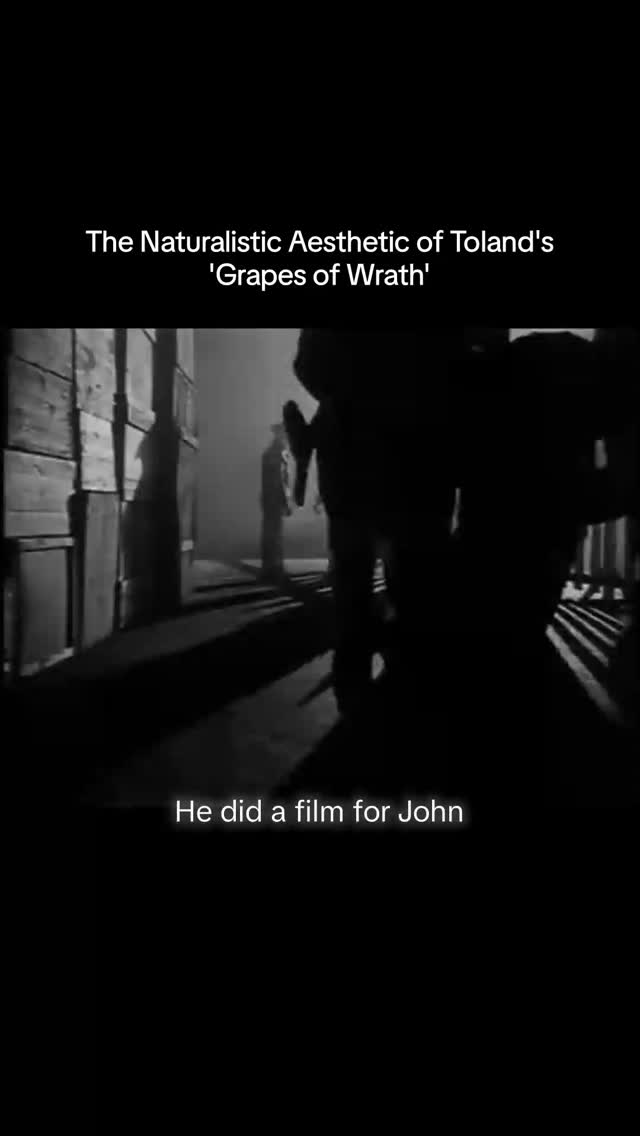
In the annals of cinematic history, few films achieve the profound, almost spiritual connection to their source material as John Ford’s 1940 masterpiece, The Grapes of Wrath. And fewer still owe so much of that resonant power to the singular vision of its cinematographer. Gregg Toland, a name synonymous with visual innovation and uncompromising artistry, didn't just photograph Steinbeck's epic; he etched it into the celluloid with a stark, documentary-like realism that remains breathtakingly potent eight decades later. The Instagram caption rightly posits that the film's visual fabric is almost indistinguishable from the WPA-era photography it sought to emulate – a testament to Toland's genius and a masterclass in visual storytelling.
To understand the magnitude of Toland's achievement, one must first grasp the visual landscape of the Great Depression. Photographers like Dorothea Lange, Walker Evans, and Arthur Rothstein, working for the Farm Security Administration (FSA) and later the Works Progress Administration (WPA), produced iconic images that defined an era. Their work was characterized by unvarnished truth, naturalistic lighting, deep focus, and often, a raw, almost confrontational intimacy with their subjects. These weren't staged portraits; they were snatched moments of resilience, despair, and human dignity amidst immense suffering. Toland, a man deeply attuned to the sociological power of images, understood that to adapt Steinbeck’s novel effectively, the film needed to speak this same visual language.
Mimicking the Masters: Toland's Technical Prowess
Toland’s approach was a deliberate and meticulous deconstruction of traditional Hollywood glamour. He eschewed the soft, diffused lighting and pristine compositions common in the studio system of the time. Instead, he embraced a harsher, more contrasty aesthetic. He frequently utilized available light or simulated it with carefully placed, often unmotivated, practical sources, creating deep shadows and pools of light that mirrored the harsh realities faced by the Joad family. This wasn't merely a stylistic choice; it was a philosophical one, designed to strip away artifice and immerse the audience in the grim reality of the Dust Bowl migrants.
“Toland understood that to adapt Steinbeck’s novel effectively, the film needed to speak the same visual language as the WPA photographers.”
The choice of black and white film stock further amplified this connection to documentary photography. Panchromatic film, with its ability to render a wide spectrum of tones, allowed Toland to achieve a rich, nuanced grayscale that felt authentic and timeless. He often employed wide-angle lenses, not for distortion, but to capture the vast, oppressive landscapes and the Joads' small, vulnerable place within them. His deep focus technique, a hallmark of his collaboration with Orson Welles on Citizen Kane just a year later, is already evident here, keeping both foreground and background sharp, allowing the audience to take in the full scope of their environment and the struggles unfolding within it.
Lighting as Narrative: The Power of Authenticity
Consider the interiors: the cramped shacks, the makeshift camps. Toland’s lighting here is often sparse, emanating from single sources like a bare bulb or a window, casting long, dramatic shadows. This isn't just atmospheric; it's narrative. It speaks to poverty, to the scarcity of resources, and to the psychological weight pressing down on the characters. The faces, often illuminated by this harsh light, are etched with worry and determination, much like Lange's iconic 'Migrant Mother.' The camera often remains at eye level, a subtle choice that fosters empathy and avoids any sense of voyeurism, instead positioning the viewer as an observer within the scene, not above it.
Toland’s filmography is a masterclass in versatility and innovation. From the poetic realism of The Long Voyage Home (also with Ford) to the experimental depths of Citizen Kane and the dramatic chiaroscuro of Wuthering Heights, he consistently pushed the boundaries of what cinematography could achieve. Yet, The Grapes of Wrath stands as a unique testament to his ability to harness technical skill in service of profound social commentary. He understood that the camera was not just a recording device, but a powerful tool for empathy and understanding.
Legacy of Realism: A Timeless Influence
The visual legacy of The Grapes of Wrath extends far beyond its immediate impact. It set a precedent for a more grounded, unvarnished style of filmmaking that resonated with post-war neorealism and continues to influence cinematographers today. Its raw authenticity reminds us that sometimes, the most profound beauty in cinema lies not in polished perfection, but in the unflinching portrayal of reality. Toland’s work on this film is a powerful reminder that technical mastery, when combined with a deep understanding of human experience, can elevate cinematography from mere image-making to a powerful form of historical documentation and emotional truth. It is, unequivocally, a masterclass in how light, shadow, and framing can transcend the screen and embed themselves in the collective consciousness as captured history.