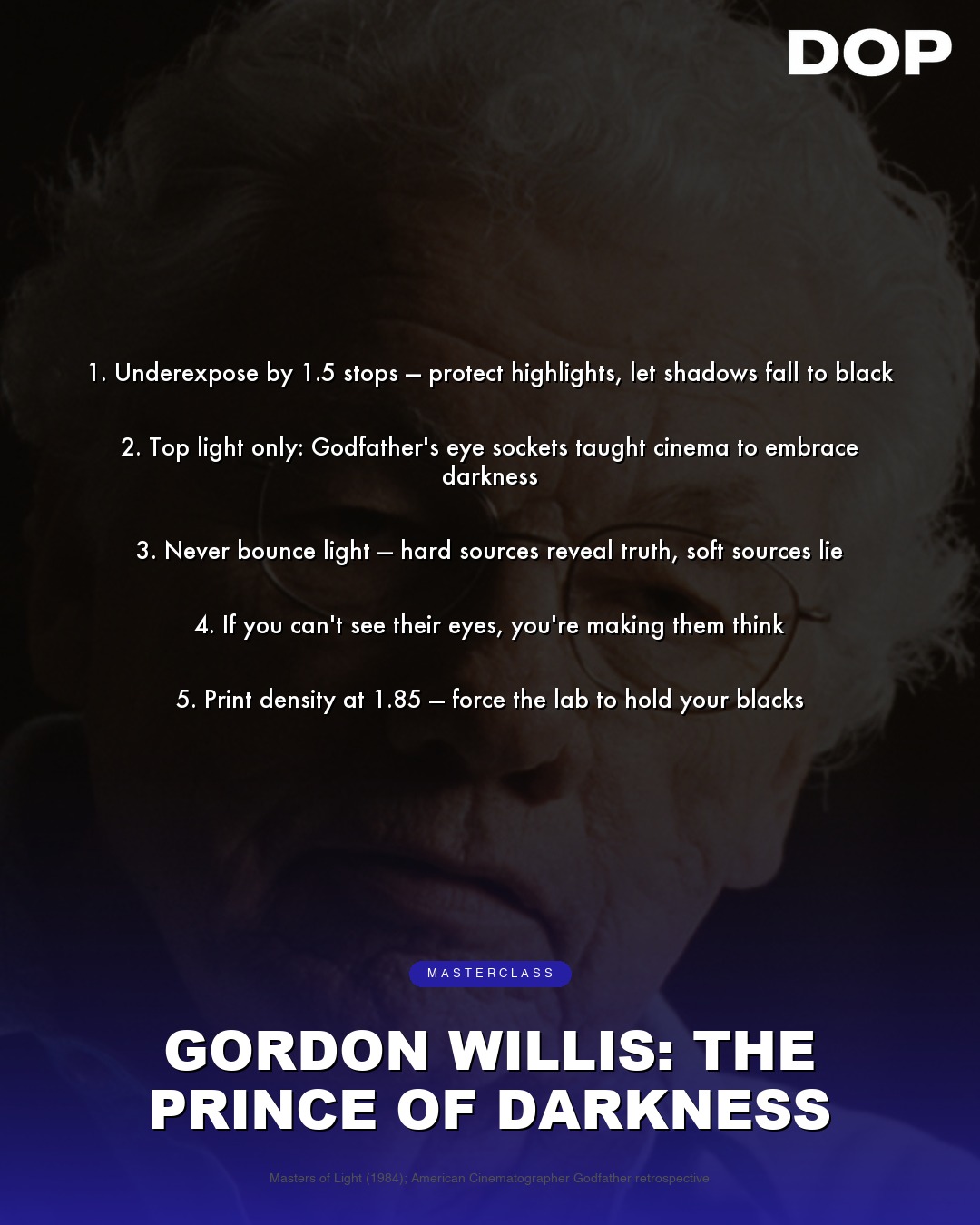
In the hallowed halls of cinematography, few names resonate with the mystique and profound influence of Gordon Willis. Dubbed 'The Prince of Darkness,' Willis wasn't merely a master of light; he was a virtuoso of absence, a poet of the unseen. His approach, often radical for its time, redefined how shadows could articulate narrative, evoke emotion, and sculpt character. The five tenets often attributed to his masterclass wisdom aren't just technical directives; they are a philosophical treatise on visual storytelling, a blueprint for DPs seeking to imbue their frames with depth, ambiguity, and an undeniable power.
Willis's first commandment, 'Underexpose by 1.5 stops – protect highlights, let shadows fall to black,' is a foundational principle for any DP looking to achieve truly cinematic results. In an era where digital sensors often prioritize dynamic range to capture every nuance, Willis's analog wisdom reminds us that control, not mere capture, is paramount. By deliberately pulling back on exposure, he wasn't just saving highlights from clipping; he was actively sculpting the image, allowing the shadows to become a palpable presence. This isn't about crushing blacks; it's about giving them purpose, creating a rich, velvety texture that draws the eye and suggests untold stories within the gloom. It's a bold move that demands confidence in one's vision, a trust that the audience will lean in, rather than be alienated by the absence of overt detail.
The Godfather's Gaze: Embracing the Void
The second point, 'Top light only: Godfather's eye sockets taught cinema to embrace darkness,' speaks directly to Willis's iconic work on Francis Ford Coppola's masterpiece. The unforgettable image of Marlon Brando's Vito Corleone, his eyes often obscured by shadow, wasn't an accident or a limitation; it was a deliberate artistic choice. This strategic use of top light, often from a single source, created a stark, chiaroscuro effect that became synonymous with the film's moral ambiguity and the characters' hidden depths. It forced the audience to project meaning into the unseen, to grapple with the unspoken, and to feel the weight of power and secrecy. It proved that sometimes, what you don't show is far more potent than what you do. This technique wasn't about cheap tricks; it was about psychological realism, about portraying characters whose true intentions often lay buried beneath a facade.
"If you can see everything, you've said nothing – trust the shadow."
'Never motivate what you can simply exclude – omission is a tool' further solidifies Willis's minimalist philosophy. This isn't just about practical lighting; it's about the entire visual composition. Why bother justifying a light source if its absence, or the deliberate obscuring of it, serves the narrative more effectively? Willis understood that the human imagination is a powerful co-conspirator. By presenting a partial reality, he invited the viewer to fill in the gaps, making them an active participant in the storytelling process. This economy of visual information is a hallmark of his style, evidenced across his filmography, from the paranoid tension of All the President's Men to the melancholic beauty of Annie Hall.
Contrast as Narrative: The Language of Light and Shadow
The assertion that 'Contrast ratio is story – high contrast means moral complexity' cuts to the heart of Willis's brilliance. He didn't just use contrast for aesthetic appeal; he wielded it as a narrative device. The extreme high contrast in films like The Godfather trilogy wasn't merely dramatic; it visually represented the moral quandaries, the stark choices, and the inherent darkness within the characters and their world. It created a palpable tension, a visual metaphor for the internal struggles and external pressures. In a world of greys, Willis dared to paint in stark blacks and whites, finding profundity in the extremes. This is not to say that low contrast has no place, but Willis demonstrated how a deliberate push into the upper echelons of contrast could elevate a film's thematic resonance.
Finally, the summation: 'If you can see everything, you've said nothing – trust the shadow.' This encapsulates the entirety of Gordon Willis's enduring legacy. In an era often obsessed with clarity and perfect illumination, Willis argued for the power of the enigmatic. He taught us that shadows are not merely the absence of light, but a canvas for implication, a shroud for mystery, and a profound tool for character development. His work reminds us that true mastery in cinematography isn't about showcasing every detail, but about making deliberate choices, about understanding the profound impact of what is withheld. For DPs today, grappling with ever-more sensitive sensors and brighter lenses, Willis's wisdom serves as a crucial reminder: sometimes, the most powerful statement is made in the dark, through the deliberate, artful embrace of the unseen.
This article contains affiliate links. We may earn a small commission at no extra cost to you. Learn more.