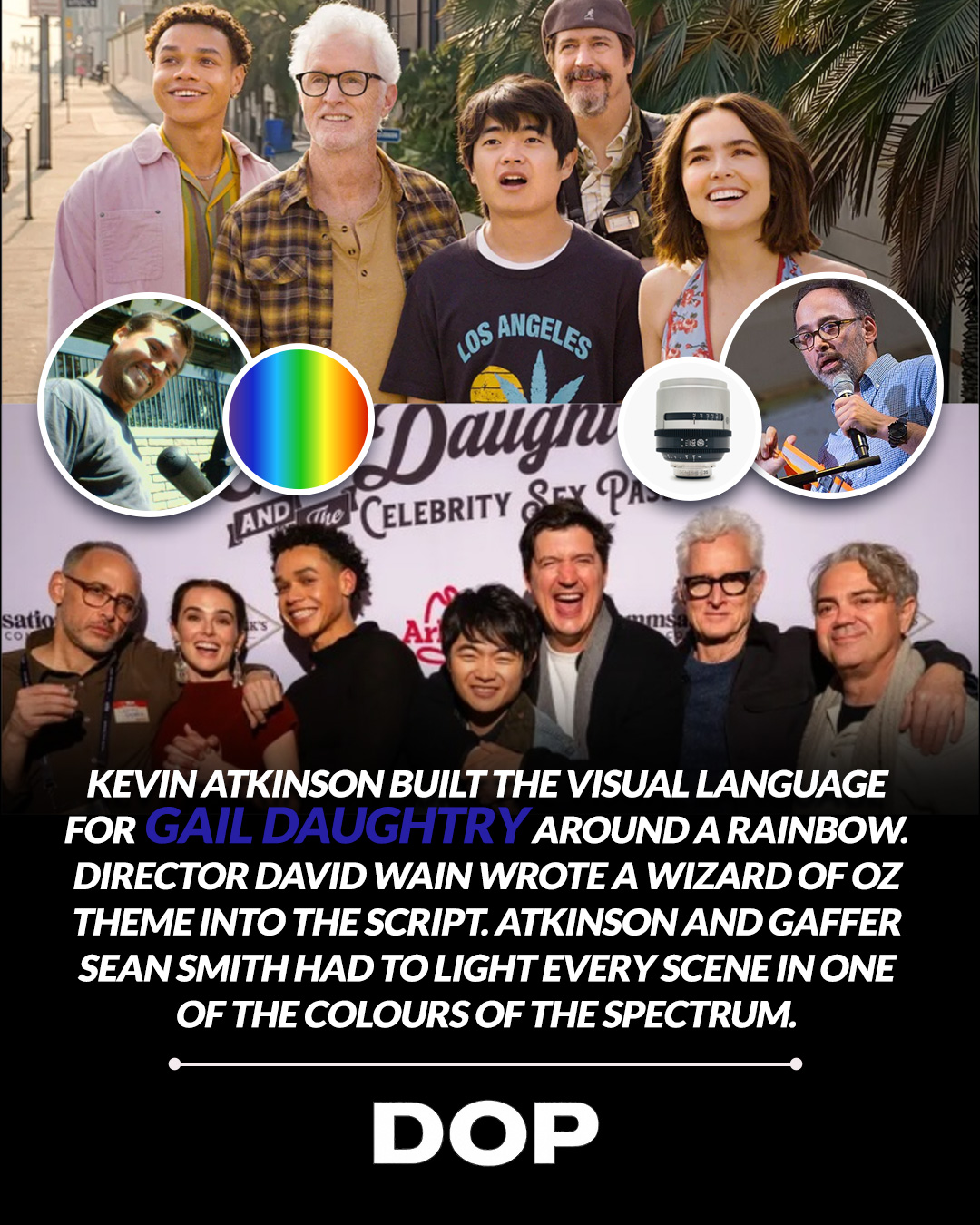
In an industry often seeking to ground its visual language in realism, the audacious decision to paint an entire narrative with the vibrant brushstrokes of a rainbow stands out. Such is the case with Gail Daughtry and the Celebrity Sex Pass, directed by David Wain and lensed by the visionary Kevin Atkinson. Premiering to buzz at SXSW 2026, this film didn't just flirt with color; it embraced it as a foundational narrative element, a choice that elevated the craft of cinematography to a new, almost theatrical, plane.
The genesis of this chromatic journey began not on set, but in the script. Director David Wain and co-writer Ken Marino ingeniously wove a Wizard of Oz-esque rainbow theme directly into the screenplay, dictating that every scene would be bathed in a distinct hue from the spectrum. This wasn't merely an aesthetic flourish; it was a profound structural decision that demanded an extraordinary level of collaboration and technical prowess from the entire visual team. Production designer Justin Lieb laid the groundwork by integrating these specific colors into the set design, but it was DP Kevin Atkinson and gaffer Sean Smith who were tasked with translating this ambitious concept into tangible light.
The Chromatic Challenge: Lighting Beyond Reality
The challenge for Atkinson and Smith was formidable. Traditional cinematography often seeks motivated light, where sources within the scene dictate the illumination. Here, the motivation was purely conceptual, an external, authorial imposition of color. This required a delicate balance: how to imbue each scene with its prescribed spectral hue without it feeling artificial or distracting? Their workflow began at the script stage, meticulously mapping out which color would correspond to which scene, ensuring a cohesive and emotionally resonant progression through the rainbow.
“The lighting is not motivated by the story world's practical sources - it is a layer of visual grammar imposed on realistic locations.”
The technical execution of this vision was equally demanding. Atkinson and Smith leveraged a sophisticated array of LED lighting and HMI fixtures to achieve precise color control and intensity. LEDs, with their granular control over hue and saturation, were undoubtedly instrumental in painting these vivid canvases. HMIs, known for their powerful output and daylight-balanced quality, likely provided the foundational ambient light, which was then meticulously gelled or augmented to achieve the desired spectral purity. This combination speaks to a gaffing team at the peak of their craft, capable of wrangling complex lighting setups to achieve a seemingly simple, yet profoundly impactful, result.
Crafting the Look: Sensor, Glass, and Glimmer
For a project so reliant on color fidelity and nuanced light, the choice of camera and lenses was paramount. Atkinson opted for the Sony Venice 2, a digital cinema camera renowned for its exceptional color science, dynamic range, and ability to render subtle gradations. The Venice 2's full-frame sensor and robust processing power would have been crucial in capturing the vivid, yet never oversaturated, palette dictated by the script. Its ability to handle extreme highlights and deep shadows would have ensured that even in scenes dominated by a single strong color, detail and texture were preserved, preventing the image from becoming a flat, monochromatic wash.
The lens choice further refined the film's unique aesthetic: Gecko G35 Vintage '66 Prime lenses, paired with Glimmer Glass filters. The Gecko G35s, with their vintage character, likely introduced a subtle softness and unique flare signature, counteracting any potential digital harshness and imbuing the image with a timeless, filmic quality. This choice is particularly astute; while the color scheme is inherently bold and modern in its conceptualization, the lenses provide a beautiful, textural counterpoint. The Glimmer Glass filters would have added another layer of diffusion, softening highlights, and creating a gentle, ethereal glow around light sources, further enhancing the film's dreamlike, Oz-ian quality. This combination of cutting-edge digital capture with character-rich vintage glass and subtle filtration demonstrates a nuanced understanding of how optics can shape narrative tone.
The success of Gail Daughtry lies not just in its bold concept, but in the meticulous execution by Atkinson and Smith. They didn't just light scenes; they infused them with emotional and narrative meaning through color, transforming a potentially gimmicky idea into a sophisticated visual language. This film serves as a powerful reminder that cinematography, at its heart, is about storytelling, and sometimes, the most compelling stories are told in a spectrum of vibrant hues, carefully orchestrated and masterfully lit.
This article contains affiliate links. We may earn a small commission at no extra cost to you. Learn more.