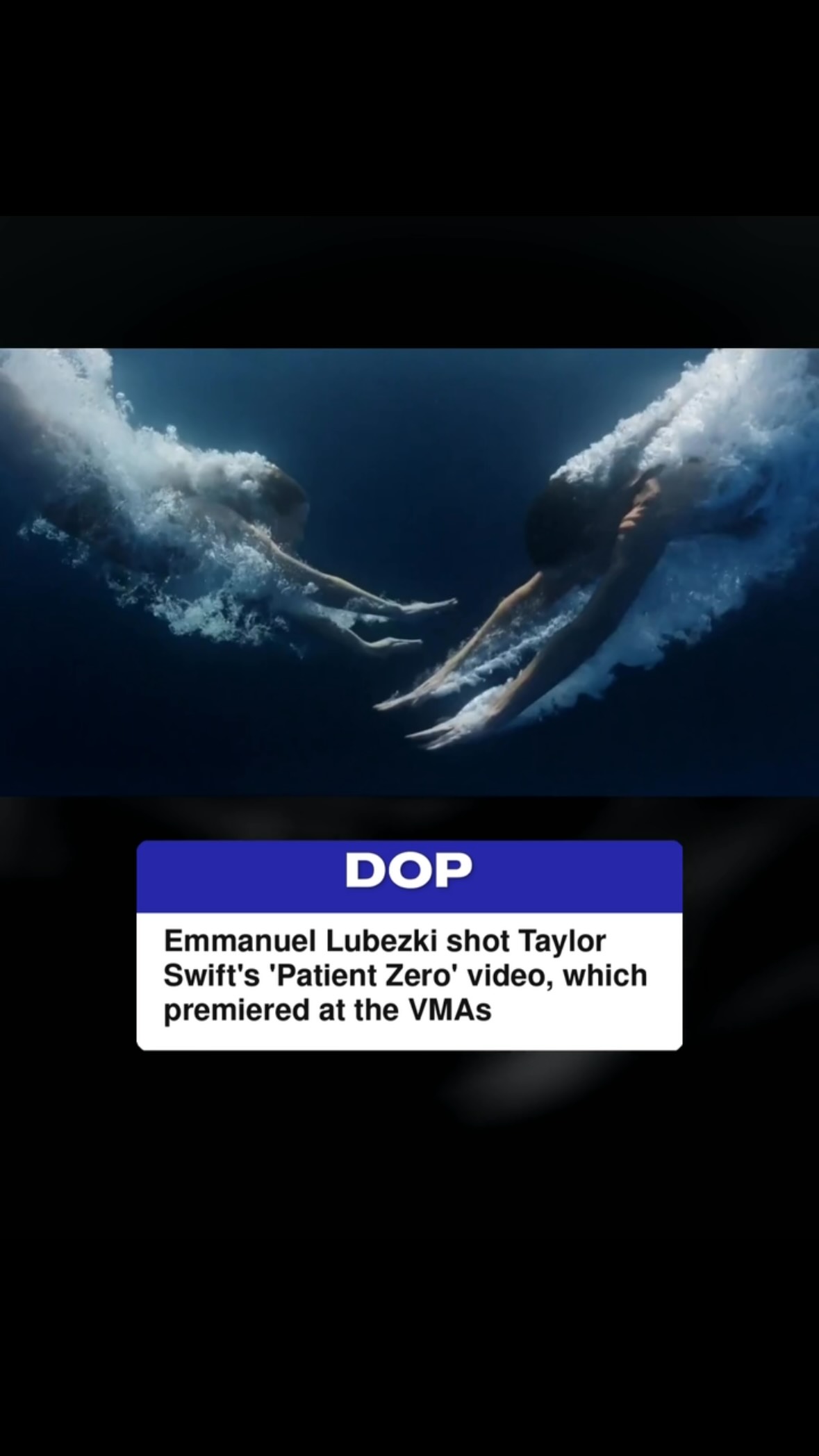
When the credits roll on a massive pop production, you typically expect a kinetic cascade of names: producers, choreographers, stylists, colorists, and post-production houses. Yet at the conclusion of Taylor Swift’s latest narrative project, only one name was granted sovereign isolation on screen: Emmanuel Lubezki, ASC, AMC. For cinematographers and cinephiles alike, the gesture was not merely a polite nod from a director to her collaborator; it was an explicit acknowledgement that the visual grammar of the piece belonged to the master affectionately known throughout the industry as Chivo.
Bringing Chivo into the orbit of a music video is a seismic statement. The three-time consecutive Academy Award winner, celebrated for his historic triumphs on Gravity, Birdman, and The Revenant, has spent three decades dismantling Hollywood’s conventional shooting paradigms. Across his landmark partnerships with Alfonso Cuarón, Alejandro G. Iñárritu, and Terrence Malick, Lubezki radically redefined the cinematic medium’s relationship to natural illumination, spatial blocking, and wide focal lengths. Teaming with Swift, production designer Ethan Tobman, and editor Chancler Haynes, Chivo adapts his uncompromising photographic philosophy to a haunting ghost story anchored by Dakota Johnson and Colin Farrell.
The Poetics of Proximity and Wide Glass
From the opening frames, Lubezki’s signature optical fingerprint is unmistakable. While conventional directors often frame grief and haunting narratives through long, detached telephoto lenses to convey isolation through compression, Chivo does the opposite: he steps in close with extreme wide-angle glass. It is the same strategy he deployed alongside Malick in The Tree of Life and To the Wonder, frequently operating with focal lengths ranging between 14mm and 21mm mere inches from the actors’ faces.
Paired with a large-format sensor, likely an Arri Alexa LF or Mini LF, this physical proximity to Johnson and Farrell yields an immersive, three-dimensional presence. Wide-angle large-format photography pulls the background into direct emotional conversation with the foreground without flattening perspective. The curvature of the lens gently wraps the periphery of the frame, capturing the ambient decay of Tobman’s atmospheric, texture-heavy interiors while registering every involuntary micro-expression of an aching performance.
“Chivo does not simply photograph an environment; he employs the wide lens as a spatial instrument that forces the viewer into the physical aura of the subject.”
Kinetic Choreography and Spatial Storytelling
Working in lockstep with production designer Ethan Tobman, the visionary behind The Menu and Swift’s monolithic stage designs, the camera navigates domestic interiors that feel simultaneously tangible and metaphysical. Haynes’ editorial choices give the cinematography room to breathe, resisting the hyper-kinetic, micro-second cut rates endemic to modern music videos. Instead, the sequence preserves Lubezki’s fluid spatial choreography, where the camera drifts like an unmoored apparition through thresholds, corridors, and doorways.
This camera motion isn't just ornamental movement; it is an active narrator. Chivo’s long-standing mastery of gimbal setups, lightweight Steadicam configurations, and fluid head operation allows the camera to circle Farrell and Johnson with predatory grace. Rather than relying on coverage, the pedestrian master-shot/close-up formula, the camera glides between subjective and objective points of view, blurring the boundary between the living and the spectral.
Motivated Naturalism and Negative Fill
Photographically, Chivo remains cinema’s premier purist of motivated light. Even when working on stylized interior sets, his lighting package avoids aggressive, theatrical backlights or hyper-saturated keys. Instead, the piece favors soft, naturalistic ambient sources: low-angle winter sunlight bleeding through muslin-draped windows, the gentle flicker of tungsten practicals, and deep, velvety falloff into negative fill.
Rather than flooding shadows with artificial bounce, Lubezki embraces low-key tonalities, relying on the modern digital sensor’s extraordinary latitude to sculpt depth out of near-darkness. Highlights roll off with organic, painterly softness, evoking Dutch Golden Age portraiture more than polished contemporary pop visuals. It is a masterclass in photographic restraint, a reminder that visual atmosphere is not built by what a cinematographer illuminates, but by what they deliberately choose to leave in the dark.