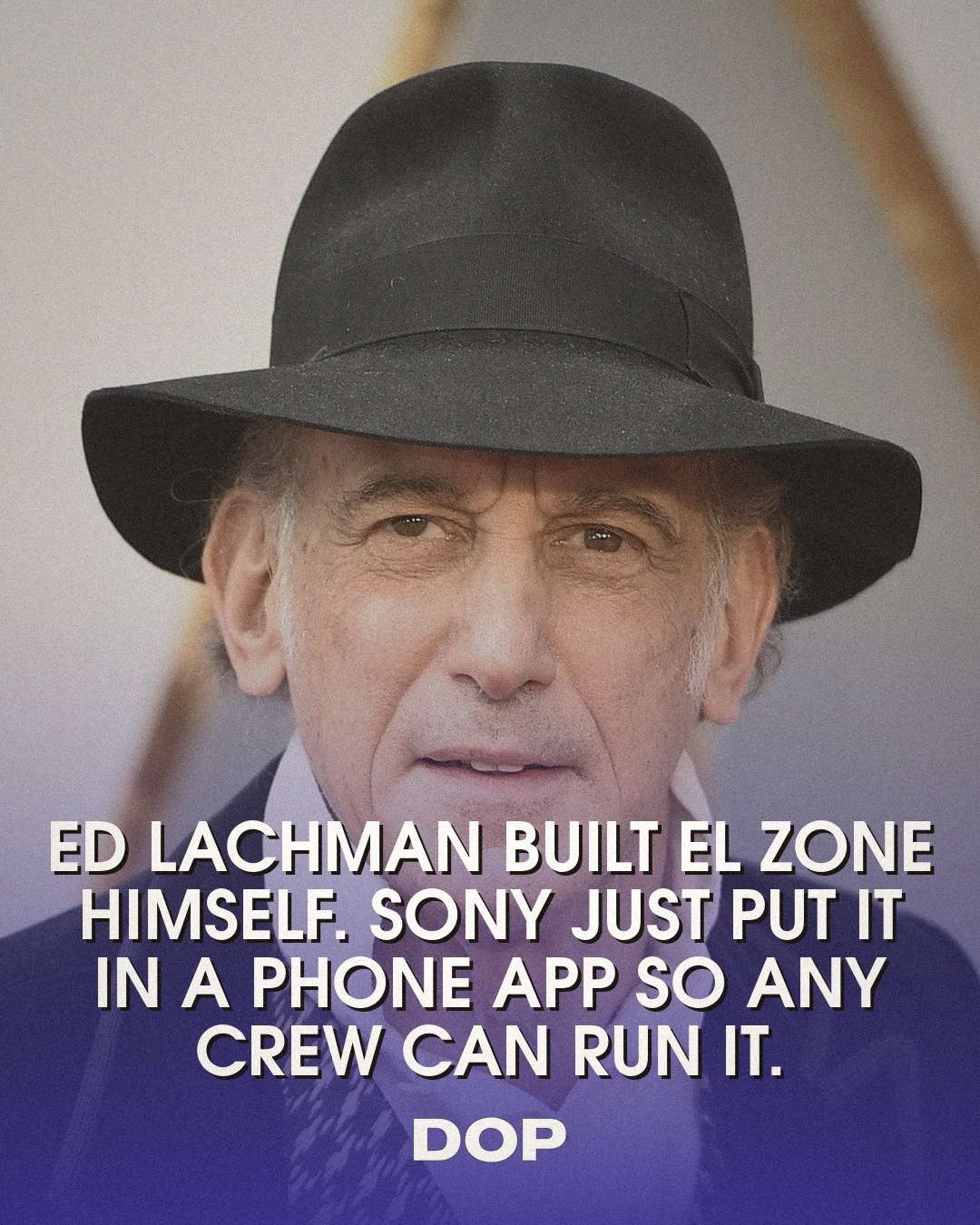
In the relentless pursuit of visual perfection, cinematographers have long grappled with the ephemeral nature of light and the precise art of capturing it. For decades, the mantra of 'expose for the highlights' or 'expose for the shadows' has guided our craft, often relying on a blend of technical expertise, intuition, and the subjective interpretation of waveform monitors and false color. But what if there was a system that could simplify this complex equation, offering a universal language for exposure that transcends individual monitoring solutions? Enter EL Zone, a revolutionary stop-based exposure system that promises to redefine how we perceive and manage light on set.
Conceived and patented by the legendary Ed Lachman, ASC, EL Zone is not merely another software update; it's a paradigm shift. Developed in collaboration with engineers Barry Russo and Marko Massinger, this ingenious system was integrated into Sony's Monitor & Control version 3.0, released on July 23rd. For those unfamiliar with Lachman's illustrious career, his filmography speaks volumes: from the stark, evocative frames of Carol and Far From Heaven to the raw, intimate portrayals in The Virgin Suicides and I'm Not There, Lachman's mastery of light and shadow is undeniable. His work often exhibits a painterly quality, a meticulous attention to color and texture that elevates storytelling.
The Philosophy Behind EL Zone: A Universal Language
At its core, EL Zone reads exposure in stops, directly correlating to a lens's T-stops and a light meter's readings. This seemingly straightforward concept unlocks profound implications for crew communication and consistency. Imagine a world where every member of the camera and lighting department, regardless of their monitor's calibration or false color preferences, can instantly understand and replicate an exposure value. This is the promise of EL Zone. It bypasses the often-confusing array of false color schemes, each manufacturer with its own interpretation, and instead provides a clear, numerical representation of exposure in a language all cinematographers intrinsically understand.
"EL Zone offers a universal language for exposure, allowing crews to rebuild lighting setups with unprecedented precision and consistency, even without a dedicated monitor."
This standardization is particularly critical for complex setups, multi-camera shoots, or when revisiting a location. A gaffer, for instance, can precisely dial in a light source to achieve a desired stop value, confident that the DP and camera operator will see the exact same information displayed on their monitors. This eliminates guesswork, reduces precious on-set time, and ensures a cohesive visual aesthetic across all captured footage. For a system born from the mind of Ed Lachman, whose visual precision is legendary, this pursuit of clarity and consistency feels entirely authentic to his artistic ethos.
Pioneering Use: El Conde and Beyond
The first feature film to boldly embrace EL Zone was Pablo Larraín's critically acclaimed El Conde, lensed, of course, by Lachman himself. This collaboration provided the perfect proving ground for the system, allowing Lachman to refine and validate its efficacy in a real-world, high-stakes production environment. While details on specific camera and lens choices for El Conde are often guarded, Lachman's past work frequently features a blend of classic and contemporary tools. He's known for his affinity for anamorphic glass, which often imparts a unique character and shallow depth of field, as seen in Carol. His choice of digital cinema cameras, such as ARRI Alexas or Sony VENICE, typically aligns with their robust dynamic range and nuanced color science, crucial for capturing the subtle gradations of light and shadow he masterfully employs.
The integration of EL Zone into El Conde likely played a significant role in achieving its distinctive visual style, allowing for meticulous control over the film's monochromatic palette and stark contrasts. It enabled Lachman and his team to push the boundaries of exposure, confident in the precise information EL Zone provided. This pioneering use underscores the system's potential not just for efficiency, but for artistic liberation, empowering cinematographers to make more informed and daring creative choices.
The Technical Edge: Sensor Choice and Lighting Philosophy
Lachman's technical approach often involves exploiting the full dynamic range of modern sensors. Whether he's working with the rich blacks and subtle highlight rolloff of an ARRI sensor or the expansive latitude of Sony's VENICE, his lighting philosophy is always about crafting depth and mood. He frequently employs soft, diffused light, often from large sources, to sculpt faces and environments, creating a naturalistic yet highly stylized look. The precision offered by EL Zone would have been invaluable in these scenarios, allowing him to precisely place key lights and fill lights to achieve specific stop values, ensuring that no detail was lost in the shadows or blown out in the highlights.
Consider the interplay of light and shadow in a film like Carol, where the period aesthetic is meticulously crafted through subtle lighting. EL Zone provides a tool to ensure that every scene maintains that delicate balance, regardless of changing ambient conditions or shot setups. It's a testament to Lachman's commitment to the craft that he not only pushes artistic boundaries but also contributes to the technological advancements that empower future generations of cinematographers. EL Zone isn't just a feature; it's a testament to the ongoing evolution of our art, a tool that will undoubtedly become indispensable in the cinematographer's arsenal, allowing for greater precision, communication, and ultimately, more compelling visual storytelling.
This article contains affiliate links. We may earn a small commission at no extra cost to you. Learn more.