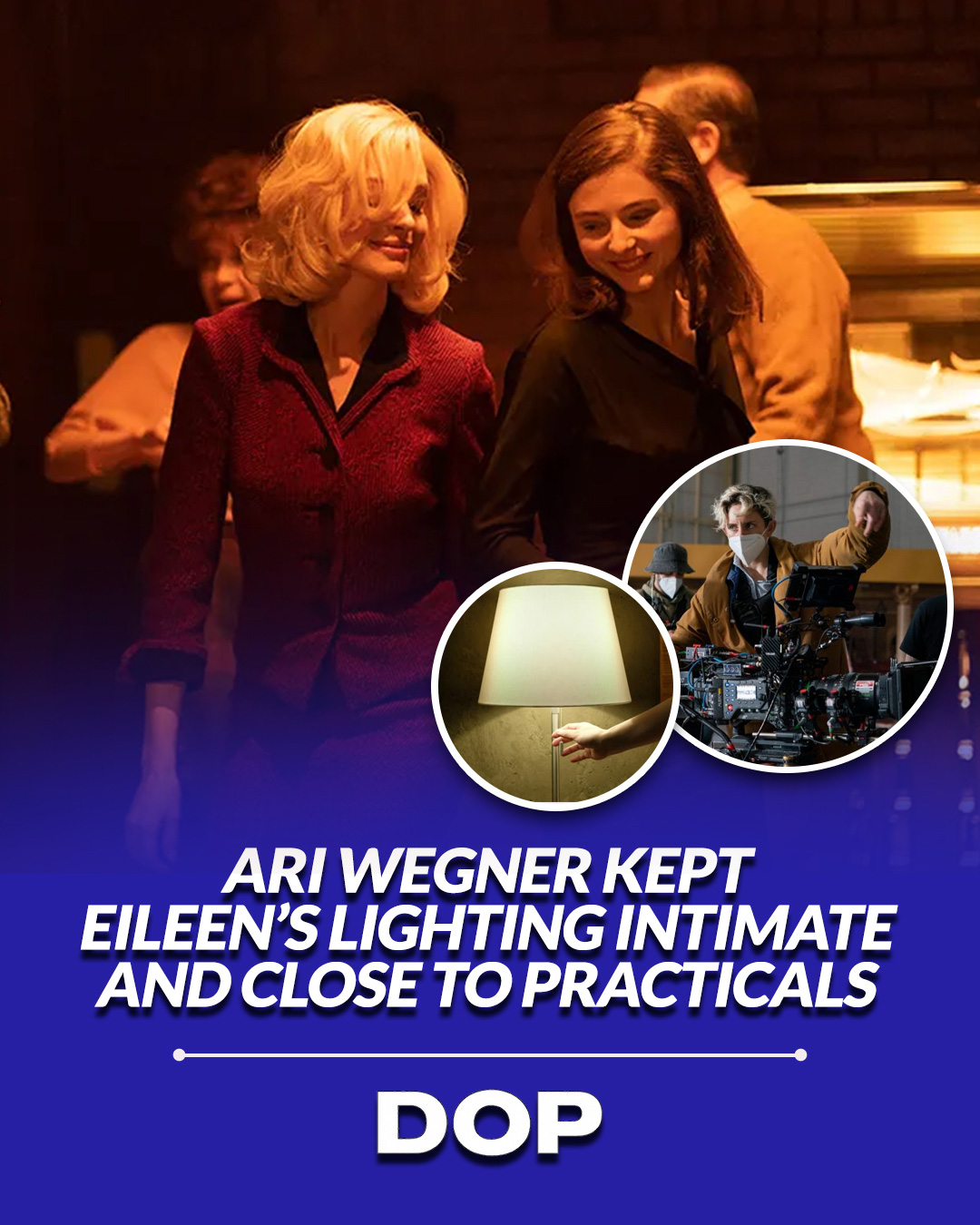
In William Oldroyd's psychological thriller Eileen, cinematographer Ari Wegner ASC, ACS once again demonstrates her unparalleled ability to craft atmosphere through meticulously controlled light. Far from the sprawling, epic landscapes of The Power of the Dog or the vibrant, sun-drenched palette of Lady Macbeth, Eileen plunges us into the claustrophobic interiors of 1960s suburban America, using light not as a grand statement, but as an intimate, almost conspiratorial whisper. Wegner's approach here is a masterclass for any DP navigating the challenges of small spaces and period authenticity: lean into the practical, embrace the shadow, and trust the narrative to guide every motivated source.
The film's visual language is defined by its commitment to verisimilitude, shunning overt stylization in favor of a raw, almost voyeuristic intimacy. Wegner achieves this by relying almost exclusively on practical lamps, available window light, and a judicious handful of motivated sources. This isn't just a stylistic choice; it's a philosophical one that grounds the film firmly in its era and its protagonist's internal world. The light in Eileen is never expansive or flattering; it's low, localized, and often oppressive, creating pools of illumination on faces while allowing the corners of rooms to recede into an inky murk. This technique transforms the mundane settings, small offices, dimly lit bars, and uninviting homes, into extensions of Eileen Dunlop's suffocating existence.
The Art of Motivated Darkness
Wegner's genius in Eileen lies in her ability to make the absence of light as potent as its presence. The film actively avoids the pitfall of over-lighting, a common temptation in interior scenes, especially when working with limited space. Instead, she meticulously selects which practicals are 'doing the job', a desk lamp, a kitchen fixture, a bar light, and then strategically augments them with just enough hidden support to make them register believably on camera. This support is often subtle: a small LED panel tucked out of frame, a bounce card reflecting a distant window, or a carefully flagged source to enhance a practical's throw. The result is an environment that feels lived-in, authentic, and perpetually on the verge of revealing a hidden truth.
"In Eileen, Ari Wegner shows how to work in cramped interiors without over-lighting: decide which practicals are 'doing the job,' then add just enough hidden support to keep them believable on camera."
The choice to keep the palette subdued and let shadows hang heavy serves a dual purpose. Aesthetically, it evokes the often drab and restrictive atmosphere of the 1960s, a period Wegner has demonstrated a keen eye for in her previous collaborations. Narratively, it allows the performances of Thomasin McKenzie and Anne Hathaway to carry the film's considerable tension. The low-key lighting forces the audience to lean in, to scrutinize the subtle shifts in expression, the furtive glances, and the unspoken anxieties that simmer beneath the surface. This isn't a film where the lighting announces itself; it's a film where the lighting *enables* the story, creating a private, almost suffocating space for the character study to unfold.
Technical Nuances: Sensor Choice and Lens Character
While specific camera and lens details for Eileen are often kept close to the vest, Wegner's consistent visual philosophy offers clues. Her previous work on The Power of the Dog, shot on ARRI ALEXA Mini LF with Panavision PVintage lenses, demonstrated a preference for large format sensors and lenses that offer a nuanced, organic fall-off and a pleasing textural quality. It's plausible that a similar approach, perhaps with a different set of vintage-inspired glass, was employed for Eileen to achieve its rich, yet subdued, aesthetic. The large format sensor's ability to render subtle gradations in shadow and its inherently shallower depth of field would have been instrumental in isolating characters within their confined spaces, further emphasizing their emotional isolation.
The color science in Eileen is another testament to Wegner's precision. Rather than a stark, desaturated look, the film presents a muted, almost melancholic palette. Warm tones from practical lamps are allowed to breathe, contrasting with the cooler, often overcast light from windows. This careful balance prevents the film from feeling monochromatic, instead imbuing it with a sense of quiet resignation. The interplay of these limited color temperatures, combined with the strategic use of shadow, creates a visual texture that is both stark and strangely inviting, drawing viewers deeper into Eileen's unsettling world. It’s a testament to Wegner’s mastery that she can achieve such rich emotional depth with what appears to be such a restrained lighting scheme.
For cinematographers, Eileen is more than just a well-shot film; it's a masterclass in the power of restraint. It's a reminder that sometimes, the most impactful lighting is the least ostentatious. By understanding the psychology of light and shadow, and by trusting the inherent drama of the scene, Wegner demonstrates how to craft an immersive, character-driven experience, even in the most modest of settings. It’s a powerful argument for motivated sources, practical lamps, and the profound emotional resonance that can be found in the art of motivated darkness. This film solidifies Ari Wegner's reputation not just as a talented DP, but as a true artisan of cinematic storytelling.
This article contains affiliate links. We may earn a small commission at no extra cost to you. Learn more.