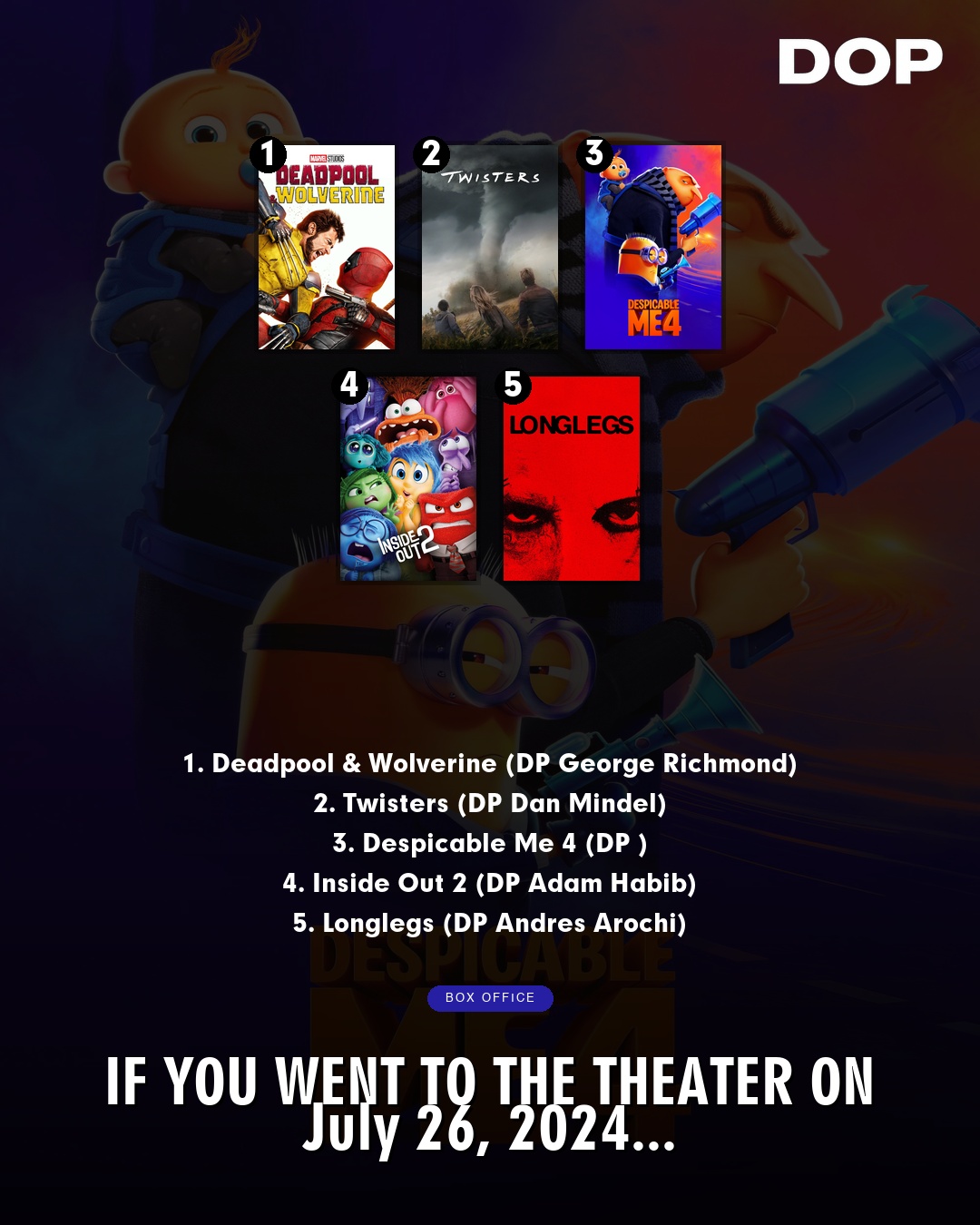
The summer of 2024 delivered an unprecedented confluence of cultural events, from political seismic shifts to global sporting spectacles. Yet, for cinephiles and industry insiders, July 26th marked a different kind of phenomenon: a cinematic showdown where three distinct visual languages vied for audience attention. While the headlines screamed about political succession and Olympic fanfare, the box office told a story of visual artistry, with George Richmond's explosive work on *Deadpool & Wolverine*, Dan Mindel's visceral approach to *Twisters*, and Shawn Kim's unsettling aesthetic for *Longlegs* each leaving their indelible mark.
At the apex of this weekend's cinematic mountain stood *Deadpool & Wolverine*, not just as a box office behemoth, but as a testament to George Richmond's evolving mastery of large-scale action. Richmond, a DP known for his robust, dynamic lensing on films like *Kingsman: The Secret Service* and *Rocketman*, brought a vibrant, yet grounded, energy to the MCU's R-rated entry. His choice of anamorphic lenses, often a signature of his work, likely played a crucial role in crafting the film's widescreen spectacle, allowing for expansive compositions that frame both the chaotic action and the intimate character moments with equal weight. The challenge of balancing the comic book's irreverent tone with the demands of a high-stakes blockbuster required a delicate visual hand, one that Richmond clearly possessed.
The Art of Controlled Chaos: Richmond's Deadpool & Wolverine
Richmond's cinematography on *Deadpool & Wolverine* undoubtedly leaned into a heightened reality, employing sophisticated lighting techniques to sculpt the often-fantastical environments. Consider the intricate dance between practical and LED lighting, a staple in modern blockbuster production, which would have been essential for achieving the film's signature look, a blend of gritty realism and vibrant, comic-book pop. His meticulous attention to color science, ensuring that the vivid hues of the characters' costumes and the fantastical effects maintained their impact without becoming oversaturated, is a hallmark of his craft. The success of the film, beyond its star power, rests heavily on its visual coherence, pulling audiences into a world that is both absurd and surprisingly tactile.
“The true magic of cinematography isn't just in what you see, but in how it makes you feel. It's about translating emotion into light and shadow.”, George Richmond (on previous work)
Shifting gears entirely, Dan Mindel's return to the disaster genre with *Twisters* presented a different set of visual challenges. Mindel, a frequent collaborator with J.J. Abrams on films like *Star Trek* and *Star Wars: The Force Awakens*, is celebrated for his ability to craft immersive, high-stakes environments. His work often features a raw, almost documentary-style approach to action, utilizing dynamic camera movement and a keen understanding of natural light to enhance the sense of urgency and chaos. For *Twisters*, one can anticipate a reliance on practical effects augmented by cutting-edge VFX, all captured through a lens that prioritizes immersion. The sheer scale of the tornadoes, coupled with the intimate human drama, would have demanded a versatile lighting strategy, from the ominous glow of a storm-laden sky to the frantic, flickering light within a damaged shelter. Mindel's penchant for lens flares, often used to great effect in his sci-fi work, could also have found a compelling application here, adding a visceral punch to the swirling maelstroms.
Atmosphere and Dread: Kim's Longlegs and Mindel's Twisters
Then there's Shawn Kim's work on *Longlegs*, a film that, despite its more modest box office, garnered significant critical attention for its unsettling visual style. Kim, known for his atmospheric and often disquieting cinematography on films like *It Follows* and *The Lodge*, is a master of building dread through light and shadow. His approach is less about grand spectacle and more about meticulous composition, using negative space and ambiguous lighting to create a sense of unease. For *Longlegs*, one would expect a palette dominated by muted tones, deep contrasts, and a deliberate use of shallow depth of field to isolate characters and emphasize psychological horror. The choice of camera and lens here would be crucial, perhaps favoring older, characterful glass that introduces subtle imperfections, or a sensor known for its low-light performance to achieve those deep, inky blacks that define the genre. Kim's ability to make the mundane feel menacing is a testament to his understanding of the psychological impact of visual storytelling, proving that sometimes, less light can reveal far more.
The stark contrast between these three films, both in genre and visual approach, offers a fascinating snapshot of contemporary cinematography. Richmond's *Deadpool & Wolverine* showcases the pinnacle of blockbuster visual engineering, Mindel's *Twisters* embodies high-octane realism, and Kim's *Longlegs* delves into the chilling power of atmospheric horror. Each DP, with their distinct stylistic fingerprints, contributed significantly to the cultural fabric of that eventful July weekend, reminding us that while the narratives may differ, the art of visual storytelling remains a powerful, captivating force.
From the explosive action of the MCU to the terrifying beauty of a supercell, and the creeping dread of psychological horror, the cinematographers behind these films demonstrated the breadth and depth of their craft. They didn't just capture images; they crafted experiences, shaping our perceptions and emotions through the careful manipulation of light, color, and composition. As the industry continues to evolve, these DPs stand as prime examples of how technical prowess, combined with artistic vision, continues to elevate the cinematic experience.
This article contains affiliate links. We may earn a small commission at no extra cost to you. Learn more.