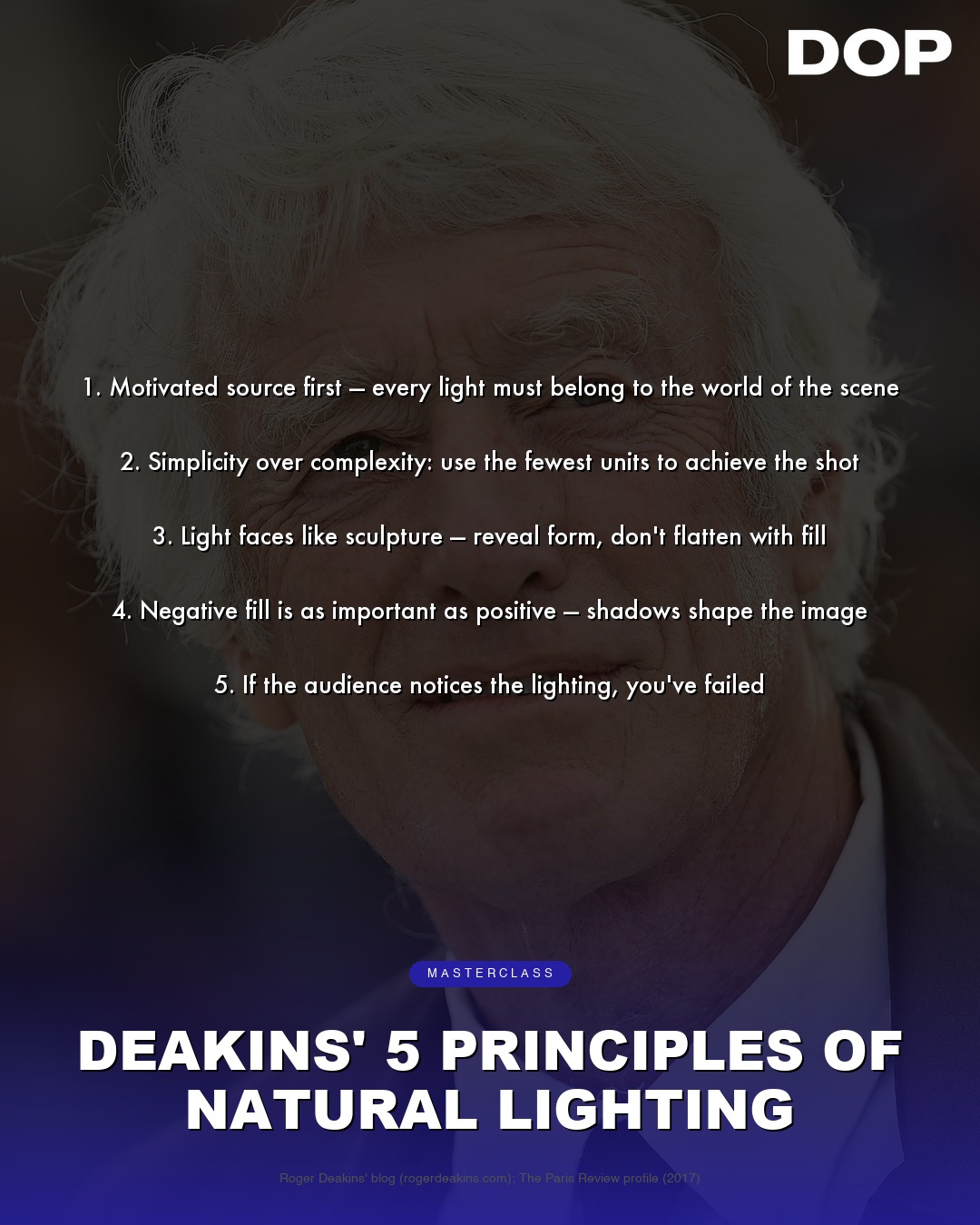
In the vast, often overwhelming landscape of modern cinematography, where technology continually offers new avenues for creative expression, the foundational principles of visual storytelling remain paramount. Few cinematographers embody this ethos with such elegant consistency as Roger Deakins, ASC, BSC. His work, from the stark beauty of Sicario to the painterly grandeur of 1917, consistently demonstrates a profound understanding of light – particularly natural light. Recently, Deakins distilled his philosophy into five core principles, a masterclass in brevity and insight that every serious practitioner of the craft should engrave into their creative DNA. These aren't mere suggestions; they are the bedrock upon which truly compelling visual narratives are built.
The Authenticity of Illumination
Deakins' first and arguably most crucial principle is: Motivated source first – every light must belong to the world of the scene. This is not merely about hiding your lights; it's about the very soul of the image. When light feels organically integrated, whether it's a practical lamp, a window, or even the glow of a distant fire, it grounds the audience in the reality of the narrative. Unmotivated light, conversely, pulls the viewer out, reminding them they are watching a constructed image. Think of the subtle, almost imperceptible shifts in light in No Country for Old Men, where the sun tracking across a dusty motel room feels as much a character as Llewelyn Moss. This commitment to motivation often dictates camera placement, blocking, and even set design, forcing the entire crew to consider the source before the effect.
Following closely is the imperative for Simplicity over complexity: use the fewest units to achieve the shot. In an era of ever-expanding lighting packages, Deakins champions restraint. This isn't about being cheap; it's about clarity and impact. A single, well-placed source, correctly shaped and diffused, often yields a more profound emotional resonance than a dozen lights fighting for dominance. This minimalist approach forces the cinematographer to truly understand the quality of light – its direction, intensity, and color temperature – rather than simply throwing more light at a problem. The stark, singular key lights often seen in his interiors, sculpted by carefully positioned negative fill, are a testament to this philosophy.
The Human Element: Exposing for Emotion
Perhaps the most challenging and often misunderstood principle for emerging DPs is: Expose for the face, not the meter – read skin tones, not incident readings. This isn't a dismissal of technical tools but a re-prioritization. The human face is the primary canvas for emotion in cinema. If the face is incorrectly exposed – too dark, too bright, or with incorrect color – the emotional impact is lost, regardless of how 'technically correct' other elements of the frame might be. Deakins' ability to render skin tones with such naturalism, whether under the harsh sun of Prisoners or the flickering candlelight of The Assassination of Jesse James by the Coward Robert Ford, is legendary. He trusts his eye and his understanding of how light interacts with flesh, often pushing the boundaries of what a light meter might suggest for the sake of character and mood.
“Expose for the face, not the meter – read skin tones, not incident readings.”
The practice of Negative fill before adding light – subtract before you add is a corollary to simplicity and a cornerstone of controlled contrast. Before reaching for another light, Deakins asks: can I shape the existing light by blocking it, absorbing it, or redirecting it? Negative fill, often achieved with flags, solids, or black fabric, is used to deepen shadows, control spill, and create separation. It's a sculptor's approach, chipping away at excess to reveal the desired form. This technique is evident in the precise fall-off on faces and the enhanced dimensionality that characterizes much of his work, ensuring that even in brightly lit scenes, there is always a compelling interplay of light and shadow.
Embracing the Environment
Finally, and perhaps most liberatingly, Deakins advises: Never fight the location – find what it's already giving you. This principle is an ode to collaboration with the environment. Instead of imposing a pre-conceived lighting scheme onto a space, a great cinematographer observes, understands, and then enhances the existing light. Is there a beautiful quality of light from a window? Can the practicals be augmented? Does the natural light suggest a particular time of day or mood? This approach, which Deakins has mastered across countless films shot on location, allows for a more organic and believable aesthetic. It respects the inherent character of a space, turning potential challenges into creative opportunities. His work on Blade Runner 2049, for example, masterfully integrates the existing industrial and urban light sources, transforming them into key narrative elements rather than battling against them.
These five principles are not just technical guidelines; they are a philosophy for visual storytelling. They encourage observation, restraint, and an unwavering focus on the human element within the frame. In an age of digital tools and endless possibilities, Deakins reminds us that the most powerful cinematography often stems from the simplest, most authentic sources of light, guided by an artist's discerning eye and a deep respect for the narrative.
This article contains affiliate links. We may earn a small commission at no extra cost to you. Learn more.