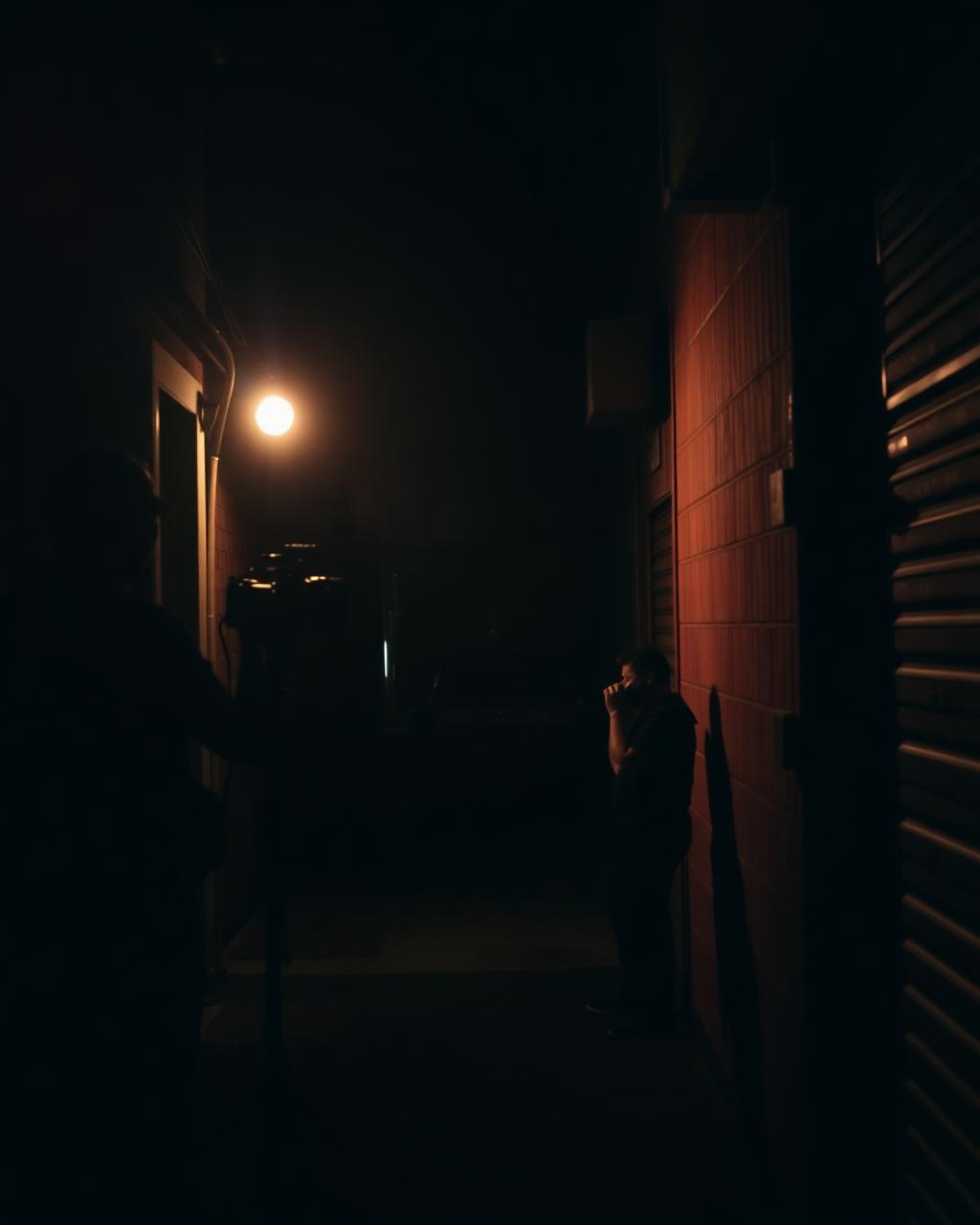
In In a Whisper, Leyla Bouzid's Berlinale 2026 film, cinematographer Lucas Goepfert used an approach to interior lighting that makes darkness itself a statement. The film is set in a family house in Sousse, Tunisia—a space that becomes the primary visual argument about what this family will not illuminate, what conversations will not happen, what truths will remain in shadow. This is not atmospheric cinematography. It is autobiographical.
Goepfert's strategy is straightforward: strong exterior light, rooms left in semi-darkness, characters appearing in backlight as silhouettes or near-silhouettes inside the house. A character in an interior space is often lit by light that comes from outside—a window, a doorway—creating a bright rim around their form while their face and body exist in relative darkness. This technique creates a visual paradox: the character is present and visible, but their face is obscured. We see their outline. We see their shape. We do not see their expression.
In conventional cinematography, backlight is used to separate the character from the background, to create dimensionality, to add visual interest to compositions that might otherwise be flat. Goepfert's use of backlight in In a Whisper serves a different function. It photographs the family's emotional truth: they are present with each other, but disconnected. They occupy the same space, but do not communicate openly. The darkness is not a lighting problem. It is the subject of the film.
The film explores queer erasure within a family structure—inherited silence around identity, desire, and authenticity. Every room that stays dark is a conversation that never happened. Every backlit figure is a person whose internal life is not accessible to the family around them. The cinematography does not narrate this theme. It photographs it directly. The darkness is not metaphorical. It is literal. The family keeps its space dim. The family does not illuminate its inhabitants.
Goepfert's approach requires discipline. It would be easier to add fill light, to bring up the shadows, to make the faces visible. This would make the cinematography more conventionally attractive and would allow the viewer to read more information from the actors' faces. Instead, Goepfert chose to withhold that information. By keeping the interiors in semi-darkness, by using backlight to obscure faces, by refusing to soften the shadows or brighten the rooms, he makes a cinematographic argument that aligns with the story's deepest concern.
The exterior brightness—the Tunisian light that floods through windows and doorways—creates the contrast that makes the interior darkness visible. If the interior were simply lit to a low level of brightness, the darkness would read as night or as technical limitation. But because Goepfert contrasts strong exterior light with interior darkness, the darkness reads as intentional, as chosen, as a property of the space itself.
For cinematographers approaching stories about hidden truths or inherited silence, Goepfert's work in In a Whisper demonstrates that cinematography can function as a direct photographic statement about narrative content. Darkness is often a technical challenge. Here, darkness is the point. The cinematography says: this family lives in shadow. Not because the house lacks light sources. Because the family does not illuminate itself. The cinematography trusts the viewer to understand that the difficulty of seeing the characters' faces is not a limitation of the cinematography. It is what the story requires.
Gear Recommendations
- DJI Ronin 4D-8K – Amazon
- Tiffen Variable ND Filter | Adorama – B&H Photo
- Blackmagic Pocket Cinema Camera 6K Pro | Adorama – B&H Photo
- SmallHD Ultra 7 Monitor | Adorama – B&H Photo
Note: Links above are affiliate links. Occupy Cinematography may earn a commission on qualifying purchases at no additional cost to you.