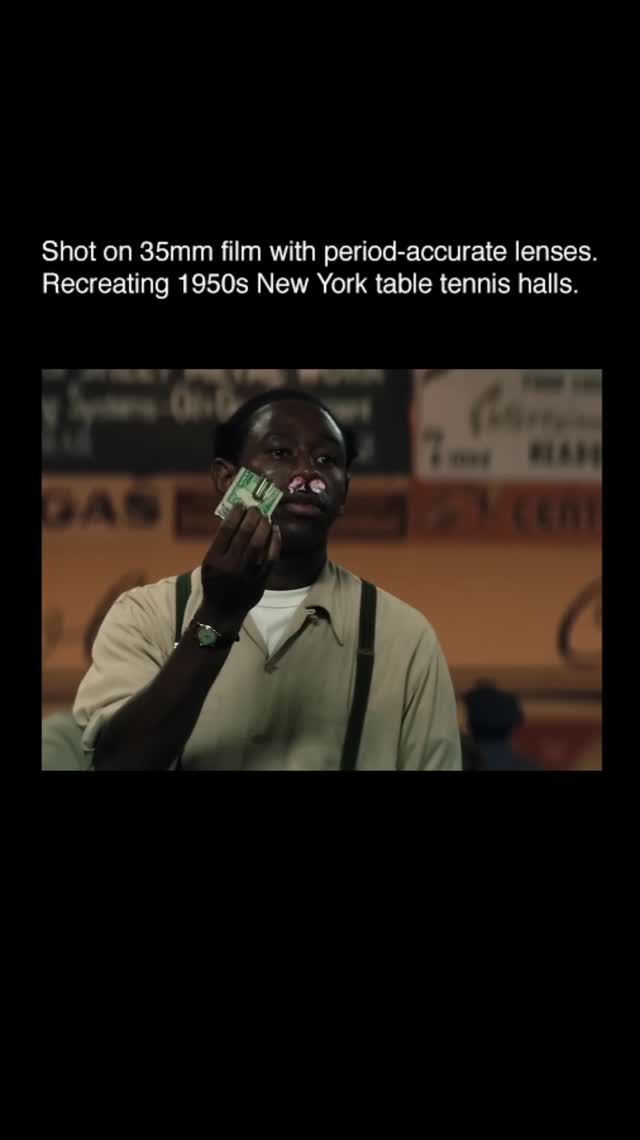
In an era increasingly dominated by the pristine, often sterile, clarity of digital acquisition, cinematographer Darius Khondji's nomination for Marty Supreme serves as a powerful testament to the enduring, irreplaceable magic of celluloid. For those of us who live and breathe the intricacies of visual storytelling, Khondji’s work on this film is more than just a beautiful image; it’s a masterclass in intentional, period-accurate craftsmanship, leveraging the very soul of 35mm to transport audiences into the sweaty, claustrophobic world of 1950s New York table tennis halls.
Khondji, a DP whose filmography spans the gritty neo-noir of Se7en to the frenetic, anxiety-inducing aesthetics of Uncut Gems, and the dreamlike introspection of Bardo, False Chronicle of a Handful of Truths, possesses a unique ability to tailor his visual language precisely to the narrative's demands. With Marty Supreme, his collaboration with director Josh Safdie appears to have been a synergistic exploration of texture, mood, and historical authenticity. The choice to shoot on 35mm wasn't merely an aesthetic preference; it was a foundational decision to imbue the film with a tactile, almost palpable sense of its era.
The Grain and Grit of 1950s New York
The inherent grain structure of 35mm film stock is a character unto itself in Marty Supreme. It’s a quality that digital cinematography, despite its advances, still struggles to authentically replicate. While digital grain simulations can be effective, they rarely capture the organic, unpredictable dance of actual silver halide crystals reacting to light. This natural grain, coupled with period-accurate lenses, immediately grounds the audience in the mid-20th century. We're not just observing the 1950s; we're feeling its grit, its imperfections, its lived-in reality. This decision speaks volumes about Khondji's dedication to historical fidelity, understanding that the medium itself contributes as much to the period feel as the costumes and production design.
“The inherent grain structure of 35mm film stock is a character unto itself in Marty Supreme. It’s a quality that digital cinematography, despite its advances, still struggles to authentically replicate.”
The choice of lenses would have been critical here. While the specific glass used isn't mentioned, one can infer a preference for anamorphic or spherical lenses from the era, known for their distinct optical imperfections: softer edges, unique flaring characteristics, and a particular way of rendering bokeh. These aren't flaws to be corrected; they are features to be embraced, contributing to the visual texture and period authenticity that define the film's look. Modern, surgically sharp lenses, while technically superior, would have been antithetical to the desired aesthetic, pulling the audience out of the 1950s immediacy.
Sweat, Claustrophobia, and Practical Illumination
Khondji's collaboration with Josh Safdie on creating a “sweaty, claustrophobic atmosphere” is particularly intriguing, especially concerning the competition sequences. This description immediately brings to mind the intense, almost unbearable tension Khondji helped craft for the Safdie brothers' Uncut Gems, where the camera itself felt like an anxious participant. In Marty Supreme, the challenge would have been to translate that same visceral energy to a different era and setting.
The reliance on practical lighting in these table tennis halls is a key element of this claustrophobic effect. Instead of relying on a vast array of hidden film lights, Khondji and his team likely utilized and augmented the existing light sources – fluorescent tubes, bare bulbs, and perhaps even period-appropriate fixtures – to shape the scene. This approach not only enhances realism but also inherently limits and defines the light, creating pools of harsh illumination and deep shadows that contribute to a sense of being hemmed in. The light wouldn’t be sculpted for beauty, but for truth, emphasizing the sweat, the desperation, and the raw physicality of the players.
Consider the color science at play: shooting on 35mm, Khondji would have had a specific film stock in mind, one chosen for its particular color rendition and latitude. Coupled with the practical lighting, this would dictate the film’s overall palette – perhaps favoring warmer tones under incandescent bulbs or a cooler, starker look under fluorescents, all contributing to the emotional tenor of the scenes. The interplay of these elements – film stock, period lenses, practical lighting – creates a holistic visual experience that goes far beyond simply capturing an image; it crafts an entire world.
Darius Khondji's nomination for Marty Supreme is a timely reminder that the art of cinematography is not about chasing the latest technological trend, but about making deliberate, informed choices that serve the story. His work on this film stands as a beacon for DPs who believe in the power of texture, the poetry of grain, and the immersive authenticity that only a deeply considered, hands-on approach to image-making can achieve. It's a celebration of the analog soul in a digital age, and a powerful argument for the continued relevance of film as a medium for profound cinematic expression.
This article contains affiliate links. We may earn a small commission at no extra cost to you. Learn more.