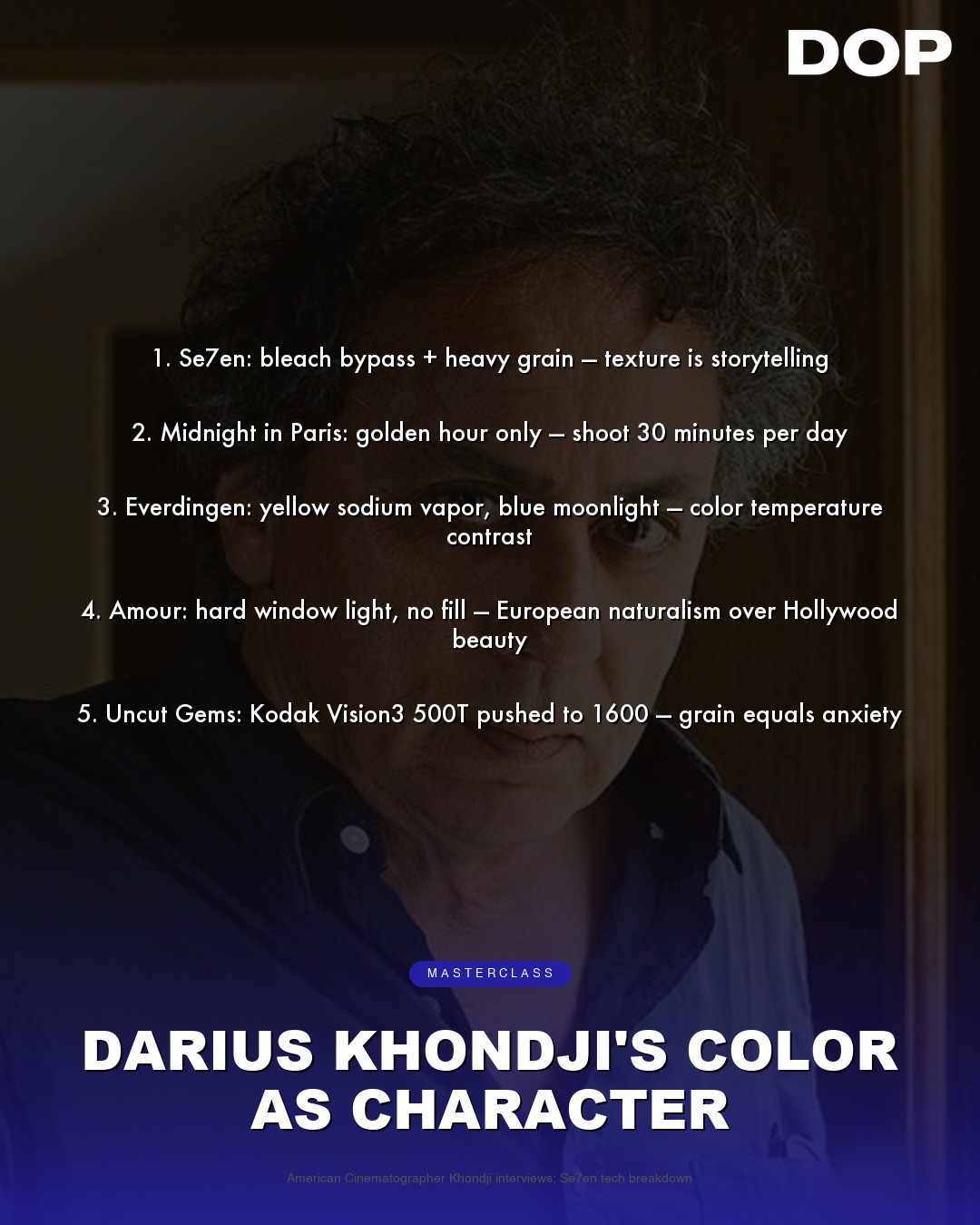
Darius Khondji, ASC, AFC, is a name synonymous with a visual language that is at once meticulous, evocative, and deeply psychological. His filmography reads like a masterclass in atmospheric storytelling, where every frame is imbued with a deliberate sense of mood and meaning. Recently, Khondji shared insights into his craft, articulating a philosophy that elevates color beyond mere aesthetic choice, positioning it as an integral component of character development and narrative temperature. For Khondji, color is not just seen; it is felt, understood, and experienced as a moral dimension within the story world.
Consider the stark, unforgiving palette of David Fincher's Se7en. Khondji famously employed a bleach bypass process, pushing the film stock to its limits to achieve a desaturated, high-contrast look that became iconic. This wasn't merely a stylistic flourish; it was a deliberate narrative choice. The heavy grain, a byproduct of the process, added a grimy, tactile texture that mirrored the film's decaying urban landscape and the moral rot at its core. It’s a profound example of how process choices, like silver retention in the lab, directly translate into thematic weight. The ENR process, a silver retention technique, further allowed Khondji to achieve incredible density in the blacks without sacrificing crucial shadow detail, maintaining control over the image's inherent bleakness.
The Spectrum of Storytelling: From Decay to Radiance
The contrast between Se7en and films like Woody Allen's Midnight in Paris perfectly encapsulates Khondji's versatility and his 'color as character' ethos. For Midnight in Paris, Khondji embraced an entirely different approach, committing to shooting almost exclusively during the golden hour. This wasn't just about pretty pictures; it was about imbuing Paris with a nostalgic, romantic glow that reflected the protagonist's idealized vision of the past. The discipline required to shoot only 30 minutes a day for that specific warmth speaks volumes about his dedication to achieving a precise emotional resonance, demonstrating that sometimes, less time on set with the right light yields infinitely more impact.
This deliberate manipulation of color to convey moral temperature is a recurring motif in Khondji's work. In Alan Parker's Evita, for instance, the warmth of the palette often correlates with Eva Perón's ascent and public persona, while other scenes might shift to cooler tones to suggest vulnerability or political machinations. It’s a subtle but powerful visual language, where the color grade becomes a barometer of the narrative's emotional and ethical climate. This is not about arbitrary color schemes; it's about deep thematic integration, where the visual texture of the film reinforces its underlying themes.
"Color is not just an aesthetic choice; it's a moral temperature, a character trait, a narrative force that shapes how an audience experiences a story."
Mastering Light: Augmentation, Not Replacement
Khondji's approach to lighting further underscores his commitment to authenticity and evocative storytelling. His philosophy is one of augmentation, not replacement. He famously advocates for enhancing available light rather than overwhelming it with artificial sources. The anecdote of 'a candle and a bounce card beating a Kino' is a testament to this principle. It speaks to a profound understanding of light's inherent qualities – its natural fall-off, its softness, its directionality – and the art of coaxing out its cinematic potential with minimal intervention.
This isn't to say Khondji shies away from complex lighting setups, but rather that his starting point is always the existing light, whether it’s a sunbeam through a window or the warm glow of a practical lamp. He then uses carefully chosen tools – a bounce, a flag, a single well-placed light – to sculpt and refine, shaping the scene to achieve the desired mood without sacrificing its organic feel. This meticulous attention to light, combined with his unparalleled command over color, solidifies Darius Khondji's legacy as a true master of cinematography, whose work continues to inspire and challenge our understanding of visual storytelling.