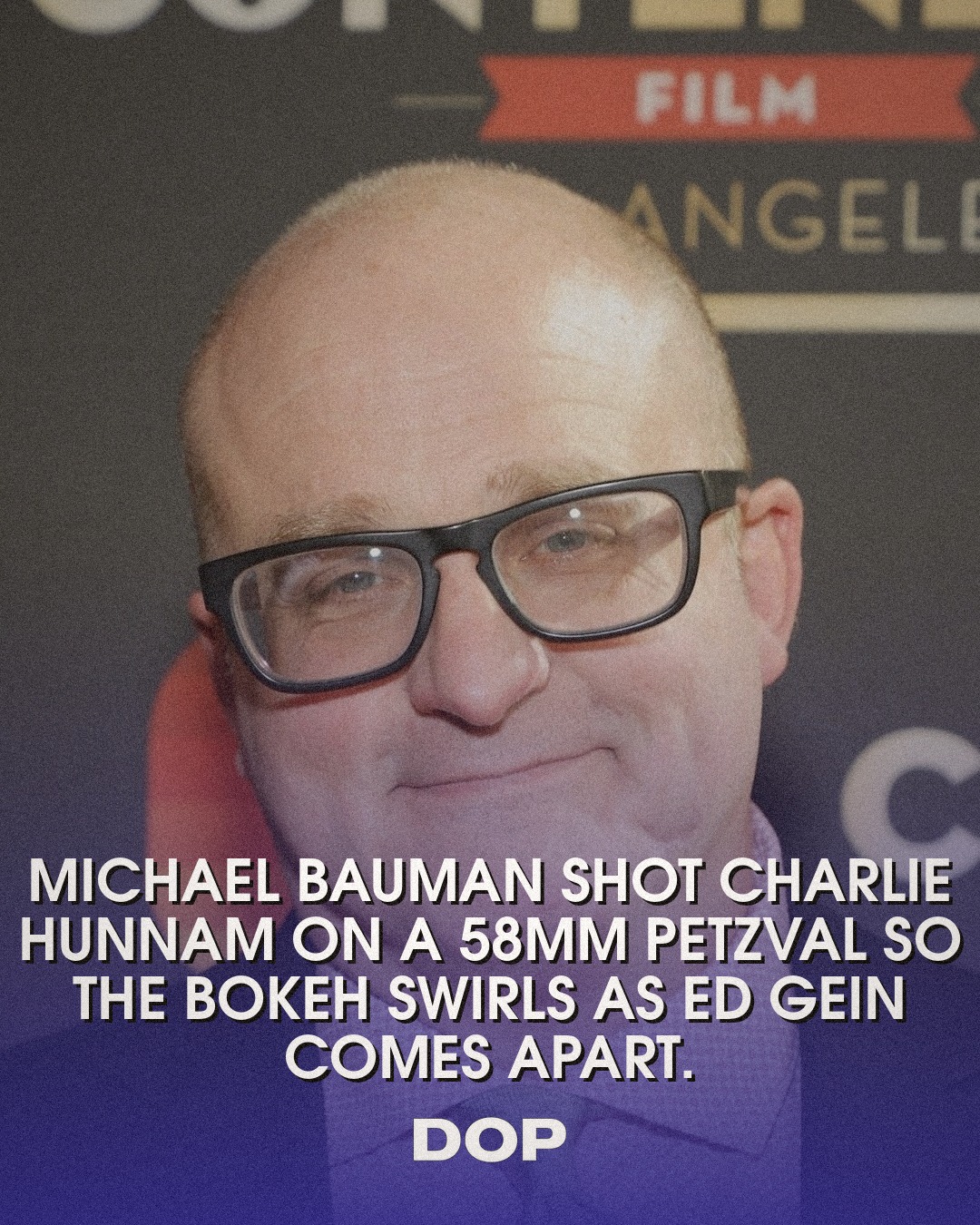
When rendering the grim topography of American true crime on screen, cinematography often teeters on a razor's edge between stark documentary realism and stylized psychological dread. For Netflix’s Monster: The Ed Gein Story, Emmy-nominated Director of Photography Michael Bauman embraced the latter with uncompromising visual intent. Rather than relying on contemporary horror tropes, Bauman returned to the tactile, imperfect textures of mid-century optical craft and period-authentic lighting physics to immerse viewers in the unhinged interiority of Plainfield, Wisconsin's most notorious recluse.
Vintage Panavision Glass and the Petzval Swirl
Central to Bauman’s visual language was a deliberate rebellion against digital sharpness. Collaborating closely with the optical engineers at Panavision, the cinematographer curated a suite of detuned vintage optics designed to degrade the image organically at the periphery. The centerpiece of this optical arsenal was an adapted 58mm Petzval lens, a design originating in the 19th century known for its intense central sharpness surrounded by extreme astigmatism and distinctive rotational bokeh.
“We worked with Panavision on vintage glass, including a 58mm Petzval lens, which has a swirly bokeh pattern that happens as you shoot at certain stops,” Bauman noted. “It pulls the audience directly into Ed's fractured state of mind.”
On modern high-resolution sensors, the Petzval design generates a violent field curvature. When opened up to wide apertures, the background doesn't simply fall out of focus; it warps and spirals around the subject. Bauman harnessed this aberration during pivotal psychological sequences, physically bending the frame around Gein to visually represent the character’s detachment from reality. This technique recalls Bauman’s masterclass work alongside Paul Thomas Anderson on projects like Phantom Thread and Licorice Pizza, where analog texture and bespoke glass served as primary story engines.
The Radiance of Kerosene and Period Practicality
In designing the light for Gein’s decaying farmhouse, historical fidelity drove every aesthetic decision. Working in lockstep with production designer Matthew Flood Ferguson, Bauman recognized a crucial historical detail: rural Central Wisconsin was among the slowest regions to adopt the electrical grid. For Gein’s isolated home in the 1950s, illumination did not emanate from tungsten bulbs, but from the low, flickering amber of kerosene lanterns.
This limitation dictated a high-contrast, low-key lighting scheme. Rather than bathing sets in soft ambient fill, Bauman embraced deep, unforgiving negative fill and single-source dominance. Working with modern LED units color-matched to the warm 1800K, 2200K spectrum of open flame, the camera department simulated the fragile, erratic pulse of oil wick lamps. The resulting imagery treats shadow not as empty space, but as a suffocating, tactile presence that conceals the grotesque horrors harbored within the farmhouse walls.
Architectural Confinement: Frames Within Frames
Beyond optical distortion and low-key exposure, Bauman partnered with director Max Winkler to devise a compositional strategy rooted in spatial claustrophobia. The duo consistently constructed nested frames, shooting past door jambs, through grimy window panes, and down cramped, wood-paneled corridors. By slicing the wider sensor aspect ratio into narrow vertical segments of architecture, Gein is perpetually depicted as a prisoner of his own environment.
This formalist rigor elevates the series above typical genre fare. By combining historically motivated lighting, spatial compression, and the hypnotic optical defects of bespoke Petzval glass, Michael Bauman crafts an immersive portrait of isolation. His work on Monster: The Ed Gein Story stands as a definitive blueprint for how modern cinematographers can use historical optical physics to tell deeply unsettling, character-driven visual stories.