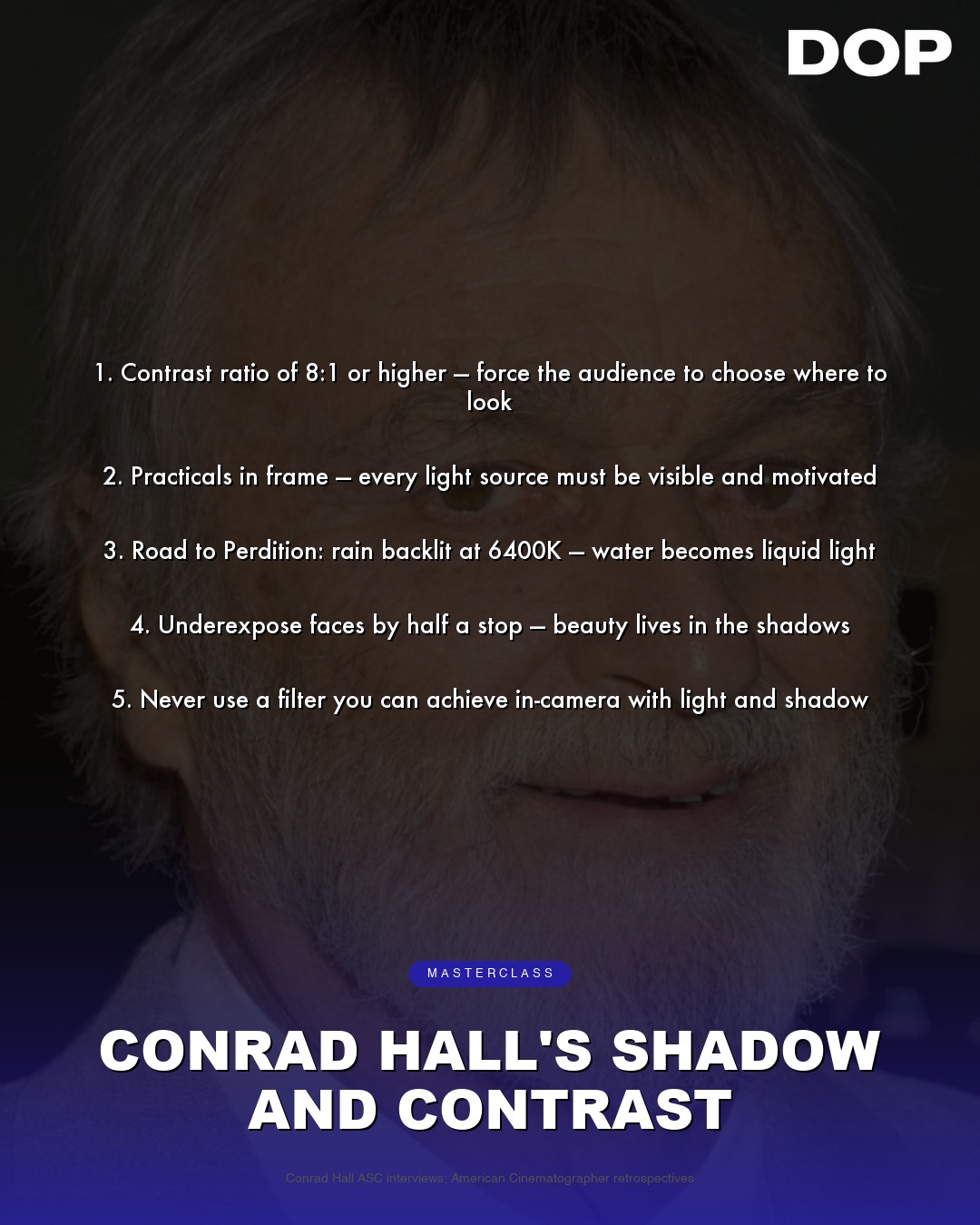
Conrad L. Hall, ASC, was not merely a cinematographer; he was a visual poet, a sculptor of light and shadow whose philosophy transcended mere technical proficiency. His work, gracing such masterpieces as In Cold Blood, Butch Cassidy and the Sundance Kid, and American Beauty, redefined what was possible within the frame. Hall's enduring legacy is built on a profound understanding of how light, or the absence thereof, can shape narrative, evoke emotion, and guide the viewer's gaze. The principles he espoused are not just technical directives but philosophical tenets for visual storytelling.
One of Hall's most potent weapons was contrast. He famously championed a contrast ratio of 8:1 or higher, a bold statement in an era where many DPs sought a more evenly lit aesthetic. This wasn't about creating harsh, unpleasing images; it was about intentionality. By pushing the boundaries of light and shadow, Hall forced the audience to actively engage with the frame, to choose where their eye would fall. This deliberate visual hierarchy ensured that every highlight and every deep shadow served a narrative purpose. Think of the stark, chiaroscuro lighting in In Cold Blood, where the psychological torment of the characters is mirrored in the unforgiving interplay of light and dark. It wasn't just illumination; it was an emotional landscape.
The Authenticity of Light Sources
Hall's insistence on "practicals in frame" speaks volumes about his commitment to motivated and authentic light. For him, every light source had to be justified, visible, and integrated into the world of the film. This wasn't a rigid rule to be followed blindly but a guiding principle to ground the visual language in reality. Whether it was a flickering lamp in a dusty saloon or the muted glow of a neon sign, the origin of the light was as important as the light itself. This approach lends a tactile reality to his cinematography, making the environments feel lived-in and the characters illuminated by the very world they inhabit. It's a testament to his belief that the magic of cinema comes from revealing, not concealing, the sources of its illusion.
"Flare is honesty – if the sun is in the world, let it hit the lens."
The embrace of lens flare, once considered an undesirable artifact, became another hallmark of Hall's honest approach. "If the sun is in the world, let it hit the lens," he declared. This wasn't about gratuitous visual flourish but about acknowledging the physical reality of the camera's interaction with light. When shooting on film with lenses that were less resistant to flare than modern optics, Hall saw these optical phenomena not as flaws but as organic elements that added a layer of authenticity and immediacy. It broke the fourth wall in a subtle, almost subconscious way, reminding the viewer of the camera's presence and the raw, unfiltered nature of the moment. This philosophy is particularly evident in the sun-drenched landscapes of Butch Cassidy and the Sundance Kid, where flares often punctuate the vastness of the American West, adding to its untamed beauty.
The Power of Backlight and Embracing Imperfection
Hall's maxim, "Backlight reveals texture – frontal light flatters, backlight reveals truth," is a fundamental lesson in the art of three-dimensional imaging. Frontal light can indeed be beautiful, but it often flattens subjects, reducing their dimensionality. Backlight, however, carves out forms, separates subjects from their backgrounds, and most importantly, reveals the intricate textures and contours that define them. It adds depth, drama, and a sense of realism. Consider the way Hall used backlight to sculpt faces and hair, giving them a luminous quality that felt both ethereal and grounded. This technique wasn't just aesthetic; it was a way to imbue subjects with a deeper, more profound presence.
Perhaps one of Hall's most radical ideas was the notion that "ugly light can be beautiful." This principle is famously exemplified in his work on Road to Perdition, where the relentless, dreary rain was not an obstacle but a deliberate creative choice. Instead of fighting the natural conditions or attempting to 'prettify' them, Hall leaned into the inherent bleakness, transforming what might be considered visually unappealing into a powerful narrative element. The rain and the diffused, often harsh light it created became an extension of the film's somber tone and moral ambiguity. This willingness to embrace and even celebrate imperfection, to find beauty in the unconventional, is what truly sets Hall apart. It's a reminder that the cinematographer's role isn't just to make things look good, but to make them look right for the story, however challenging that might be.
Conrad Hall's wisdom remains as relevant today as it was decades ago. His teachings are not about specific gear or f-stops, but about a profound understanding of light's psychological and narrative power. For cinematographers seeking to elevate their craft beyond mere technical execution, Hall's five principles offer a timeless roadmap: use contrast to guide the eye, ground your light in reality, embrace the honesty of the lens, use backlight to reveal truth, and never be afraid to find beauty in the unexpected. His legacy is a constant inspiration to push boundaries and wield light as a storyteller's brush.
This article contains affiliate links. We may earn a small commission at no extra cost to you. Learn more.