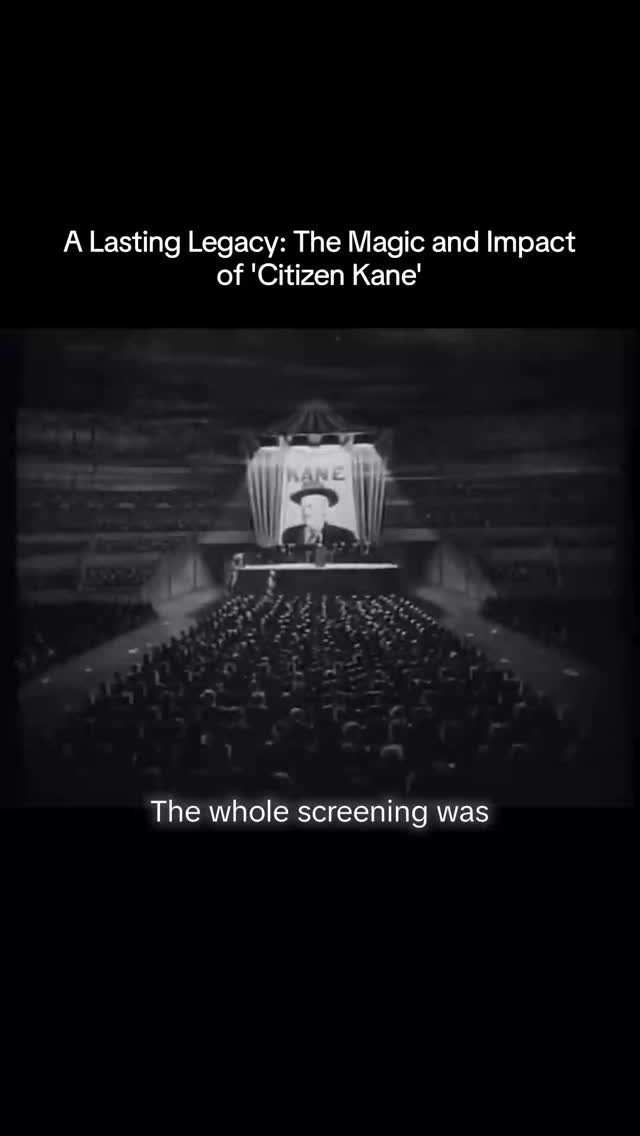
For many, the first encounter with Citizen Kane isn't merely watching a film; it's a baptism into the profound possibilities of cinematic art. It’s an experience that carves itself into memory, a revelation that filmmaking could transcend mere narrative to become a canvas for audacious visual poetry. To witness its audacious deep focus, its expressionistic lighting, and its innovative camera movements, especially for the first time in a communal setting, is to understand why this 1941 opus remains the quintessential textbook for aspiring filmmakers and seasoned cinematographers alike.
At the heart of this enduring legend lies the unparalleled collaboration between a young, visionary Orson Welles and the seasoned, revolutionary cinematographer Gregg Toland. Their joint credit, a then-unprecedented gesture for a director, wasn't just a sign of respect; it was an acknowledgment of a creative symbiosis that birthed a new visual language. Welles, a theatrical prodigy, brought a bold, experimental sensibility, but it was Toland, with his mastery of light, shadow, and optical mechanics, who translated those audacious ideas into tangible, breathtaking imagery.
Deep Focus: Redefining the Frame
The most celebrated technical innovation of Citizen Kane is undoubtedly its pioneering use of deep focus. Prior to Toland's work on Kane, the prevailing cinematic aesthetic often favored shallow depth of field, drawing the viewer's eye to a singular plane. Toland, however, pushed the boundaries, creating frames where foreground, middle ground, and background were all rendered with startling clarity. This wasn't just a technical flex; it was a narrative strategy. By keeping multiple planes in focus, Welles and Toland allowed audiences to actively engage with the entire composition, revealing complex character relationships and environmental details simultaneously, without the need for rapid cutting.
“Toland's deep focus wasn't just about sharp images; it was about empowering the audience to choose where to look, to unravel the narrative through visual exploration.”
Achieving such extreme depth of field in 1941 was no small feat. It required a combination of wide-angle lenses (like the 28mm and 35mm), high-speed film stocks (such as Kodak Super-XX), and an extraordinary amount of light. Toland often employed apertures as small as f/16 or f/22, necessitating powerful arc lamps and a meticulous approach to exposure. The result was a visual density that imbued every frame with profound information, allowing for longer takes and a more immersive, theatrical viewing experience that defied conventional Hollywood grammar.
Lighting as Narrative: Sculpting Shadows
Beyond deep focus, Toland's lighting in Citizen Kane is a masterclass in expressionism. Influenced by German Expressionist cinema, he utilized stark contrasts, dramatic chiaroscuro, and low-key lighting to sculpt characters and environments, reflecting their psychological states and the film's overarching themes of ambition, isolation, and decay. Think of the cavernous, shadowy interiors of Xanadu, or the dramatic backlighting that often silhouettes Kane, emphasizing his solitary power and eventual downfall. Toland wasn't just illuminating scenes; he was imbuing them with emotional weight and symbolic meaning.
His use of practical lights within the frame, often integrated as part of the production design, further enhanced the realism and depth of the scenes. This attention to detail, combined with his willingness to experiment with unconventional lighting setups – including shooting from low angles to emphasize power dynamics or using ceilings in frames – contributed to the film's revolutionary visual texture. For a cinematographer, studying Kane is to understand how light can be as eloquent as dialogue, shaping perception and driving the narrative forward.
The Bittersweet Aftermath: A Singular Vision
The ultimate tragedy for film history, of course, is that Citizen Kane marked the only collaboration between Welles and Toland. Toland passed away in 1948, leaving behind an indelible, albeit too short, legacy of innovation. One can only imagine the further visual frontiers they might have explored together. Yet, Welles, ever the respectful artist, ensured Toland's name appeared alongside his own, a rare and profound tribute that spoke volumes about their shared creative endeavor.
Welles's subsequent films, though often brilliant, never quite recaptured the same visual audacity and technical perfection seen in Kane, a testament to Toland's irreplaceable contribution. Citizen Kane remains a towering achievement not just because of its narrative ambition or Welles's directorial genius, but because it is a living, breathing testament to the power of cinematography to elevate storytelling into an art form. It's a film that continues to challenge, inspire, and educate, cementing Gregg Toland's status as one of the most influential DPs in cinematic history, a true pioneer whose visual vocabulary continues to resonate in every frame that dares to push the boundaries of the craft.