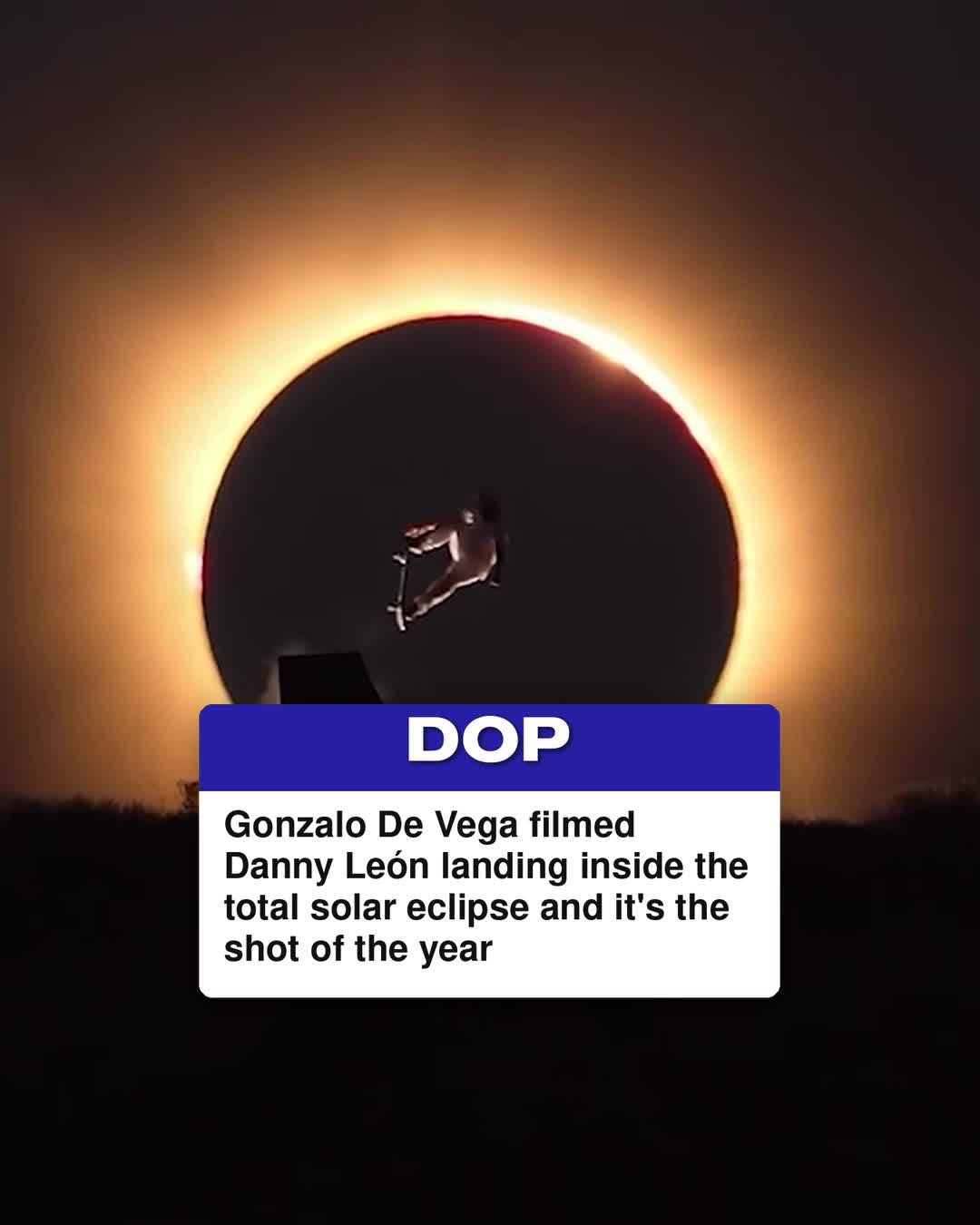
In cinematography, perfection is often a game of iteration. You rehearse the blocking, meter the key-to-fill ratio, adjust your NDs, and ask the operator for another take. But when your key light is being eclipsed by the moon and your subject is an elite skateboarder soaring off a custom quarterpipe at peak velocity, the luxury of take two simply does not exist. That was the high-stakes reality faced by filmmaker Gonzalo De Vega and photographer Jose Izquierdo when capturing Danny León framed dead center against a total solar eclipse.
The margin for error in a shot like this shrinks to a mathematical razor’s edge. Europe’s first total solar eclipse in decades offered a totality window measured in mere minutes, but the optical geometry required to pull off the framing demanded weeks of relentless pre-visualization. To make the eclipsed sun appear massive behind León rather than a distant white pinprick, the production had to rely on extreme telephoto compression, pushing past 600mm to 1000mm equivalent focal lengths.
The Mathematics of Optical Compression
When working with extreme focal lengths, perspective distortion fundamentally changes how distance is perceived. To scale the sun so that Danny León’s body fit cleanly within the blazing rim of the solar corona, the camera had to be positioned hundreds of meters away from the quarterpipe. Even a minor miscalculation in camera height, distance, or angle by just a few inches would throw the entire alignment off, casting the skater completely outside the sun’s silhouette.
Utilizing high-end cinema optics, such as the Canon CINE-SERVO 50-1000mm T5.0-8.9 or super-telephoto prime lenses paired with high-performance extenders, De Vega locked down on heavy-duty fluid heads capable of dampening even micro-vibrations. At this level of magnification, atmospheric shimmer and shutter vibration become catastrophic enemies, meaning rigid support and precise pan-and-tilt tension were vital.
“Totality does not wait. You aren't adjusting the light to fit your frame, you are conforming your entire technical workflow to the brutal clock of the cosmos.”
Managing the Vanishing Exposure Window
Beyond the geometric conundrum lies the exposure nightmare. In the moments leading up to totality, ambient daylight plummets by more than ten stops in a matter of seconds. The transition from intense direct sunlight to the eerie, deep twilight of totality requires continuous, split-second exposure management. Operators must avoid blowing out the fragile details of the solar corona while preserving enough edge resolution to keep León from degrading into muddy, sensor-induced noise.
Relying on a large-format sensor with exceptional dynamic range, such as the ARRI ALEXA Mini LF or RED V-RAPTOR, allowed the filmmakers to pull off this delicate dance. The wide latitude of these modern cinema sensors ensures that the deep black center of the moon and the blistering high-frequency light of the diamond ring effect can coexist on the same log curve without clipping or falling apart in the post grade.
Timing the run itself was the final, pulse-pounding variable. Danny León had to drop in, pump the transition, and hit the apex of his air at the exact second the moon completed its transit. One mistimed push or hesitation on the lip of the ramp, and the corona would be empty. De Vega held focus and exposure as León launched upward, freezing human athleticism inside celestial mechanics.
The result is a stunning fusion of action sports and fine-art cinematography. It stands as a testament to what happens when rigorous pre-production meets absolute technical precision under the most unforgiving lighting condition on Earth: the total disappearance of the sun.
This article contains affiliate links. We may earn a small commission at no extra cost to you. Learn more.