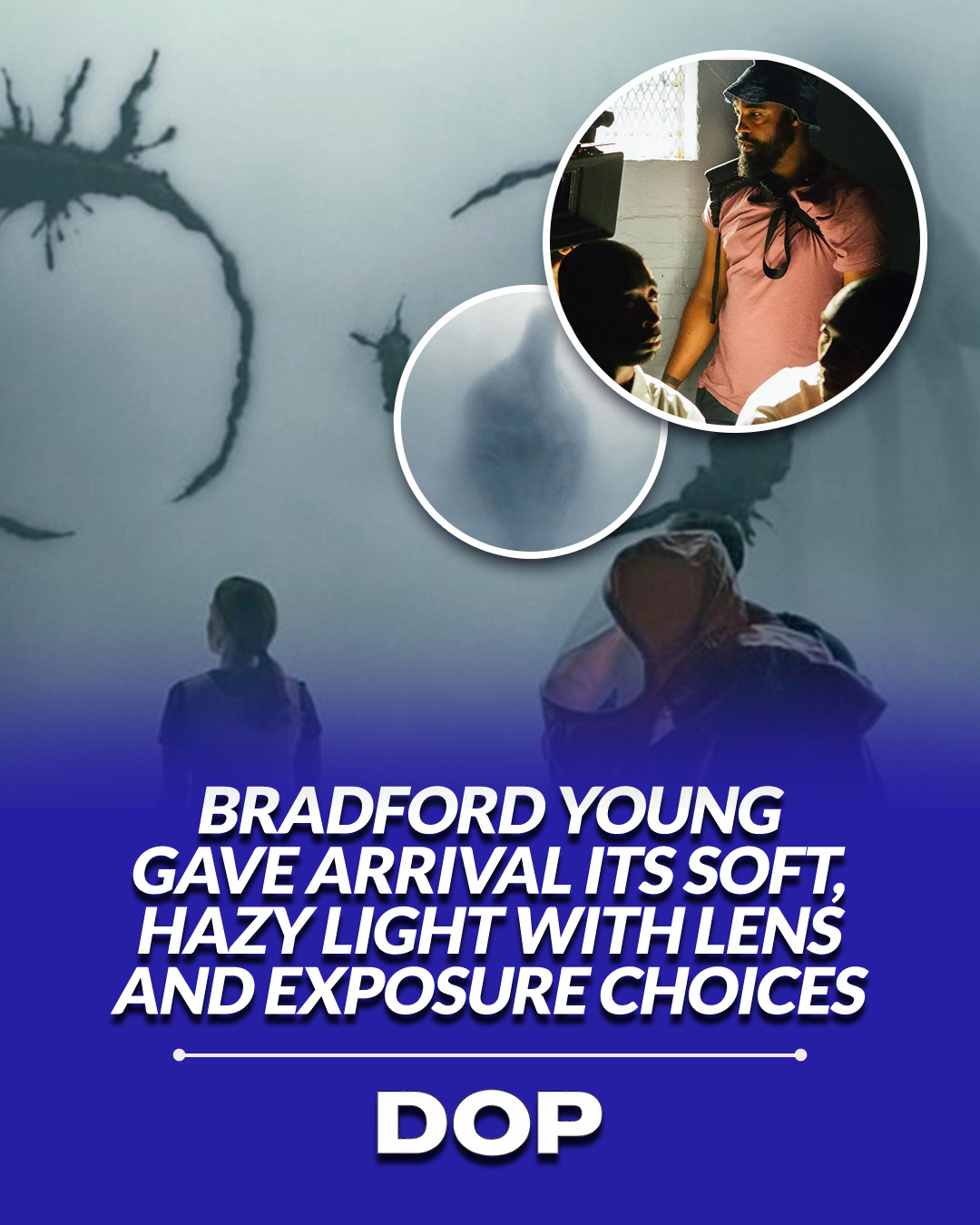
When Denis Villeneuve’s Arrival landed in theaters in 2016, it radically reshaped the visual lexicon of modern science fiction. Standard genre aesthetics had long favored hyper-clinical cleanliness, ultra-sharp digital fidelity, and vibrant metallic blues contrasted against high-key laboratory whites. DP Bradford Young, ASC, deliberately took the opposite path. Rather than presenting sci-fi as an exercise in cold, distance-oriented technology, Young approached the story of linguist Louise Banks as an intimate, deeply human memory play anchored in grief.
To achieve this grounded interiority, Young eschewed pristine digital renders in favor of a soft, tactile visual signature. Shooting primarily on the Arri Alexa XT paired with customized vintage optics, he crafted an aesthetic that felt less like traditional cinema and more like atmospheric landscape photography. The result is a film that breathes with naturalistic texture, where light feels thick with moisture, dust, and emotional weight.
Subverting Sci-Fi Tropes Through Exposure and Vintage Optics
Central to Young’s approach was his deliberate strategy around exposure and optics. Opting for Camtec Vintage Ultra 28 lenses alongside Leica Summilux-C primes, Young sought glass that brought organic imperfections to the digital sensor. By shooting near wide-open T-stops, he encouraged natural halation around highlights and created a gentle, sweeping focus roll-off. This ensured that bright background elements never felt harshly defined, but instead bloomed softly into the surrounding shadows.
Exposure management was equally crucial to establishing the film’s melancholic tone. Young is celebrated for his sophisticated control of underexposure, frequently pushing the digital sensor into low-key territory while protecting the integrity of skin tones. Rather than filling in shadows with key and fill lights, he allowed the dark regions of the frame to fall off naturally, creating rich, deep blacks that never felt muddy. This created an omnipresent sense of twilight, echoing Louise’s psychological state as she navigates both personal tragedy and unprecedented cosmic contact.
Lighting the Atmosphere of Grief
In lighting the film’s key locations, from the overcast valley of Montana to the interior of the alien vessel, Young leaned heavily into large, heavily diffused soft sources. Rather than deploying direct, directional units, he favored large ambient bounce setups using 20x20 diffusions and negative fill to carve out subtle dimensionality on the actors' faces. Light in Arrival rarely feels like it originates from a film fixture; it feels filtered through overcast skies, rain-streaked glass, or morning fog.
"We wanted the light to feel natural, almost mundane, so that when the extraordinary happens, it hits you with absolute authenticity. Light shouldn't announce itself, it should evoke atmosphere."
Inside the alien "shell," this philosophy reached its zenith. The contrast between the stark white fog wall and the pitch-black chamber was achieved not with intense key lights, but through giant soft diffusion banks placed behind the screen. Combined with atmospheric haze on set, the light naturally scattered into the chamber, softening the silhouettes of Amy Adams and Jeremy Renner. The atmosphere itself became a physical element in the frame, bridging the gap between human observers and extraterrestrial visitors.
Restrained Palette and the Power of Texture
Color design played a pivotal role in maintaining the film’s poetic restraint. Working closely with production designer Patrice Vermette, Young established a desaturated, earth-bound palette dominated by slate grays, muted moss greens, and warm, washed-out creams. In the non-linear memory sequences involving Louise’s daughter, this palette shifts slightly toward golden dusk, yet retains its soft, low-contrast softness. The visual transition between memory and present-day reality remains seamless, bound together by consistent grain and texture.
By treating light as a medium of emotion rather than mere exposure, Bradford Young demonstrated that science fiction can be grand without feeling distant. For working cinematographers, Arrival serves as a masterclass in visual discipline. It proves that embracing softness, trusting the shadows, and allowing atmosphere to dictating image texture can elevate a narrative from simple technical spectacle into enduring visual poetry.
This article contains affiliate links. We may earn a small commission at no extra cost to you. Learn more.