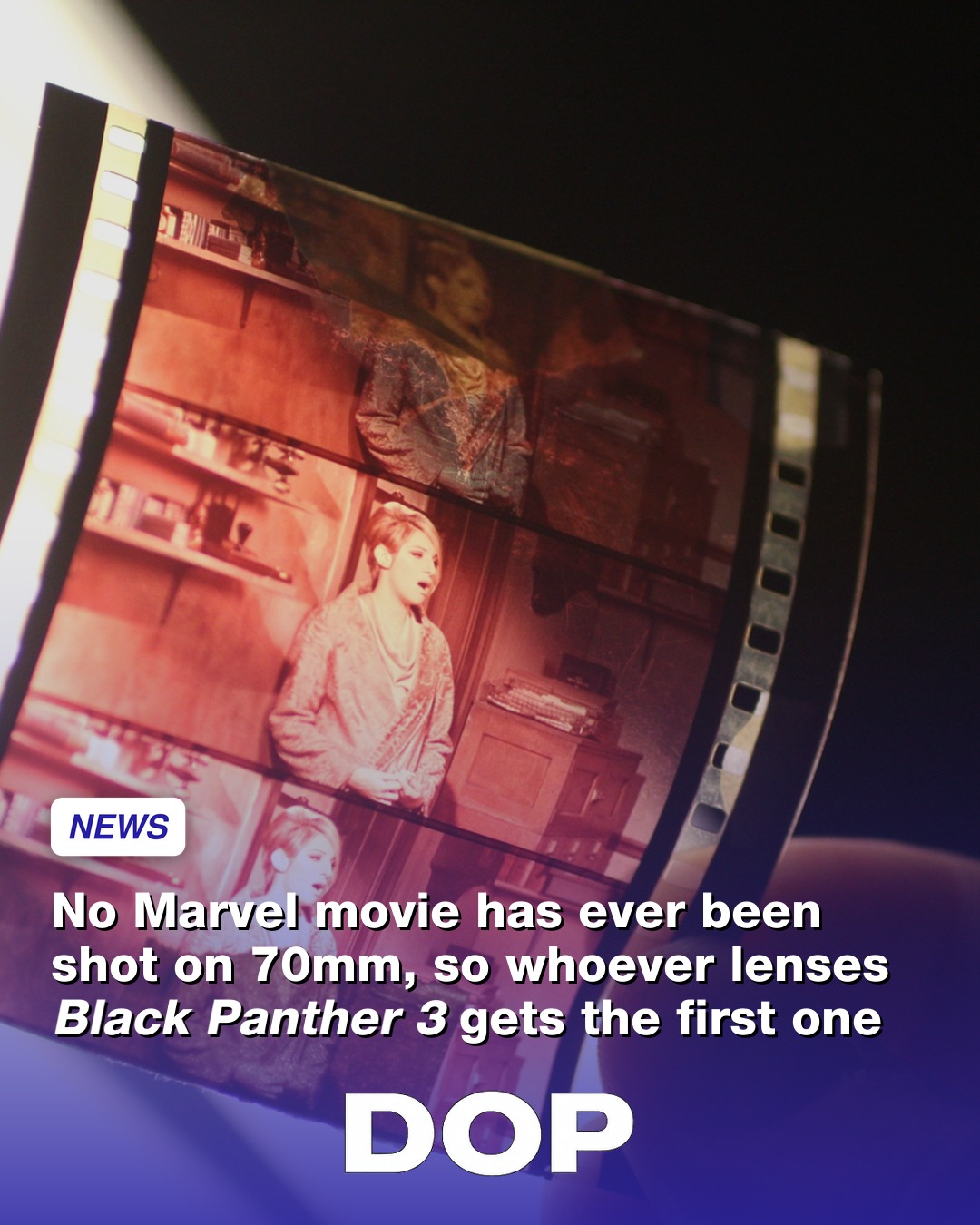
The recent announcement at Comic-Con that Black Panther 3 will be captured natively on 70mm film has sent ripples through the cinematography community, and for good reason. This isn't just another Marvel tentpole; it's a significant commitment to large format film, a medium that, despite its challenges, offers an unparalleled cinematic grandeur. For a studio that has largely embraced digital acquisition, this move signals a bold artistic choice, one that promises to elevate the visual tapestry of Wakanda to new, breathtaking heights.
The implications for the camera department are profound. Stepping into a 70mm production, especially one of this scale, is a demanding undertaking. The logistical ballet of film stock orders, lab turnarounds, and the meticulous handling of magazines, each offering mere minutes of capture time, requires an immense level of precision and coordination. Unlike digital workflows, where terabytes of footage can be recorded with relative ease, every frame on 70mm is a precious commodity, demanding thoughtful planning and execution. The cinematographer tasked with this mission will be navigating a landscape where the stakes are inherently higher, and the craft more tactile.
The Large Format Challenge: Depth, Detail, and Discipline
One of the most immediate and impactful aspects of shooting 70mm is the inherent shallow depth of field, a direct consequence of the larger negative size. For focus pullers, this translates to an unforgiving environment where even minor misjudgments can render a shot unusable. The precision required is akin to high-stakes surgery, demanding an almost intuitive understanding of lens characteristics, actor blocking, and camera movement. This isn't merely about technical proficiency; it’s about a deep, almost spiritual connection to the mechanics of the craft, where every millimeter of focus pull is a deliberate artistic choice. The visual payoff, however, is immense: a separation of subject from background that digital often struggles to replicate, lending a three-dimensional quality and an immersive sense of presence to the imagery.
“Shooting on 70mm isn't just about resolution; it's about the texture, the depth, and the almost visceral connection it creates with the audience. It’s a medium that demands respect and rewards precision.”
The choice of 70mm also opens up fascinating possibilities for lens selection. While specific optics haven't been announced, the large format sensor/negative plane allows for the use of lenses with larger image circles, often resulting in unique optical characteristics, a wider field of view without extreme distortion, or a particularly pleasing fall-off towards the edges. Cinematographers might lean towards vintage glass for its character and organic imperfections, or embrace modern large-format primes designed for sharpness and clarity across the expansive frame. Whatever the choice, these lenses will be instrumental in defining the visual language of Black Panther 3, imbuing Wakanda with a sense of scale and detail that transcends typical superhero fare.
Wakanda's Evolution: From Anamorphic Digital to 70mm Film
It's worth noting that Ryan Coogler, the visionary director behind the Black Panther franchise, is no stranger to large format. His recent collaboration with Autumn Durald Arkapaw on Sinners, captured on large format and earning her an Academy Award for Best Cinematography, showcases his appreciation for the format's aesthetic power. Arkapaw, who masterfully shot Black Panther: Wakanda Forever anamorphically on digital, delivered a visually rich and emotionally resonant film. Her work on Wakanda Forever, utilizing the anamorphic squeeze to create a widescreen, epic feel with distinct lens flares and bokeh, demonstrated a keen understanding of how to craft a unique visual identity.
However, moving from anamorphic digital to native 70mm film represents a significant paradigm shift. While both offer a grand cinematic canvas, the textural qualities, color science, and dynamic range of film are inherently different. The grain structure of 70mm film, even at its finest, adds a tactile layer to the image, a subtle organic quality that digital often strives to emulate but rarely perfectly replicates. The color rendition, particularly in the highlights and shadows, can exhibit a nuanced richness that film stock is renowned for. Imagine the vibrant hues of Wakandan attire, the intricate details of its architecture, or the ethereal glow of the Ancestral Plane, all rendered with the unparalleled depth and luminosity of 70mm. This will be a new frontier for whoever takes the reins, demanding an understanding of film's unique characteristics and how to harness them to tell this particular story.
The lighting philosophy for Black Panther 3 will undoubtedly evolve with this format change. Lighting for large format film requires careful consideration of contrast ratios and exposure latitude. Film, particularly negative film, has a remarkable ability to hold detail in both extreme highlights and deep shadows, offering a forgiving yet demanding medium for cinematographers. The challenge will be to craft lighting schemes that not only enhance the narrative but also leverage the unique properties of 70mm to create truly iconic imagery. This isn't just about making a beautiful film; it's about pushing the boundaries of visual storytelling within the superhero genre, setting a new benchmark for cinematic ambition. The global anticipation for Black Panther 3, now amplified by this 70mm revelation, positions it as a defining moment in contemporary cinematography, a testament to the enduring power and allure of large format film.
This article contains affiliate links. We may earn a small commission at no extra cost to you. Learn more.