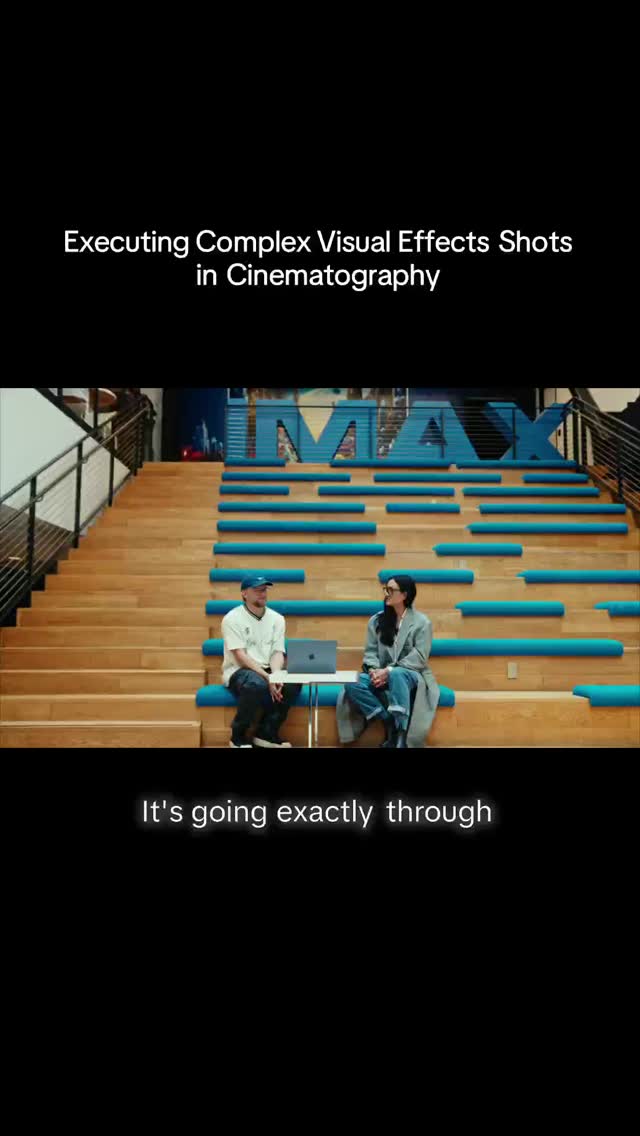
In contemporary film production, the gravitational pull toward post-production safety nets is stronger than ever. Faced with tight schedules, complex blocking, or intricate visual transitions, the default impulse on modern sets is frequently to defer the hard choices. A planned split-screen pass or a digital head replacement offers a clean, predictable workflow on paper. Yet, as any seasoned director of photography knows, the clinical safety of a CG composition rarely carries the visceral charge of a complex shot captured live on the sensor.
The tension between convenience and authenticity reached a boiling point on set recently when a planned split-screen sequence was scrapped in favor of a dynamic wrap-around reveal. Originally conceived as a split composition requiring meticulous post-production stitching, the sequence threatened to feel compartmentalized and static. The breakthrough came not from a pre-visualization suite weeks in advance, but from a quick iPhone sketch drawn on the floor, a real-time visual proposal that completely shifted the team's approach to the scene.
The Anatomy of an On-Set Pivot
Pivoting a production setup in real time demands absolute clarity of vision and seamless communication between the DP, camera operator, and director. The proposed wrap-around move required abandoning a stationary camera position for a continuous fluid arc that kept the talent locked within a single, uninterrupted spatial continuum. To execute this, the team replaced the safety of a multi-take green screen approach with an ambitious physical dolly and boom move, operating near the physical limits of the camera package.
Executing a continuous arc around actors creates immediate technical challenges, particularly regarding optical character and focus pull precision. Selecting wide spherical primes, such as ARRI Signature Primes or Cooke S7/i glass, allows the operator to maintain extreme proximity to the subject without introducing harsh barrel distortion. The high resolving power and subtle contrast fall-off of modern large-format sensors give the image room to breathe, capturing the tactile nature of skin, wardrobe, and practical lighting as the camera sweeps through the environment.
When you commit to capturing the move in-camera, you aren't just saving a VFX budget, you're capturing a spatial truth that no computer model can fully replicate.
Protecting Performance Over Convenience
The ultimate argument for solving shot design on set rather than in post-production comes down to performance. Head replacements and green-screen composites place an artificial constraint on actors, requiring them to replicate movements and emotional beats within rigid, pre-determined boundaries. By shifting to a live wrap-around camera move, the actors are liberated to interact in physical space, reacting to the physical presence of the lens as it orbits them.
Lighting continuity also gains an organic realism that digital relighting struggles to emulate. As the camera travels 360 degrees around the subject, the key light, fill, and rim sources dynamically transform in real time. A fixed soft light rig paired with subtle practical cues allows light to roll off the actor's face naturally during the rotation, producing authentic specular highlights and shadow shifts across the native sensor's dynamic range.
The Imperative of Live Collaboration
Choosing the harder path on set requires bravery from key creative departments. It demands that gaffers rapidly adjust cable runs and flag off spill, that focus pullers execute flawless distance shifts on wireless hand units, and that directors trust the immediacy of the moment over a multi-layered post-production backstop. That iPhone sketch served as a catalyst, reminding everyone present that the visual language of cinema is rooted in physical space and temporal continuity.
As digital tools continue to advance, the temptation to push spatial logic into the suite will only grow. However, scenes that capture real performance through deliberate, in-camera choreography carry an undeniable weight. By prioritizing physical execution over post-production fixes, cinematographers safeguard the tactile soul of film craft, one real-time pivot at a time.
This article contains affiliate links. We may earn a small commission at no extra cost to you. Learn more.