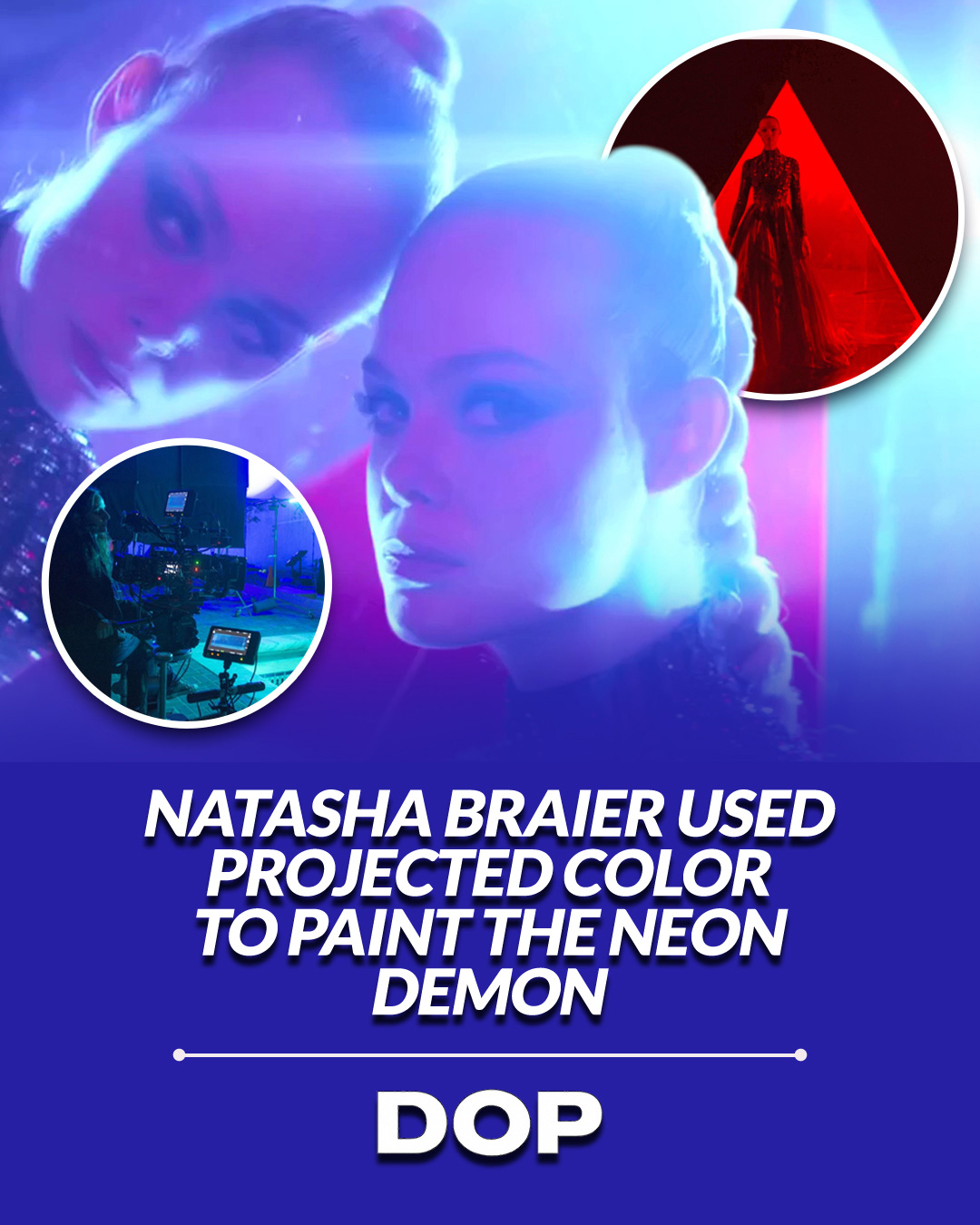
When director Nicolas Winding Refn set out to craft the predatory, hyper-stylized universe of The Neon Demon, he turned to cinematographer Natasha Braier, ADF, to build a visual vocabulary rooted in beauty, illusion, and existential dread. Set against the ruthless backdrop of the Los Angeles fashion scene, the film demanded a lighting language that felt synthetic, seductive, and constantly shifting. Rather than relying solely on traditional tungsten or LED fixtures outfitted with standard gel packs, Braier revolutionized her setup by employing high-powered digital video projectors as primary key lights.
This unconventional choice fundamentally transformed the camera’s relationship with light and shadow. By projecting animated graphics, pre-rendered video loops, and moving geometric patterns directly onto the actors’ skin, wardrobe, and set pieces, Braier achieved a tactile visual texture impossible to replicate with static gelled units or post-production visual effects. The light didn't simply illuminate the frame; it mapped across human contours, wrapped around edges, and physically reacted with makeup, sweat, and fabric in real time.
Painting with Photons: The Physics of Projected Illumination
Capturing this vibrant sensory assault required precise camera and lens selection. Braier paired the ARRI Alexa XT with vintage-inspired Cooke Anamorphic/i lenses, utilizing the glass's characteristic warmth, gentle contrast, and painterly falloff to take the digital edge off the projected imagery. Because the dynamic projections were thrown physically into the space, the resulting interactive lighting was captured entirely in-camera. Specular highlights in the actors' eyes, delicate skin reflections, and shifting color gradients were perfectly synced without requiring a single frame of digital tracking or CGI compositing in post.
This approach empowered scenes to swing effortlessly from pristine monochrome washes to shifting, multi-hued light cycles within a single continuous take. In a narrative world consumed by high-fashion runways, digital displays, and superficial glamour, using raw video signals as key illumination felt authentically tied to the story's DNA while pushing atmospheric visual storytelling forward.
By treating the video projector not as a background prop, but as a primary key light, you unlock an animated universe of color and texture that no traditional gelled fixture can replicate.
Technical Precision: Sync, Flicker, and Color Science
Using digital video projectors as key lighting sources introduces significant technical hurdles that demand rigorous calibration on set. To avoid screen-door artifacts, severe refresh banding, or rolling scan lines, Braier and her camera crew had to meticulously synchronize the camera sensor's readout with the refresh rates of the projection equipment. Fine-tuned phase adjustments and precise shutter angles were critical to ensuring the projected light rendered smoothly across every frame.
Color science presented another formidable challenge. Digital projectors emit narrow-band RGB primary signals that can easily over-saturate specific color channels on a digital sensor, leading to ugly gamut clipping or severe remap shifts. The ALEV III sensor inside the Alexa XT proved crucial here, offering the wide dynamic range and highlight recovery needed to hold delicate skin tones underneath hyper-saturated primary magentas, deep cyan washes, and piercing neon blues.
The Legacy of Interactive Light
Braier’s work on The Neon Demon served as a prophetic precursor to today's virtual production revolution. Long before LED volumes, UnReal Engine background walls, and image-based lighting setups became industry standard tools, her innovative work proved that display technologies could be repurposed as expressive, practical key lights in a narrative context.
For modern cinematographers and gaffers, Braier’s methodology serves as an inspiring reminder to rethink conventional lighting instruments. By taking color out of the post-production suite and projecting it live onto the set, she demonstrated that in-camera optical craft remains the ultimate tool for generating visual magic.
This article contains affiliate links. We may earn a small commission at no extra cost to you. Learn more.