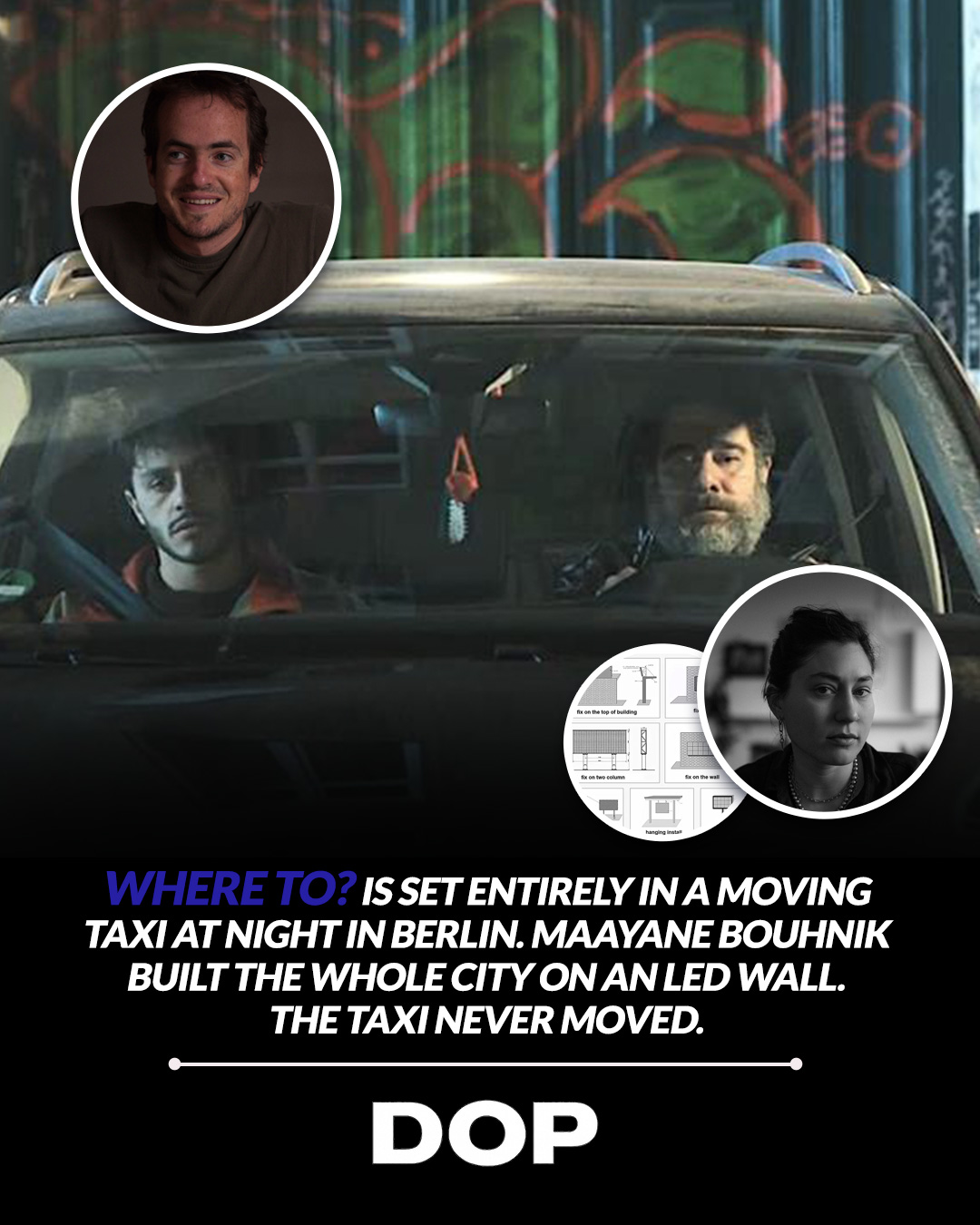
In an industry increasingly defined by its embrace of virtual production, certain projects stand out not just for their technical ambition, but for their profound artistic implications. Assaf Machnes's Where To?, with cinematography by Maayane Bouhnik, is one such film. Premiering in Berlinale 2026's Perspectives section, this film, set entirely within a moving taxi at night in Berlin, is a masterclass in controlled illusion, a testament to the power of the LED stage to redefine visual storytelling.
The premise alone is deceptively simple: two men, disparate cultures, a series of nocturnal Berlin rides, all confined to the intimate, claustrophobic space of a taxi. What elevates this from a logistical nightmare to a cinematographic triumph is Bouhnik's ingenious solution: the entire city of Berlin was built not on location, but on an LED wall. The taxi, a static stage piece, never moved. This wasn't merely a cost-saving measure; it was a deliberate artistic choice that granted Bouhnik an unprecedented level of control over the visual fabric of the film.
The LED Canvas: Berlin Reimagined
The decision to recreate Berlin on an LED stage speaks volumes about Bouhnik's meticulous approach to world-building. Traditional location shooting, while offering authenticity, often sacrifices control. The vagaries of weather, traffic, and ambient light can be a DP's greatest adversary. By constructing the Berlin exterior as a dynamic LED backdrop, Bouhnik could sculpt every beam of light, every reflected glow, every shift in color temperature as the taxi theoretically traverses different precincts of the city. This level of precision is virtually unattainable on location, especially for a night-set film where practical light sources are paramount to establishing mood and realism.
"The LED stage gave the production control that location shooting never could."
Consider the subtle nuances of light that define a city at night: the warm glow of a cafe, the stark blue of a police car's flashing lights, the streaking bokeh of streetlights. Bouhnik, working with the LED canvas, could program these elements with surgical accuracy. This allowed for not just consistency, but also for specific dramatic beats to be underscored by environmental light changes. Imagine a tense conversation punctuated by the sudden, fleeting passage of an emergency vehicle's siren, its light spilling into the taxi's interior – all pre-programmed and perfectly executed.
Mastering the Confined Space
Screen Anarchy rightly noted Bouhnik's ability to "maintain visual fluidity despite the restricted space of the car interior, working with alternating perspectives from the front and back seats." This is where technical prowess meets creative vision. Shooting inside a car, even a static one, presents inherent challenges. The limited depth of field, the constant interplay of reflections, and the need to create a sense of movement without actual motion demand a nuanced understanding of optics and light.
While the specific camera and lens package aren't detailed, one can infer that Bouhnik likely opted for compact, high-performance cameras – perhaps a Venice 2 or an Alexa Mini LF – paired with fast, versatile primes or compact zooms. The choice of glass would have been critical to managing reflections and achieving a pleasing bokeh for the virtual city outside. The LED wall itself would have served as both a light source and a visual backdrop, allowing for dynamic changes in ambient light and color temperature within the taxi's interior. This integrated approach to lighting – where the background itself is a key light source – is a hallmark of sophisticated virtual production.
Bouhnik's filmography, while not extensively detailed here, likely showcases a penchant for intimate narratives and a mastery of controlled environments. Her work on Where To? suggests a DP who understands that sometimes, the most compelling realism is found not in replication, but in meticulous fabrication. The film serves as a powerful reminder that the tools of virtual production are not just for grand fantasy or blockbuster spectacles, but can be harnessed to tell deeply human stories with unparalleled visual precision.
The Future of Storytelling: Control and Creativity
The success of Where To? at Berlinale 2026 is a significant marker for the evolution of cinematography. It demonstrates that virtual production, specifically LED stage technology, is not merely a technical gimmick but a powerful creative instrument that can empower DPs to sculpt light, environment, and mood with unprecedented control. For films that rely heavily on the illusion of motion, or where specific lighting conditions are crucial for dramatic impact, the LED stage offers a compelling alternative to traditional location shooting.
This film is a testament to the fact that the art of cinematography is constantly evolving. It pushes the boundaries of what is possible within a confined space and redefines our understanding of what constitutes "on location." Maayane Bouhnik's work on Where To? is not just about a taxi in Berlin; it's about the journey of cinematic innovation, showing us where the future of visual storytelling might take us.
This article contains affiliate links. We may earn a small commission at no extra cost to you. Learn more.