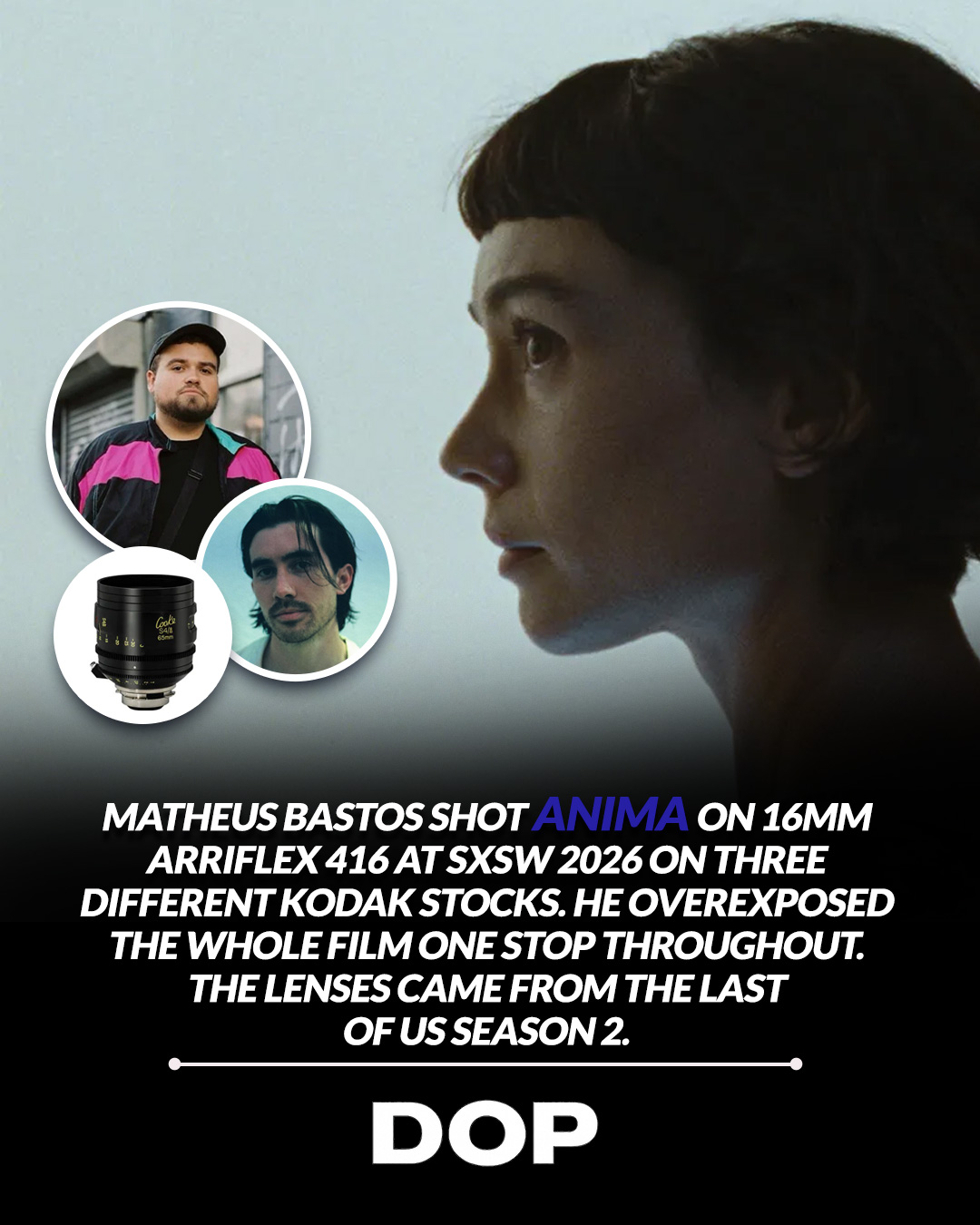
In an era often dominated by the pristine, almost clinical precision of digital capture, the announcement of a 16mm film premiering at a major festival like SXSW is always cause for celebration for those of us devoted to the tactile magic of celluloid. But when that 16mm capture is meticulously crafted with a specific, unwavering philosophy of exposure across multiple Kodak stocks, it demands a deeper dive. Matheus Bastos’s work on ANIMA, directed by Brian Tetsuro Ivie, isn't just a nostalgic nod to film; it’s a masterclass in intentionality, a bold commitment to a visual language forged in the emulsion itself.
The decision to shoot on 16mm Arriflex 416 immediately signals a desire for a particular aesthetic – the organic grain structure, the subtle color shifts, the inherent texture that digital often struggles to replicate authentically. Yet, Bastos didn't stop there. He leaned into the medium’s capabilities with a singular vision: overexposing every single roll by one stop. This isn't a casual preference; it's a profound commitment, a pre-production declaration that dictates every lighting setup, every meter reading, every nuance of color and contrast from the first frame to the last. The 416, a workhorse of modern 16mm production, provides a stable, reliable platform for such precise experimentation, allowing the DP to focus on the expressive qualities of the film stock rather than the camera's mechanics.
The Triad of Kodak Stocks and the Power of Overexposure
Bastos’s choice of three distinct Kodak Vision3 stocks – 50D, 200T, and 500T – is particularly insightful, each selected to align with specific lighting conditions. This isn't merely about matching ISO to available light; it's about leveraging the unique characteristics of each emulsion. The 50D, with its incredibly fine grain and vibrant color rendition, would have been pushed to new levels of luminosity and detail with that extra stop of light. The 200T, a versatile all-rounder, would have gained a richer, more saturated mid-tone response. And the 500T, already known for its deep blacks and excellent shadow retention, would have seen its shadow detail explode, offering a nuanced, information-rich negative even in the darkest scenes.
“Committing to overexpose every roll one stop across a multi-stock production means the decision is made before the first day of shooting and cannot be reversed. Every lighting setup on set calibrates against it.”
The technical rationale behind this overexposure is sound and deeply rooted in the physics of film. Film, unlike digital sensors, loves light. Overexposing film, especially negative stock, pushes more information into the emulsion, creating a denser negative. This density translates directly to richer colors, smoother gradients, and, crucially, significantly improved shadow detail. When scanned, these denser negatives yield a cleaner image with less visible grain in the shadows, as the scanner has more information to work with. Bastos’s description of achieving a “clean, saturated quality” through this method perfectly encapsulates the desired outcome: not an overblown, washed-out image, but one imbued with a luminous depth and vibrant, yet natural, color palette.
Lenses with Lineage: Cooke S4X and the Digital-to-Analog Bridge
The choice of Cooke S4X primes, repurposed from The Last of Us Season 2, adds another fascinating layer to ANIMA’s visual identity. Cooke lenses are renowned for their “Cooke Look” – a flattering, slightly warm, and organic rendering that is often described as inherently cinematic. The S4X series, being a relatively modern iteration, offers excellent optical performance, sharp but not clinical, with beautiful fall-off and pleasing bokeh. The fact that these particular lenses were modified by Arri Rental suggests they might have had specific characteristics tailored for a high-end digital production, perhaps in terms of flare control or color matching. To then pair these optically sophisticated lenses with the organic, unpredictable nature of 16mm film creates a compelling tension. It’s a bridge between the precision of contemporary optics and the textural beauty of analog capture, potentially offering the best of both worlds: sharp, detailed imagery imbued with the soul of film.
The final step in this meticulously planned chain was the 4K scan at Kodak NYC on a Lasergraphics Scanstation. This high-resolution scan is critical for translating the wealth of information captured on the dense 16mm negatives into a digital format that retains the film’s intrinsic qualities. A 4K scan of 16mm is more than sufficient to capture the full fidelity of the format, ensuring that every nuance of grain, every subtle color shift, and every rich detail brought forth by Bastos’s overexposure technique is preserved and translated faithfully to the digital realm. This careful handling of the negative, from exposure to scan, underscores the commitment to honoring the medium and maximizing its expressive potential.
Matheus Bastos’s work on ANIMA is a testament to the power of deliberate photographic choices. It's a reminder that cinematography isn't just about capturing an image, but about crafting it. By understanding the intrinsic qualities of film and pushing its boundaries with informed technique, Bastos has likely created a film that is not only visually striking but deeply resonant, proving that sometimes, the boldest artistic statements are made by embracing the analog and exposing it to a little more light.
This article contains affiliate links. We may earn a small commission at no extra cost to you. Learn more.